Orrin Woodward on LIFE & Leadership

Inc Magazine Top 20 Leader shares his personal, professional, and financial secrets.

  • Orrin Woodward

    1
    Former Guinness World Record Holder for largest book signing ever, Orrin Woodward is a NY Times bestselling author of And Justice For All along with RESOLVED & coauthor of LeaderShift and Launching a Leadership Revolution. His books have sold over one million copies in the financial, leadership and liberty fields. RESOLVED: 13 Resolutions For LIFE made the Top 100 All-Time Best Leadership Books and the 13 Resolutions are the framework for the top selling Mental Fitness Challenge personal development program.

    Orrin made the Top 20 Inc. Magazine Leadership list & has co-founded two multi-million dollar leadership companies. Currently, he serves as the Chairman of the Board of the LIFE. He has a B.S. degree from GMI-EMI (now Kettering University) in manufacturing systems engineering. He holds four U.S. patents, and won an exclusive National Technical Benchmarking Award.

    This blog is an Alltop selection and ranked in HR's Top 100 Blogs for Management & Leadership.

  • Orrin’s Latest Book


  • 7 Day Free Access to Leadership Audios!

  • Email Me

  • NY Times Bestselling Book


  • Mental Fitness Challenge

  • Email Subscription

    Enter your email address to subscribe to this blog and receive notifications of new posts by email.

    Join 2,438 other subscribers
  • Categories

  • Archives

Archive for December, 2010

The Mouth Speaks

Posted by Orrin Woodward on December 31, 2010

For out of the abundance of the heart the mouth speaks. – Matthew 12:34

It’s amazing how much one can learn from a person just by listening.  People who believe that they have a positive attitude, give away their negativity when they speak. I like to begin mentoring sessions with, “Tell me the good, the bad, and the ugly.  The good we will celebrate, the bad we will make adjustments, and the ugly we will pray about.”  This is sure to get people talking, helping me to identify, not just what happened, but how they are thinking about what happened.  Which, in the end, is more important than the event; since the event happens only once, but how they think about the event repeats over and over in their minds and hearts.  Painful experiences happen to both achievers and non-achievers.  The difference is in the responses, achievers learning from the bad cards, choose to draw more; while non-achievers complaining about the cards of life being stacked against them, choose to quit the game.  But what’s actually stacked against them is their own thinking. Winners received the same stimulus, but chose to respond differently than the non-winners.

When something bad happens to a winner, he immediately focuses on minimizing its effects, learning anything he can from the situation.  No pity parties, no woe is me attitudes, just resolution and teachable moments.  The extent a person wins in life, is many times, related to how quickly he can go from problem identified to problem solved, learning through the pain of the process.  When people stay down for weeks, months, sometimes even years at a time, can they honestly expect a positive outcome?  There is only so much mental energy, when it’s spent dwelling on negative thoughts, allowing them to enter the heart, eventually pouring out of the mouth, why is anyone shocked that so little is accomplished in life?  The key is pulling the weeds (negative thoughts) upon entering the mind, not allowing them to move into the heart and out the mouth.  Weeds are much easier to pull when immediately seized when they enter the mind, but much tougher when allowed to root in the heart, eventually flowing out of the mouth.  Don’t provide fertile soil in the mind for weeds; don’t allow weeds to seed into the heart; and whatever you do, don’t allow negative seeds to spread out of your mouth, infecting other people. The former leader literally becoming a carrier of negativity.

Leaders are gardeners of their own minds, identifying and pulling weeds quickly.  True leaders are never down period, choosing to pull weeds promptly.  But if they ever were down, they certainly wouldn’t spread the disease to their communities, since they know that pulling weeds is an inside job.  If a weed is extra difficult, then leaders have the discipline to seek out their mentors for help, refusing to contaminate others with their weed seeds.  One of the first, and most important, assignments of any would-be leader is consistent and prompt pulling of his own weeds.  It’s not an option if he plans on inspiring others, since no one is inspired by a bitter attitude and sour faced person.  Pull your weeds, guard your mind, protect your heart, for out of the abundance of the heart the mouth speaks.  Leadership occurs when people having confidence in the leader, if a person’s attitude is unpredictable, he disqualifies himself for leadership, until he learns to pull his own weeds. Leaders are dealers in hope, change, and growth, beginning inside of them.  Perhaps it’s time that we launched a leadership revolution, let’s start the revolution by tending to our own gardens.  God Bless, Orrin Woodward

Posted in All News | Comments Off on The Mouth Speaks

Creating a Winning Culture Current

Posted by Orrin Woodward on December 29, 2010

Systems make up a big part of living. Think of the different types of systems in life, and the careers available for those who study them.  Scientists study the systems available in nature, learning how the world works, developing similar systems to enhance life. Doctors study the systems in the human body, while veterinarians study animal’s body systems.  Engineers study product and process systems, even creating new systems when creating new products.  But, unless one is specifically in these fields, why take the time to learn about systems?  Mainly, because there is another type of system, one that all human beings are apart of from birth, it’s called the cultural system.  Every human being joins the culture of humanity when born, it’s not optional, and every culture – humanity, business organizations, faith organizations, charities, clubs, etc, have a cultural system that guides the behavior of its members.  The McKinsey organization teaches that culture is “how we do things around here”.  Culture matters, and the more one understands the culture of an organization, the better one can improve the culture, thus improving results.  Without an understanding of systems, it will be hard to study, let alone to change, the culture of organizations.  Just as scientist, doctors, veterinarians, and engineers study and create systems, leaders must study, change, and create cultures. In fact, majoring on culture is one of a leaders most important assignments.

Think of culture in an organization, as a riverbed, directing the flow of the river.  The riverbed set the boundaries of acceptable behaviors, controlling the flow of the water, helping new people move within the cultural river.  Riverbed cultures are fantastic systems to guide behaviors when the riverbed aligns with the behaviors needed within a culture, but imagine if the riverbed is guiding behavior in a direction opposed to the behaviors desired and professed by the organization.  This creates a riverbed cultural issue, where the culture is directing behavior that is opposed to the professed norms and values of the community, creating a misalignment between purpose and actions.  For example, suppose an organization desires to be the best company for service and support in the local market.  Advertisements trumpeting this message are shared throughout the marketplace, slogans are placed in the office, and sales meetings share the importance of follow up on existing customers, ensuring that customers are satisfied, focusing on long term business relationships.  This all sounds great, communicating clearly how important serving existing customers are in the company’s culture, but unless the reward system, for the salesforce, lines up with the culture, it will not change behaviors.  In other words, if rewards only pay for new sales, but not existing sales, then why would the salesmen take apply efforts to service an existing customer, when his pay is increased only when he makes a new sale to a new customer.  Can you see where the riverbed is guiding the behavior in one direction, even though the words and slogan are attempting to guide behaviors in another course?   No amount of slogans, meetings, or advertisements are going to change culture, until the leaders change the riverbed which lead to the actions.

Leaders must study the systematic riverbeds of their respective organizations, determining if the stated beliefs, values, and norms line up with the direction taken by the riverbed.  Leaders can get upset at a communities behavior, punish them, even fire them, but if the riverbed doesn’t align with desired behaviors, the fault isn’t with the people, but with the leadership team responsible for creating the culture and reward systems.  Let’s examine further the organizational cultures.  The reader might be thinking, but I don’t work at a big company, so this doesn’t apply to me.  But remember, cultural systems apply to every organization, everywhere.  Families, churches, clubs, workplaces, businesses, etc, all have cultures.  The sooner one becomes aware of the culture, learning the flow of the water through the riverbed, the quicker one can see if riverbed and behaviors are aligned or if changes are necessary.  Everyone in the community is responsible to help the leaders develop a proper riverbed, because everyone is affected when the riverbed is off course.  One of the best descriptions of the factors that make up the culture (riverbed) of an organization comes from Gerry Johnson, and is called Cultural Webs.  In his article, titled, “Rethinking Incrementalism”, in the 1988 Strategic Management Journal, Johnson defines the paradigm and six elements of the Cultural Web that create the culture of an organization.  One of the goals of a leader is to study the six factors independently and interdependently, learning how each factor can be improved individually, and how they can be improved where they interact with one another.  The leaders objective is to develop the culture by improving how each element ties into the overall message, forming a riverbed that aligns with the deepest beliefs, values, and norms of the organization.

The Paradigm defines what the organization is about, meaning what it does; what’s its mission; what it values. The Cultural Webs are the six factors or elements that combine to fulfill the paradigm.  Here are the six elements with a brief description:

1. Stories – The historical events and people that are talked about inside and outside of the company, creating part of the myths surrounding the company, telling a great deal about what the company’s beliefs, values, and norms are.
2. Rituals and Routines – The daily behaviors that signal actions within the riverbed and those outside of the riverbed.  This creates expectations upon each member of community to behave and act in certain acceptable ways valued by leaders.
3. Symbols – This includes company logos, the layout of offices, power positions at offices and meeting rooms, and formal or informal dress codes.
4. Organizational Structure – This involves the formally defined structures, like organizational charts, and the informally and unwritten power and influence, this is how most leaders get things done, even when structures are broken.
5. Control Systems – This is how the organization is controlled or influenced, including financial systems, quality systems, and rewards.  Rewards communicate what is valued in the company, and are extremely important to align with riverbed.
6. Power Structures – This is where the real power lies in a company, the law of E. F. Hutton – when they speak, people listen. Whether it is one or two key executives, a managing group of executives, or a department, the point is that these leaders have the greatest influence to change operations, strategies, and cultures.

Let’s simplify the idea of culture even further.  Before diving into how to improve each of the factors forming the culture, let’s develop a mental model to simplify how culture is viewed.  Do you remember the game that kids play in the pool, where everyone runs in the same direction, forming a current in the pool, so that the kids can lift their legs and float around the pool, carried by the current they created?  This is an excellent analogy for culture, since the current in the pool performs the same function as the culture does in an organization.  Culture, like the current, is created when people are aligned in beliefs, values, and norms, forming a current that carries people in the proper direction to success.  When people are aligned in a culture, they create a current that helps the new people adopt the cultural norms quickly, flowing with the current in the water.  But, when people aren’t aligned, there is little, if any, current created, forcing people to develop their own beliefs, values, and norms, leaving disunity if not chaos in the pool.  Since there isn’t current (culture) to align the community, the culture becomes a free for all, people showing up, not because they buy into the culture, but only because they buy into paying their bills.  Imagine each organization as a pool when studying the culture.  By studying the stated paradigm for its existence and the six elements that help form the cultural paradigm, one can determine whether the culture current is aligned with the paradigm and elements.  Are the elements creating the proper flow in the pool, or are they confusing, sending mixed messages, hindering the ability of the organization to achieve its stated paradigm?  A leader’s role is to align the elements with the operating paradigm, forming a cultural current that will lead people and the organization to success.

Convergent cultural currents, help explain why two successful cultures, from two successful companies, can combine to create an unsuccessful culture in a struggling company.  Two companies, both successful in their own right, when combined, typically struggle, because the cultural currents fight against one another, creating cognitive dissonance, paralyzing actions and results.  It shouldn’t surprise anyone familiar with the mental model of the pool current. Combining separate cultures is one of the toughest leadership assignments, and shouldn’t be attempted, without a clear understanding of the cultures involved and the steps involved in aligning the cultures into one fast moving current.  There are many good cultures that do things differently, because there isn’t a clear cut right way to build a culture, but, just as in the pool example, everyone must be running in the same direction to create the cultural flow.  If half the people are running in one direction, the other half in another direction, the company is experiencing a cultural civil war, creating disunity, severely damaging the results produced by the organization.  It takes a leader, with tact, systems thinking, and patience to bring the diverse cultures together, uniting them in a common vision, forming common beliefs, values, and norms, which allows the company to thrive again. The leader creates the culture (riverbed), directing the behaviors, and the culture creates the long term results of the organization. Are you working on the culture in your organizations? God Bless, Orrin Woodward

Posted in All News | Comments Off on Creating a Winning Culture Current

Leadership & Systems Thinking

Posted by Orrin Woodward on December 27, 2010

Have you ever watched a team of mountain climbers scale a cliff?  I have watched with awe as the mountain climbers work together, as a team, to pull of this feat.  Imagine five climbers, all connected together by ropes and pulleys, ensuring the safety of all, scaling a cliff thousands of feet up.  The five climbers are a system, each action by one of the climbers affects the actions of the rest.  No climber could choose to scale the cliff if the others, were resting.  In fact, no four of the climbers could scale the cliff if just one chose to stop.  The ropes magnify the interdependence between the individuals, but with or without the ropes, people in communities are part of a system, being interdependent upon one another.  Each person in a community needs to understand systematic thinking as their actions will affect all others in the community.  Every leader must learn to think systematically in order to lead to his full potential.  Systems thinking is the process of understanding how individual parts influence one another within the entity as a whole. Both nature and organizations are filled with systems.  Nature is filled with ecosystems involving air, water, plants, animals and more in systems to sustain life, while organizational systems consist of people, structures, and processes that interact to produce results.  Whether the results are good or bad depends upon the system interactions orchestrated by the leader.

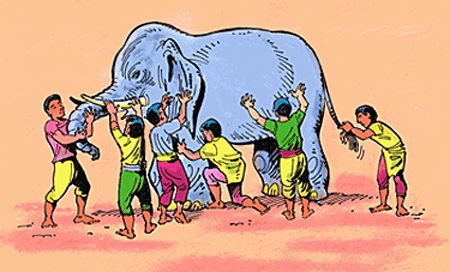
Remember the story of the elephant and the blind men?  This is an excellent example displaying systems thinking. Read it again, thinking through how portions of truth must be combined (like a system) to gain the entire truth.

Blindmen Elephant pictureOnce upon a time, there lived six blind men in a village. One day the villagers told them, “Hey, there is an elephant in the village today.” They had no idea what an elephant is. They decided, “Even though we would not be able to see it, let us go and feel it anyway.” All of them went where the elephant was. Everyone of them touched the elephant.

“Hey, the elephant is a pillar,” said the first man who touched his leg.

“Oh, no! it is like a rope,” said the second man who touched the tail.

“Oh, no! it is like a thick branch of a tree,” said the third man who touched the trunk of the elephant. 

“It is like a big hand fan” said the fourth man who touched the ear of the elephant. 

“It is like a huge wall,” said the fifth man who touched the belly of the elephant. 

“It is like a solid pipe,” Said the sixth man who touched the tusk of the elephant. 

They began to argue about the elephant and everyone of them insisted that he was right. It looked like they were getting agitated, each blind man wondering how the others could be so stupid. Each believing they had the truth, since he felt it with his own hands. A wise man was passing by and he saw this. He stopped and asked them, “What is the matter?” They said, “We cannot agree to what the elephant is like.” Each one of them told what he thought the elephant was like. The wise man calmly explained to them, “All of you are right and all of you are wrong. The reason each of you is telling it differently is because each one of you touched a different part of the elephant. Each of you has a partial truth.  The elephant has all the features that each of you described, but isn’t fully what you described unless you combine all of your answers.”

Each of the blind men has touched upon a truth of the elephant, but individually, none of them had the whole truth.  If they had spent their time arguing, insisting upon the truth of what they had felt with their own hands, the community would have broken down, forming individual perceptions and not gaining a system perspective of the truth.  Only when each individual learns that they are part of a system, touching upon truth at some point, but probably not touching upon the total systematic truth, will each teammate seek out alternative perspectives.  Many times, disagreements are not really disagreements at all, but just individuals seeing or feeling a different aspect of the system, revealing a portion of the truth, that only when combined yields the whole truth.  System thinking is essential for leaders to help everyone work as a team, gathering all of the facts to accurately model the system they are working on to improve. Without a systems perspective, the leader quickly takes sides with one of his personal favorites, forcing others to comply with his partial interpretation of the truth, killing his credibility, alienating many of his teammates, destroying the motivation to share alternative perspectives in the future.

I love the blind men analogy. If leaders will remember the lesson of the blind men, their ability to solve problems will greatly increase, no longer satisfied with portions of the truth, they will seek out all perspectives to gain a larger view of reality.  Let’s discuss another example of systems thinking.  I believe I heard a version of this story first from Stephen Covey.  Covey uses the example of a fishermen going to a river to enjoy a day of fishing, but just minutes after getting there, he sees a young boy flailing his arms in the middle of the river, screaming for help. The fishermen jumps in and save him.  The boy is healthy, so the fishermen starts fishing, but fifteen minutes later, a young girl is flailing her arms, yelling for help, in the middle of the river.  The fishermen saves her also.  At this point, he ponders what the odds are, that two people would need saving on the same day.  Fifteen minutes later, when a third child needs to be rescued, he is certain that there must be more to the picture (system), than he is touching upon.  At this point, he starts asking questions, no longer believing that the children who needed rescuing, are isolated events.  He believes there is more to this system than is meeting his eyes. The fishermen, deciding to solve the cause at its roots, not just continue to trim at the leaves, walks upstream, discovering a children’s camp.  The fishermen finds that the local bully, doing what bullies do, was throwing kids in the river every fifteen minutes, and would continue to do so, until everyone surrendered their money.  The fishermen, a true problem solver, took the bully by the ear, walked him into the camp office, solved the root cause of the problem (the bully), and enjoyed the remaining fishing time in peace.

I know the example is simplistic, but it does capture the main points in systematic thinking.  Many times in life, people run from emergency to emergency, never stopping to think if the emergencies are related systematically.  The simple system described above included the boys and girls, the bully, the river, and the fishermen downstream.  The fishermen would have had a busy day, if he hadn’t solved the problem at its root.  You can stay busy your entire life, but unless you are solving problems at the root, nothing of long-term consequence is being solved.  Busy is not the goal, but productivity is.  As Covey teaches, one can trim the leaves for life, but if you wish to eliminate a tree, one must attack the roots.  Toyota has a problem solving system that helps discover the root causes, called the Five Whys.  It teaches that most root causes are at least five questions removed from the issue that is being addressed at the moment.  The root cause is usually not the first why, but, if one will keep asking questions, the root cause will typically be revealed.

For example, if someone slips and falls on a slippery factory floor, breaking their arm in the process, the quick solution is to order a cleaning crew to work more hours, cleaning the floors daily to ensure a non-slippery surface.  A non-slippery floor is the right answer, but before hiring extra people, spending money and time on the problem, the Five Why’s would attempt to discover the root cause (like the bully in example above).  Leaders aren’t happy with just trimming the leaves, while the root cause remains unaddressed and will use the Five Why’s to help determine the root issues.  The Five Whys in this example would go something like this:

Q: Why did the man slip and fall?
A: Because the ground was slippery.
Q: Why was the ground slippery?
A: Because there was oil on the floor.
Q: Why was there oil on the floor?
A: Because one of the machines was leaking oil.
Q: Why was the machine leaking oil?
A: Because an oil pan bolt was loose.
Why was the oil pan bolt loose?
A: Because the machine vibrated the bolt loose.
Q: Why did the machine vibrate the bolt loose?
A:  Because the shaft bearing is worn out in the machine.
Q: Why is the shaft bearing worn out in the machine?
A: Because maintenance hasn’t changed it and it is past it’s useable life.
Q: Why haven’t they changed out the old bearing?
A: Because we cut all preventative maintenance in a cost cutting measure.

The Five Why’s has revealed the systematic issue in the factory system, not just the obvious answer of cleaning up the oil.  When the preventative maintenance program was eliminated, in an effort to save money, it brought upon other effects, not clearly understood at the time.  If another department has to hire more cleaning crews, or paying overtime to existing ones, then we have not really saved any money, but still have a maintenance issue.  This only compounds the factories problems further, having not understood the systematic effects of the choices made.  Trimming the leaves by cutting preventative maintenance, but causing a bigger root problem, by machines failing over time. Without the proper machine maintenance, further degradation is inevitable, leading to more trimming leaves behavior, while the root cause, the improper maintenance, ruins the productivity and safety of the entire factory.  Only when the leader thinks systematically, will the root cause be revealed.  Preventative maintenance will be reinstated; machines run with quality bearings; the bolts will stay tight; the oil remains in the pan; and people can walk the floor without endangering their safety.  The factory is a system, every action performed by one department will have effects on numerous others departments.  It’s only when the leader thinks of the entire system (elephant above), that the entire truth will be revealed, leading to decisions made upon the total systems, not just the partial truths that each department feels. God Bless, Orrin Woodward

Posted in All News | 3 Comments »

Fine Art of Friendship

Posted by Orrin Woodward on December 24, 2010

True friendship is a fine art.  When you find a true friend, a friend that will be there when the chicken hits the fan, be sure to count your blessings.  Many people will live their whole life with nothing more than acquaintances, rather than friendships.  Because friends respect one another, it naturally leads to leadership influence in respective areas of expertise.  In order to lead people properly, one must love the person, as a fellow human being, believing in his/her goals and dreams.  In other words, friendship must come before leadership, forming an authentic speed of trust relationship. Without love for people, leadership can quickly degrade into manipulation, causing damage to the leaders heart and the community’s future.  Chris Brady and I wrote an entire book on leadership, our #1 best seller, Launching a Leadership Revolution, a must read for anyone in the leadership field.  If you haven’t read that book, be sure to do so, because the principles taught here will come to life, at a new level, when combined with the LLR teachings.  

Before diving into the details of this chapter, let’s examine our hearts.  Why do you want to lead?  Do you care for the people or just the prestige associated with leadership?  Are you willing to sacrifice for the team when necessary?  Although there are many rewards for leaders, at the end of the day, leadership is about service to others, not about perks for self.  Leaders must love people and use things, not love things and use people. This is foundational for all long-term leadership, love is the glue that holds communities together during the struggles to success .  When a community doesn’t feel loved, believing they are just part of the machine, they will stay only for material rewards. In the past, that may have worked, but in today’s competitive marketplace, communities will surpass individuals every time.

Since friendship comes before leadership, let’s begin our study with the key principles to develop authentic friendships.  Remember, these are principles, not techniques, being more a matter of the heart than just the physical actions.  Applying the techniques, without the right heart, will come off as inauthentic, hurting the relationship.  But with the right heart, following the principles suggested, anyone can build relationships that will last a lifetime, leading to the joy associated with true fellowship, creating a foundation for leadership excellence.  When gathering with true friends for a night of fellowship, food, and fun, the laughter and learning brings happiness to all that are present, because the friendship is founded upon trust developed through proper application of the friendship principles.  Friends allow you to relax and be yourself, knowing that you will be loved, faults and all. If you want great friendships that will last a lifetime, then be a great friend first. There are several books that I recommend to help in becoming a true friend to others.  The first is Dale Carnegie’s classic, How to Win Friends and Influence People and the second is Les Giblin’s, How to Have Confidence and Power with People.  These two books did more for me, in relating to people, than any other people skills books.  With these books and the six principles that I am about to share, you will radically transform your relationships.

The first principle in developing healthy relationships is to learn that people are drawn to happy open people, not unhappy closed people.  By following the resolutions discussed previously in this book, one will find greater happiness in life.  Happiness isn’t something to be sought directly, but is found indirectly by applying personal discipline to a worthwhile goal or dream. Having a positive attitude is one of the quickest ways to draw people towards you.  Attitude is a magnet that draws or repels, depending upon whether it’s a positive or negative one.  Resolution #3 covers positive attitude and EQ, so I won’t go into much detail here, but refer back to it for further comments on attitude.  A second factor in drawing people to you is the power of a genuine smile.  Smiling is part of the universal language for the world,  communicating happiness and openness.  When traveling internationally, even when one doesn’t speak the language, a baby smiling can bring smiles and cheerfulness to all around them.  When people see you smile, it’s surprising how many people will smile right back at you. If you believe that you are happy, but aren’t smiling, please notify your face.

Another key to communicate openness and approachability is personal appearance.  How you dress and groom communicates to others how you feel about yourself.  Dress for success is more than just a catch phrase.  Grooming for success is just as important.  For example, if you have breath that would knockout a camel cold, get some breath mints, gum, or mouth wash.  Body odor is another quick way to communicate that you are unapproachable.  If they can’t get within ten feet of you without gasping, it might be difficult for you to nurture a longterm friendship.  First impressions, whether we like it or not, do have a huge impact on our ability to have a second impression.   Being approachable means that you attitude mentally, your smile and smells physically, and your looks aesthetically communicate friendliness to others.  If you are not sure how you are doing, ask your spouse or close friend.  Allow them to speak honestly, with the goal being to improve in openness and approachability.

The second principle in developing people skills is to take a genuine interest in others. What is a person’s favorite subject to talk about?  If you guessed themselves, then you just won the jackpot.  Friendships are based upon mutual interests, so learning about others interests is a key step in the process of nurturing relationships.  For example, a person’s name is sweet to their ears.  When you meet people, be sure to take the time to learn, and pronounce their name properly.  Even, if you have to ask them to repeat their name, they won’t be offended as it displays an interest in them.  With a name like Orrin, I have had to repeat my name many times, but I was always impressed when someone took the time to get my name right.  The best way to do this is to say it several times during the conversation, complimenting them by your care to remember their name, and, through repetition, storing it into memory.

One of the quickest ways to display an interest in others is to listen to them.  Stephen Covey titled it, “seek first to understand, then be understood.”  You have two ears and one mouth, let’s use them in that proportion.  I find that I learn much more when I listen, rather than talk. I believe you will discover this too.  Ask questions and then listen.  What questions you ask?  Why not start with the FOR method – Family, Occupation, and Recreation? These are great starter questions to get someone talking about themselves, helping you learn more about them.  For example, if you just met John and he is a dentist, ask, “John, how did you get into the dental field?”  I love hearing the stories develop after that question.  Whether is was a parent who encouraged them, a friend in the field, or a dream from childhood, it’s fascinating to learn people’s stories.  All stories have a dream, struggle, victory component, and as I listen, I am listening for the key struggles that were overcome.  Afterwards, I can point out to them how they played like a champion, finishing what they started.   Usually, during the discussion, the new friend will pause, realizing that he has been doing most of the talking, and will probably need encouragement to continue.  Remember, he is used to people only talking, not listening, so he is probably wondering what is wrong with you.

Cultivate listening into one of your most developed skills.  A genuine interest in others will come through in your conversations, taking listening to the highest level of active listening.  Active listening is the key to help others feel comfortable talking while intently listening.  Stay focused on them, looking them in the eyes, nodding with understanding, empathizing with the success story being shared.  In order to learn more of the dream, struggle, victory life story, you may need to ask questions during the active listening process.  Questions like: “Really, why is that?”; “Serious?”; “What kept you going?”;  “And then what happened?”; “No kidding?”; “That’s amazing!”; “Unbelievable”; How did you keep going?”, and many other short comments to inspire other to talk while you actively listen. I know, this isn’t rocket science, but listening skills are the most effective and underutilized people skill. I want to ensure everyone understands the importance of drawing others out, as nothing bonds people to you as quickly as active listening does, since nothing compliments a person more than taking a genuine interest in them.  I have found over the years that I have learned much more by listening to others, and, when I was ready to talk, I had their undivided attention.  I like to learn from experience, but if I listen well, I can learn from others experience also, not having to repeat the same lesson that others have taken for me.   By listening to others, you learn from experience – their experiences, saving you time and money.  To sum up, applying active listening skills, when you meet others, displays a genuine interest in them, paying a huge compliment by listening and learning valuable lessons along the way.

The third principle in developing true friendship is finding value in others.  Before people will find value in you, they typically must first feel valued by you.  This can create a chicken and the egg scenario where each person is waiting for the other to value them.  I have witnessed so many discussions where each person attempts to one up the other by rolling out his list of achievements.  Instead, let the person share their achievements and be truly impressed.  By giving relationship oxygen to the other side, they can breathe easier and listen after you have valued them. Let’s stop the crazy cycle by valuing others first, it cost nothing (unless your self pride is more important than others self worth), but it pays huge dividends.  How does one find value in others?  Les Giblin, the author of How to Have Confidence and Power with People, give the Triple A formula that is pure gold in relationships: Accept, Approve, and Appreciate.  I encourage you to read over and over again, Chapter 6 of Giblin’s book covering the three A’s.  It really is that good!  Let me share an overview of the Triple A formula here to help define the terms and start the learning process.

Acceptance from one human being to another creates peace, allowing one to relax and open up.  When someone is constantly judging everything said and done, it doesn’t allow the other person to relax, making friendship nearly impossible.  Acceptance does not mean you approve of everything that the person does, but you will never influence anyone that you don’t accept as a human being first.  I have found, that only after accepting the person as they are, that it frees them up to become what they want to be.  A mentor’s acceptance brings peace and joy, allowing the other person some breathing space to develop personally.  Acceptance to the soul is like food for the body, giving people nourishment, providing energy for further improvement. By accepting people as they are, they start desiring further food, creating a process of growth, nurtured along by your acceptance of them.  Most people get this wrong, thinking they cannot accept someone until they do everything right.  The problem with this is that no one does everything right, leaving all of us unaccepted, if everyone thought this way.  All of us need to grow, I certainly know that I do, but when people accept me for the way I am, this gives me the soul nourishment to keep moving on.  Since we have a full time project in working to improve ourselves, we should judge lightly the faults of others.  How many people in your life are you feeding with acceptance?

Approval moves beyond acceptance of the person into approval of specific actions and talents.  While acceptance is more an absence of negatives, approval is the recognition of a person’s positives.  In the Triple A formula spelled out in Giblin’s book, I view acceptance as the appetizer, approval as the main dish, and appreciation as the dessert, in the buffet for the human soul.  In order to approve someone, you must be looking for the attributes that you respect and admire in others.  I believe the reason most people do not take the time to approve of others is because they are too busy seeking acceptance, approval and appreciation for themselves.  When you can get over yourself, you will be in a much better position to help others get over themselves.  Focus everyday, on pointing out to those closest to you, the things that you respect and admire about them.  Approval is like oil in an engine, making everything run smoother with less friction.  Interestingly, approval has more of an impact, when the approval is in a less than obvious attribute.  For example, pointing out to a professional car racer that you admire the way he drives won’t have the same impact as pointing out you admire his relationship with his children.  Be a professional observer of excellence in others, and then point it out!  Most, so preoccupied with themselves won’t observe, but even if you do observe, it only reaches the other person by sharing your positive observations. What is the point of observing without sharing?  How many people are you approving in your life?

Appreciation is the dessert in relationship foods for the soul.  When you appreciate someone, you communicate to them that they are special to you, not just another face in the crowd.  Appreciate is the opposite of depreciate.  When something depreciates, it loses its value; but when something appreciates, it gains in value.  Are you appreciating those closest to you?  Are you increasing the value of your friends and family by appreciating them?  Little things make all the difference here.  When you set an appointment, be on time as that communicates you value the other person.  Another is to thank people personally for a job well done.  Single out what you appreciate about them as a person and in their work, making them feel special and separated from the crowd.  If you really want to appreciate others, then share all the good you can about them to others.  When others do great work, share your appreciation, not just with them, but to everyone that they know.  This is the proper use of talking behind someone else’s back, all the good that you know about them.  Everyone wants to feel accepted, approved, and appreciated, sadly most people believe condemning, criticizing, and complaining will help to change people, but nothing could be further from the truth.  You catch more bees with honey than you ever will with vinegar, so put away the vinegar for good, and start attracting people to you through the Giblin’s Triple A formula.

The fourth principle to build lifelong friendships is building a shared vision of the future.  Friendships are based upon shared experiences, the more positive experiences that people share together, the more friendships are strengthened.  Conversely, when friends lack a common vision, they lose shared experiences and eventually lose the bonds that drew them together in the first place.  All of us have had friends from high school that didn’t continue, having lost the common vision (geting out of school), and the shared experiences.  Lifetime friends are different, they are built upon common visions that last longer than the high school or job where they met.  My lifetime friends all have strengths and weaknesses (just as I do), but friends magnify each others strengths, while protecting each others weaknesses.  Few people think through why they have the friends that they have, but essentially, friends build social communities, providing value to each other by leveraging each others strengths and enjoying each others company.  In other words, the friends that you have, you have because you admire certain strengths that they possess, enhancing your life by the strengths in their life.  In the same way, your strengths increase your friends enjoyment and success on their journey of life. Shared visions, shared experiences, shared strengths while protecting weaknesses, forms the recipe for long lasting enjoyment for both parties in life long friendships.

But in life, struggles will occur, blurring the common vision.  Friends will need empathy from one another to endure the hardships thrown at them.  When a friend is hurting, its important to be there for them, listening to his situation, understanding his pain, empathizing with him, while redirecting his focus to solutions. Friends must learn to reframe the struggles in each others lives, giving a better perspective to help friends endure.  When friends fall into a pit, it’s your responsibility to help them find the way out. A true friend empathizes with, but never sympathizes with their friends struggles.  Meaning, friends will feel each others pain, but not jump into the pit with each other.  Instead, friends throw  ropes down into the pit to help their friends get out.  Listen, understand, empathize, but then reframe and help them move ahead.  All friends will go through challenges, but a true friend helps them see the light at the end of the tunnel of darkness.  Friends will remember that when the chicken hit the fan in their life, that you took the time to be there, creating bonds of friendship that will stand the test of time.  Friends who help each other in times of need are rare, so hold onto these friends.  I count a person’s real wealth to be in the quality of friends developed, not monetary net worth developed. Are you a priceless friend to your friends?

Fidelity to the reputation and character of one’s friends is another key principle in enduring friendships.   What is friendship if it isn’t loyal to one another when needed?  Loyalty to friends doesn’t mean, my friend right or wrong, but it does mean my friend, let’s help him do right.  A true friend doesn’t exit the scene when life gets tough, rather, he enters more boldly to help out.  Fair weather friends are not really friends at all.  It takes real courage to stick by people when they’re dealt painful cards in life, but that’s exactly when true friend are needed.   When someone hurts a friend, they hurt all his friends as friends stick together.  In this situation, friends must rally together to focus on resolving the dispute between friends.  If your friend is following the conflict resolution principles, but the other side isn’t, then the other side will know they have violated your friendship as well.  Conversely, if your friend is not following conflict resolution guidelines, you must sit down in love and loyalty and speak truth to them with the hope that both sides will follow the appropriate principles.  Friends have a responsibility to be loyal to their friends, abandoning a friendship only when a friend abandons truth repeatedly, creating a situation where defending your friend would put you on the side of untruth.  Even in this situation, I let my former friend know that restoration is possible when truth is restored in his life and our relationship. Loyalty, fidelity and honor are not used much in today’s society, but life long friendships must be based upon them.  In my opinion, next to truth itself, loyalty is the most valued principle in a true friendship, forming the glue that holds friendships together during the storms of life.

Lastly, friends celebrate each others victories together.  Can you be as excited for a friends victory as you are your own?  This is essential for true friendships as friends should be each others greatest cheerleaders.  Friends are not jealous of one another, nor suffer from envy, but do all they can to lift their friends up.  Friends aren’t competitors, but huge fans and encouragers of one another.  Why wouldn’t you celebrate when a friend succeeds at any worthy endeavor?  A friends victory lifts the tide for everyone surrounding them.  Friends dream together, laugh together, struggle together, have victories together, and celebrate together.  Be the biggest cheerleader of your friends successes.  Let your friends know how much you admire their strengths, sharing your thankfulness to be part of their lives. This will form bonds of loyalty, letting your friends know that you are proud of their successes, and proud to be their friend.  Friends lift one another up when they are together, but also are the biggest cheerleaders of each other when they aren’t together as well.  Be the type of friend, who cheers their accomplishments behind their backs, sharing all the good that you know about them.  No one is an island unto themselves, having friends who cheer one another’s successes is essential in making life meaningful and fruitful.

True friendship is a lost art in today’s “Me” generation, but that only increases the value of a friend when you really find one.  The best way to find friends of this caliber is to be one to others.  In life, if someone identifies a couple of friends of this quality, then he is a blessed man.  Make a personal commitment to give more to each relationship than you receive.  This is much tougher to do in practice when you find true friends as they are focusing on giving more than they receive.  Friendship brings so much joy into life and should be cultivated daily.  Conversely, damaged relationships bring so much pain to life, and should be resolved quickly.  The older I get, the more I realize that my real wealth is in my faith, family, and friends, making me more conscious to nurture the relationships that have brought so much joy into my life.  In today’s world of feckless and fickle friends, give to others a friendship based upon fidelity and faithfulness. God Bless, Orrin Woodward

Posted in Life Training | Comments Off on Fine Art of Friendship

Upgrading Mentors on Success Journey

Posted by Orrin Woodward on December 15, 2010

Here is the final audio from Art Jonak, Orjan Saele, and me discussing the mentoring process.  I hope you enjoyed this series. God Bless, Orrin Woodward

Posted in All News | Comments Off on Upgrading Mentors on Success Journey

Mentoring – Learning to Keep Score

Posted by Orrin Woodward on December 14, 2010

Here is video #5 in the mentoring series with Art Jonak and Orjan Saele.  It’s the scoreboard that reveals the truth of your personal performance.  Don’t run from the data, but learn from it.  In God we trust, all others must have data. Enjoy, Orrin Woodward

Posted in All News | Comments Off on Mentoring – Learning to Keep Score

Mentors Provide Perspective

Posted by Orrin Woodward on December 9, 2010

Here is the fourth video of the mentoring series with my friends Art Jonak and Orjan Saele.  Enjoy. God Bless, Orrin Woodward

Posted in All News | Comments Off on Mentors Provide Perspective

Preparing for Mentorship

Posted by Orrin Woodward on December 7, 2010

Here is the third installment of the mentoring series by Art Jonak, Orjan Saele, myself recorded while in Norway.  Enjoy. God Bless, Orrin Woodward

Posted in All News | Comments Off on Preparing for Mentorship

Choosing the Right Mentor

Posted by Orrin Woodward on December 6, 2010

Here is an audio recorded in Oslo, Norway.  Orjan Saele and I were interviewed by Art Jonak on mentoring.  This is the 2nd of a multiple part interview series, where we share some key nuggets to help you move on, in the success journey.  God Bless, Orrin Woodward

Posted in All News | Comments Off on Choosing the Right Mentor

The Master’s Hand & Vicarious Victories

Posted by Orrin Woodward on December 4, 2010

I can remember growing up, watching the Dallas Cowboys religiously every Sunday afternoon.  I watched every game possible, as I was sure that my (yes, I owned them in my imagination) Cowboys played better when I cheered them on.  Year after year, I supported the team, collecting the football cards, studying all the statistics, and buying every football magazine to keep abreast of the latest roster developments.  What was I paid for this magnificent display of loyalty you ask?  Absolutely nothing, in fact, I paid out money, an item in short supply, for the joy of vicariously being part of the Tom Landry’s legendary Cowboy organization.  As I grew older, my fanaticism diminished slightly, but even as a newly married young man, with responsibilities of my own, working all week, getting my MBA at night, I still watched the games.  While the game was on, in an attempt to impress my friends and family, I would predict the plays by studying the Cowboy’s formations.  My fans would ‘ooh’ and ‘ah’ in approval at another play predicted successfully.  When the Cowboys started winning Super Bowls, Troy Aikman received a huge salary increase, Emmitt Smith hit the pay dirt with his new contract, and so did Michael Irvin, but I, on the other hand, was still busted, offered no loyalty bonus as the Cowboys biggest fan (Ok, I had plenty of competition here).  There are times in a person’s life, just a few, where truth whispers to you, not quite audible, but  distinctly there.  Most choose to ignore it, changing the channel on the TV, turning up the radio, or grabbing another beer, which is what I tried to do, but I couldn’t shake it.  Eventually, the whisper turned into a roar, it blared in my mind, consuming my thoughts, making me nauseous, unable to enjoy the game, so I walked into the another room to think.  Many question arose in my mind. Why was I spending so much time watching other people win in life, while I plodded along in anonymity.  Why is my life seemingly incomplete, unless I catch the latest game?  Is this huge time commitment really taking me where I want to go in life?

Thankfully, I had parents who had taught me the American Dream, the belief in our country and the ability for anyone willing, to accomplish anything that they set their heart and mind to do.  I had, only months before, been introduced to a community building business, and had started reading and listening to grow myself.   That day, I made a decision to stop watching other people’s success and start creating my own success.  Through God’s grace, a loving wife, hard work, and great friendships developed along the way, Laurie and I converted the hours spent watching sports into the hours necessary to build our business, eventually leaving our jobs, freeing up lots of time.  Over the years, I have seen many other people, faced with the same time challenges, make different decisions, choosing the sports teams success over their own success.  If that is what someone wants to do, then more power to them, as I believe in freedom that strongly.  But I knew, that many of my friends, really wanted to win, but didn’t seem capable of overcoming the inertia of their LazyBoy chair to get into action.  They wanted to win, would have loved the results of winning, but never seemed to do what it takes to be a champion.  This success paradox puzzled me for years.   But as a leader, I focused on serving those who were ready to change, while loving and encouraging the rest of the community who weren’t ready to make that level of commitment to success, hoping that eventually they would come around.

Several days ago, while contemplating why nearly everyone loves sports excellence, yet only a few love personal excellence, I had an epiphany, finally answering the success paradox.  The more I thought about it, the stronger I feel that my hypothesis, for why more people don’t pursue personal success, will stand the scrutiny of reason and time.  I believe human beings are designed to win, being hard wired to strive for excellence in life, but, due to man’s fallen nature, the wires are crossed, being misconnected at birth.  People do not strive for success because they believe they are unworthy and incapable of winning, so they seek out victories vicariously through people, teams, or bands that are winning around them.  Here is how the Bible explains the consequences of man’s violations of God’s law and the subsequent fall from grace, Genesis 3:18/19 reads:

Thorns also and thistles shall it bring forth to thee; and thou shalt eat the herb of the field; In the sweat of thy face shalt thou eat bread, till thou return unto the ground; for out of it wast thou taken: for dust thou [art], and unto dust shalt thou return.

God’s original hard wiring proceeded from dream development directly to dream accomplishment, with little struggle to bring forth results.  But after man’s fall, work was brought work into the equation, forcing man and woman to work hard (thorns and thistles), enduring pain to bring children and the fruits of all labor into the world.  Mankind still loved winning, but now had this alien principle, of painful labor to overcome, in order to experience victories.  One cannot go from dream to victory without experiencing the struggle step, earning a living by the sweat of your brow.   Thus my hypothesis, because of the faulty wiring due to the fall, people want success, but not the hard work and long hours associated with it. In an effort to obtain the results without the work, people are drawn to the perceived shortcut, living vicariously off of other people’s victories through being a fan, not a performer.  In other words, people experience a feeling of success through their favorite sports team, without having to endure the level of pain and discipline needed to really win.  This is the vicarious victory, the feeling of accomplishment when the team wins, sharing in the celebration, feeling part of the winning team, but conveniently skipping the pain of the process involved in becoming a winner.  But the real victory in life is who people become in the dream, struggle, victory process, so by shortcutting the process, they shortcut their own personal development.

One might be thinking, if the struggle is now part of the process after the fall, why not just rewire the brain to achieve success according to the new rules of life?  That is a great question, leading me to the next success thought.   We are all born to win, even after the painful fall, but desperately need reprogramming from the Master programmer.  Without His reprogramming, people believe that they are unworthy of greatness, believing life’s trials and tribulations beyond their ability to overcome, misunderstanding the effects of the fall, they internalize the pain, believing they are worthless, instead of allowing the pain of rebellion to lead them back to their Maker, a Maker who would reveal to them their true destiny.  The truth is that we are made in the image of God and have endless potential inside of us, accomplishing greatness when we serve our Maker and others.  The reminds me of the inspiring poem written my Myra Brooks Welch called The Touch of the Master’s Hand:

It was battered and scarred,
    And the auctioneer thought it
    Hardly worth his while
    To waste his time on the old violin,
    But he held it up with a smile.
    “What am I bid, good people”, he cried,
    “Who starts the bidding for me?”
    “One dollar, one dollar, Do I hear two?”
    “Two dollars, who makes it three?”
    “Three dollars once, three dollars twice, going for three”,

    But, No,
    From the room far back a grey haired man
    Came forward and picked up the bow,
    Then wiping the dust from the old violin
    And tightening up the strings,
    He played a melody, pure and sweet,
    As sweet as the angel sings.

    The music ceased and the auctioneer
    With a voice that was quiet and low,
    Said “What now am I bid for this old violin?”
    As he held it aloft with its’ bow.
    “One thousand, one thousand, Do I hear two?”
    “Two thousand, Who makes it three?”
    “Three thousand once, three thousand twice,
    Going and gone”, said he.

    The audience cheered,
    But some of them cried,
    “We just don’t understand.”
    “What changed its’ worth?”
    Swift came the reply.
    “The Touch of the Masters Hand.”

    And many a man with life out of tune,
    All battered with bourbon and gin,
    Is auctioned cheap to a thoughtless crowd
    Much like that old violin.
    A mess of pottage, a glass of wine,
    A game and he travels on.
    He is going once, he is going twice,
    He is going and almost gone.
    But the Master comes,
    And the foolish crowd never can quite understand,
    The worth of a soul and the change that is wrought
    By the Touch of the Master’s Hand.

My dear reader, you are the the beautiful violin, having a worth beyond any asking price, lacking only the touch of the Master’s hand to accomplish your life’s purpose.  Inside of each person is talents and skills beyond imagination, but unless the wires are reconnected to the new conditions of life, people will wander aimlessly, wondering why life is so hard, and their dreams seem so far away. Do not succumb to the negativity surrounding you, but search out the Master to be reprogrammed for true greatness.

But can’t you just reprogram yourself, without the need of the Master’s help?  Sadly, to a certain extent, yes.  But the problem is that self programmed people move through life with themselves as the center of existence.  A person can become moral, hardworking, and successful financially without the master, literally becoming prideful at his own work, but can never experience true joy, unless he is one of the Master’s instruments.  I have lived portions of my life in all three conditions.  For a time, I believed that I was junk, acting out this faulty belief system, hurting myself and others. For a time, I believed I was the programmer, developing a pride in my professional success, while attempting to ignore my personal misery.  But finally, mercifully, came the touch of the Master, and my life has never been the same since.  From my vantage point, the one essential attribute, lacking in our modern world is belief.  Belief, not in yourself through your own reprogramming, but a belief in the God of the universe and in his Son, the Master who touches the human hearts, changing them forever.  No longer will one need to pursue victories vicariously through their favorite sports teams, movie stars or rock bands, as they will have the Master Himself, pursuing victories for Him in their lives.  I still enjoy winning sports teams, but they are no longer define my life, as I have my own life to live, focusing on winning the race set before me, pressing towards my mark in life.  No longer will you feel unworthy of success, because you will know that you were designed by the Master with a specific purpose in mind.  No longer will you run to experience the elation of success vicariously, because you will live the Dream, Struggle, Victory process in your own life, developing into a leader so that you can serve the Master and others.  Moreover, when people truly believe in themselves, they will pursue their own personal and professional excellence with as much ardor and passion as they formerly pursued their vicarious excellence?  Don’t misunderstand me, I think being fans of successful people is important and I encourage my kids to have heroes, not to displace their own success, but merely as models for what is possible to those who dream, believe and achieve.

Imagine if all of sports fans, who love watching successful coaches lead their teams, chose to live a life of excellence to the same standards of excellence that they hold their sports teams up to?  Can you imagine if all of the fans, fans who expect nothing less than excellence from their favorite teams, developed the same high expectations for their families and work teams?  Fans that pay good money to see excellence in sporting events, will, in their personal and professional lives, no longer tolerate mediocrity, holding to the same success standards in their own lives, that they expect from their favorite sports teams?  The paradox of success is solved only when we view life through a Biblical lens.  Several day ago, I asked why the paradox existed.  Why fans, who love excellence in competitive sports enough to pay for the right to experience it, will not apply the same standards of excellence in their own competitive professions, even though others are paying for the right to experience it.  The answer to the paradox is lack of belief in themselves and their purpose in life.  The are beautiful people, with amazing potential, with great passion (we can see that at every sporting event), but missing out on their purpose in life, due to the faulty wiring at birth.

As a life coach, for the last 18 years, I have mentored many people through the reprogramming process.  Nothing brings greater joy to me on this earth, than having a front row seat, watching the Master hands restore a work of art to its original beauty.  I used to be a fan of a sports team, a team that I had never met, spent hours of my time, never to be restored, watched other people pursue their dreams as I buried my own.  Now I am called to mentor the greatest group of leaders in the world, spending hours of my time serving these masterpieces, pursuing my destiny by helping others pursue theirs.  I am a blessed man already, but my dreams are even bigger.  I dream of a world where all people, that are willing, can pursue excellence.  I dream of a world where all people are free to pursue their God given visions.  I dream of a world, where men and women have the courage to dream, the perseverance to struggle and the humbleness to be victorious, having corrected their hard wiring, by a touch of the Master’s hand, no longer afraid to become what they were called to be. God Bless, Orrin Woodward

Posted in Faith | 3 Comments »