


Orrin Woodward on LIFE & Leadership

Inc Magazine Top 20 Leader shares his personal, professional, and financial secrets.

  • Orrin Woodward

    1
    Former Guinness World Record Holder for largest book signing ever, Orrin Woodward is a NY Times bestselling author of And Justice For All along with RESOLVED & coauthor of LeaderShift and Launching a Leadership Revolution. His books have sold over one million copies in the financial, leadership and liberty fields. RESOLVED: 13 Resolutions For LIFE made the Top 100 All-Time Best Leadership Books and the 13 Resolutions are the framework for the top selling Mental Fitness Challenge personal development program.

    Orrin made the Top 20 Inc. Magazine Leadership list & has co-founded two multi-million dollar leadership companies. Currently, he serves as the Chairman of the Board of the LIFE. He has a B.S. degree from GMI-EMI (now Kettering University) in manufacturing systems engineering. He holds four U.S. patents, and won an exclusive National Technical Benchmarking Award.

    This blog is an Alltop selection and ranked in HR's Top 100 Blogs for Management & Leadership.

  • Orrin’s Latest Book


  • 7 Day Free Access to Leadership Audios!

  • Email Me

  • NY Times Bestselling Book


  • Mental Fitness Challenge

  • Email Subscription

    Enter your email address to subscribe to this blog and receive notifications of new posts by email.

    Join 2,438 other subscribers
  • Categories

  • Archives

Archive for January, 2012

Robert Nisbet & The Quest for Community

Posted by Orrin Woodward on January 31, 2012

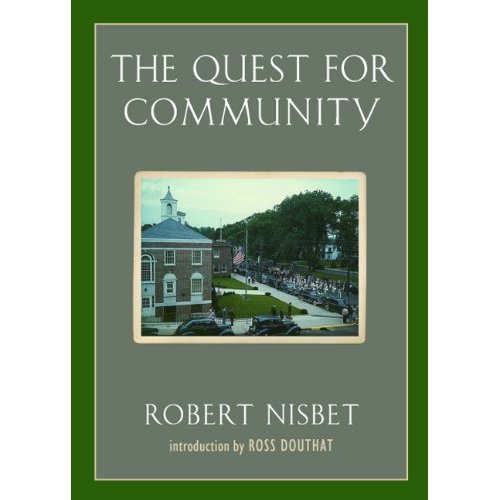
The Quest for Community pictureI finished reading Robert Nisbet’s classic book, The Quest for Community. I believe one of the most tragic facts of the twentieth century is the systematic destruction of community. Community is essential for the well-being of a civilization, for without community, people become less than human. Communities, however, are only free if people can voluntarily choose to participate. Statist communities lack this vital freedom of choice. The Life Business helps improve people both personally and professionally within leadership communities. A person will grow much faster if he has a community in which to apply his leadership lessons. Here is a summary of Nisbet’s writings from the Stanford Review by Ben Guthrie. Sincerely, Orrin Woodward

Nisbet, a communitarian who opposes statism, does not laud individualism either. For those unfamiliar with the intellectual roots of conservatism, this position may seem curious for a conservative to hold. But a communitarian ethos permeates conservatism. Nisbet views atomistic individualism as a negative force in society because “Individualism has resulted in masses of normless, unattached, insecure individuals who lose even the capacity for independent, creative living” (12). People are social creatures and depend upon communities and social structures for moral certitude. For Nisbet, the two prerequisites for community are function and authority. He defines community as the “product of people working together on problems, of autonomous and collective fulfillment of internal objectives, and of the experience of living under codes of authority which have been set in large degree by the persons involved”.

Nisbet’s analysis proceeds as a descriptive assessment of the loss of community in the modern world and the lack of emergence of suitable intermediate associations to intercede between the individual and the state. It is not that traditional forms of community, based on kinship, faith, or locality have ceased to exist, but rather they have lost functional significance. Nisbet writes, “Family, local community, church, and the whole network of informal interper­sonal relationships have ceased to play a determining role in our institutional systems of mutual aid, welfare, educa­tion, recreation, and economic produc­tion and distribution” (48). In lacking functional significance, communities lose the ability to provide psychologi­cal sustenance of “allegiance, belief, and incentive” to individuals. . .

Nisbet effectively shows that liberal individualism and authoritarian statism are not incompatible doctrines, but can in fact combine to form a lethal com­bination of totalitarianism. The safeguard against totalitarianism is a rich cultural fabric of intermediate associations – family, profession, local community, church, university, trade union, cooperative, and mutual aid association. Interestingly, Nisbet does not extensively discuss the internal content of the intermediate associations. He appears to be somewhat indifferent on the types of institutions which should prevail, so long as some functionally significant institutions prevail. Even for an important institution like the family, Nisbet appears laissez-faire in his suggestion that there “is no single type of family, any more than there is a single type of religion, that is essential to personal security and collective prosperity” (62). The lessons about the importance of community do not purely defend against creeping totalitarianism; the lessons extend to the more positive promotion of freedom.

Nisbet continues in the third part of his analysis on community and the problem of freedom, “Genuine freedom is not based upon the negative psychology of release. Its roots are in positive acts of dedication to ends and values” (238). Nisbet believes in the necessity of voluntary intermediate organizations both for the protection of individuals and for human flourishing. Since community is characterized by authority and function, it might seem paradoxical to suggest that individuals are freer when they have joined an organization to which they have submitted to an authority. But authority is a necessary component of a functional community, which is necessary for the psychological well being of individuals. The key for Nisbet is that the authority is not absolute. Freedom “lies in the interstices of authority” (239). An individual must always have recourse to leave an organization and join a different one.

Nisbet concludes his analysis with a call for a “new philosophy of laissez faire,” one in which “the basic unit will be the social group” rather than the individual (247). The values which Nisbet extols are freedom of choice, cultural diversity, pluralism, and division of authority. Robert Nisbet fits well in the traditionalist branch of conservatism, but in some ways Nisbet’s views are not incompatible with the libertarian strain of conservatism. He clearly argues that a viable free market must be embedded in social institutions, as he writes, “Capitalism is either a system of social and moral allegiances, resting securely in institutions and voluntary associations, or it is a sand heap of disconnected particles of humanity” (215). But the emphasis on voluntary associations recognizes the primacy of liberty and individual choice, given that individuals are members of strong communities.
Posted in Freedom/Liberty, Leadership/Personal Development | Tagged: , , , | 10 Comments »

Keeping Score in the PDCA Process

Posted by Orrin Woodward on January 24, 2012

Here are several paragraphs from the Systems chapter of my new book RESOLVED: 13 Resolutions for LIFE.  Keeping score in the PDCA – Plan, Do, Check, and Adjust – process is essential to success. Enjoy.  Sincerely, Orrin Woodward

Scoreboard and PDCA
When a person applies systems thinking to his life many times a seemingly small change can have a huge effect as Donella Meadows illustrates in her book Thinking in Systems:

Near Amsterdam, there is a suburb of single-family houses all built at the same time, all alike. Well, nearly alike. For unknown reasons it happened that some of the houses were built with the electric meter down in the basement. In other houses, the electric meter was installed in the front hall.

These were the sort of electric meters that have a glass bubble with a small horizontal metal wheel inside. As the household uses more electricity, the wheel turns faster and a dial adds up the accumulated kilowatt-hours.

During the embargo and energy crisis of the early 1970’s, the Dutch began to pay close attention to their energy use. It was discovered that some of the houses in this subdivision used one-third less electricity than the other houses. No one could explain this. All houses were charged the same price for electricity, all contained similar families.

The difference, it turned out, was in the position of the electric meter. The families with high electricity use were the ones with the meter in the basement, where people rarely saw it. The ones with low use had the meter in the front hall where people passed, the little wheel turning around, adding up the monthly electricity bill many times a day.

The Dutch families unconsciously used the PDCA process to improve their results  thanks to an ever-present scoreboard: the electric meter.  By changing the position of the electric meter-reader, or scoreboard, their electric bills were reduced by one third.  Studying this example through the lens of the PDCA process one can see the scoreboard is part of the feedback loop within the system.  Notice how a small change in location produced leveraged consequences. The meter then becomes the Check step in the process. When the families noticed the wheel in the meter turning faster, they were able to check and therefore make Adjustments in their electricity use ultimately reducing their electrical loads. Because the scoreboard was visible, adjustments were made quickly leading to decreased electrical usages thus conserving energy and money.

Posted in Leadership/Personal Development | Tagged: , , | 7 Comments »

Bill & Jackie Lewis – LIFE Founders

Posted by Orrin Woodward on January 16, 2012

Bill and Jackie Lewis coupleHow does an inner-city kid and a single-mom team up and break out of the mold to become a millionaire couple? More impressively, how do they do this while developing into some of the top speakers and leaders in one of the fastest growing leadership companies? The short answer is through reading, listening, and associating with those who had the results they desired.

Bill and Jackie Lewis are two of the Founders of LIFE. Their amazing story is shared on several CDs that are best-sellers in the TEAM system. Indeed, both Bill and Jackie had to change the way they viewed themselves and this only occurs through improved information and association.

Recollecting back to Bill’s first time ever speaking on a TEAM stage, he was so nervous, that he made me dizzy watching him pace back and forth.  Be that as it may, he did it anyway, displaying courage and resolve to electrify the crowd with his speaking. In fact, it’s only through the small repeated victories that people change how they view themselves. Jackie went through a similar journey, going from a tentative speaker on stage to one of the most impactful of lady leaders.

What separates the winners from the rest in life? It’s Adversity Quotient – the ability to endure the pain inherent in the change process. The Lewis’s win because they have a near limitless AQ. By combining AQ and unimpeachable loyalty, this couple bought into the goals and vision of the TEAM, exploding through the Team levels and achieving PC in 2006. Through numerous hardships, the Lewis’s never wavered, maintaining the dream of reaching a million people.

I can remember Bill writing a check for hundreds of thousands of dollars in order to cover legal expenses and keep the TEAM together. Heroes are heroes because they sacrifice for what they believe in. It is modern day heroes like Bill and Jackie that make Laurie and my leadership journey so worthwhile. When so much of the world is giving up on their dreams, there are still a few willing to sacrifice for their dreams. Bill and Jackie are part of that select few.

For example, if you have ever played competitive sports with Bill – the TEAM’s basketball wars are legendary – you quickly discover that Bill hates losing at anything. He will push himself to his limit in order to achieve victory. It’s this characteristic that has led Bill to achieve massive results, despite his humble beginnings. For example, I am not shocked that Bill is a single digit handicap golfer because his quest for excellence accepts nothing less. I love competing against Bill in sports, for I know that whoever wins will have earned it.

Today the Lewis’s live in an impressive Tuscan mansion, raising their four children and enjoying the fruits of their labors. The Lewis’s team is one of the biggest and most dynamic in the LIFE business, providing a dream lifestyle for the young couple. Dreams come true to those who are true to their dreams. Bill and Jackie were true to their dreams, becoming top leaders in the TEAM and Founders of LIFE. Laurie and I congratulate our friends and Co-Founders, Bill and Jackie Lewis, for their impressive leadership accomplishments. We look forward to a blessed future together. Sincerely, Orrin Woodward

Posted in Leadership/Personal Development | Tagged: , , | 25 Comments »

Success Demands Mind, Heart, and Will

Posted by Orrin Woodward on January 11, 2012

True success demands engaging the mind, heart, and will into your work. So many attempt to shortcut this process, but to no avail. Here is a section from my new book RESOLVED: 13 Resolutions For LIFE, explaining the importance of full engagement of the mind, heart, and will. Sincerely, Orrin Woodward

Mind, Heart, and Will
If success was as simple as writing out a few resolutions and studying them daily, wouldn’t more people apply this method to become successful? Dr. Martyn Lloyd-Jones explains why few achieve lasting success, “Man is a wonderful creature, he is mind, he is heart, and he is will. Those are the three main constituents of man. God has given him a mind, He has given him a heart, He has given him a will whereby he can act.” Transforming a life then, requires the whole person to be involved – his mind, his heart, and his will must be engaged in the process. True change isn’t just a mental (mind) assent, it isn’t just an emotional (heart) experience, and it’s more than just regimented (will) learning. For some will read the resolutions, make a mental nod of approval but won’t involve the heart or will.  Even though they claim a knowledge of how to succeed in life, they never seem to achieve anything.  To know and not to do is really not to know, since if one knew how satisfying authentic success would be, one wouldn’t delay in striving towards it. Resolutions must engage the mind, but must go beyond it, tapping into the heart and will to produce lasting real change.

Without uniting the mind, heart and will together, people will not achieve their desired results. For example, many who attend seminars have their hearts touched by the message, but don’t seem to comprehend mentally (mind) or follow-through physically (will) on the plan for success. These people jump from one achievement fad to another, gaining emotional (heart) releases, but accomplish little of real substance.  Life has been hard on them, so they attend another fad seminar, seeking, not real change, but a cathartic release of tension. Another group of people study the resolutions, attempting to transform themselves through sheer willpower, but unless the mind and heart are engaged, it cannot last.  This group attempts to take up the resolutions, rather than being taken up by them.  The will, by itself, can go through the motions, but without the heart and mind, the passion and understanding involved, the process lacks zeal.  It’s like the old saying, “A man or woman convinced against his will is of the same opinion still.”  A methodical, passionless, robotic-like study of the resolutions will not get the job done.

It’s only with a mind that understands, a heart that generates passion, and a disciplined will to follow through, that change is generated inside a person. Sadly, most success seeker’s journey will end in disappointment having made the common mistake of compartmentalizing the parts of a person rather than allowing them to work together.  The good news, however, is that anyone can develop the ability to work on the mind, heart, and will simultaneously.  The process is simple, but certainly not easy, requiring immense discipline to marry the three constituent parts together in the pursuit of excellence in any area that a person has resolved to change. By thinking seriously about where to focus, writing out clear resolutions, resolving to read, and apply them on a consistent basis, anybody can, like Washington, Franklin, and Edwards, resolve to change. Moreover, when a person changes himself, he begins a process that ultimately transforms the world around him.

Posted in Leadership/Personal Development | Tagged: , , , | 10 Comments »

Leaders Break the Cycle of Learned Helplessness

Posted by Orrin Woodward on January 9, 2012

Here is a portion of the Adversity Quotient Resolution chapter from my new book RESOLVED: 13 Resolutions for LIFE.  Learned Helplessness, by definition, is a learned behavior; therefore, it can also be an unlearned behavior. This is exactly what leaders do for other people, helping them unlearn poor attitudes, expectations, and thoughts. Let’s make 2012 the year you breakthrough, leaving learned helplessness and mediocrity behind! Sincerely, Orrin Woodward

One such compromise was discovered Dr. Martin E. P. Seligman, in 1965, when he stumbled across what the American Psychological Association has called the Landmark Theory of the Century – Learned Helplessness. Learned Helplessness is a belief that what a person does cannot alter his outcomes, that somehow life’s cards are stacked against him. Seligman’s studies created a revolution in the psychology field, displacing Skinner’s hopeless behaviorism (Stimulus controls response). In Pavlov’s original study, where he rang the bell and provided food, showing that dogs would salivate after ringing the bell, seemed to prove that humans only responded to the stimulus provided. From this experiment, Pavlov, and later Skinner, concluded that man lived by learned behaviors only, leaving no room for thinking, responsibility, changing, and therefore, no room for destiny. But Seligman’s experiments altered the field forever with the hopeful cognitive psychology revolution (thinking determines behavior). His experiments revealed, in other words, that what we do matters.

Seligman tested three groups of dogs on Pavlov’s foundation, but with a key variation in the stimulus. Group A dogs were harnessed individually, hearing a bell tone and receiving a harmless electric shock afterwards. Group A dogs could stop the shock by pressing a bar with their nose, which they quickly learned to do. Group B dogs, on the other hand, heard the bell tone and received the shock, but had no ability to stop the electric shocks.  Lastly, Group C received no shocks at all, merely heard the bell tone. The breakthrough occurred on the second day of testing when each of the dogs from the previous day were randomly placed into a shuttle box; a box with a low barrier down the middle.  One at a time the dogs were place in the shuttle box.  Each dog heard the bell tone and received the shock, but the different responses of the three groups initiated the cognitive revolution. Both Groups A and C quickly jumped the middle barrier, eliminating the discomfort of the electric shock. But Group B, contrary to expectations, did not attempt to jump over the barrier, instead the dogs merely crouched down and whimpered. Stoltz describes the breakthrough theory, “What Seligman and others discovered is that these dogs had learned to be helpless, a behavior that virtually destroyed their motivation to act. Scientist have discovered that cats, fish, dogs, rats, cockroaches, mice, and people all are capable of acquiring this trait. Learned helplessness is simply internalizing the belief that what you do does not matter, sapping one’s sense of control.” When a person believes that he cannot change his situation, he won’t even try, becoming hopeless because he believes he is helpless. On the other hand, people can change nearly anything with the right knowledge applied consistently and persistently. Learned helplessness, because it destroys this hope for change, must be exposed for the lie that it is, teaching one’s self and others that change is possible only when a person believes that he can change. Indeed, leaders must rid themselves and their teams from Learned Helplessness as its acid is fatal to all personal growth.

Another compromise that leads to failure and despair is an improper response to the pain inherent in the process of growth.  There are actually two types of pain: one comes from the inside due to the change process; the other comes from the outside due to criticism from those unwilling to make the same changes. Hope is the only fuel capable of burning through both types of pain.  Without hope, either of the pain versions will trump one’s willingness to endure, instead choosing to stop the pain by quitting the journey.  Author Robert Grudin writes, “One might reply that most people who surrender simply lack the ability to get very far.  But it is more accurate to say that ability and intelligence, rightly understood, include a readiness to face pain, while those characteristics which we loosely term ‘inadequacy’ and ‘ignorance’ are typically associated with the avoidance of pain.” When the pain reaches a certain threshold, everything inside of a person screams for relief, but champions, people with high AQ, persevere. Pain is overcome through the continuous focus on one’s purpose. Moreover, achieving greatness will require a faith that can move mountains, an AQ to endure the rising pain in the process, eventually reaching levels of success that more timid souls refuse to believe possible.

Posted in Leadership/Personal Development, Orrin Woodward | Tagged: , , | 9 Comments »

Keeping Score in the Game of Life

Posted by Orrin Woodward on January 4, 2012

Here is a portion of a talk I gave on keeping score at a LIFE TEAM event. Are you keeping score in the game of Life? Sincerely, Orrin Woodward

Posted in Leadership/Personal Development, Orrin Woodward | Tagged: , | 7 Comments »