Orrin Woodward on LIFE & Leadership

Inc Magazine Top 20 Leader shares his personal, professional, and financial secrets.

  • Orrin Woodward

    1
    Former Guinness World Record Holder for largest book signing ever, Orrin Woodward is a NY Times bestselling author of And Justice For All along with RESOLVED & coauthor of LeaderShift and Launching a Leadership Revolution. His books have sold over one million copies in the financial, leadership and liberty fields. RESOLVED: 13 Resolutions For LIFE made the Top 100 All-Time Best Leadership Books and the 13 Resolutions are the framework for the top selling Mental Fitness Challenge personal development program.

    Orrin made the Top 20 Inc. Magazine Leadership list & has co-founded two multi-million dollar leadership companies. Currently, he serves as the Chairman of the Board of the LIFE. He has a B.S. degree from GMI-EMI (now Kettering University) in manufacturing systems engineering. He holds four U.S. patents, and won an exclusive National Technical Benchmarking Award.

    This blog is an Alltop selection and ranked in HR's Top 100 Blogs for Management & Leadership.

  • Orrin’s Latest Book


  • 7 Day Free Access to Leadership Audios!

  • Email Me

  • NY Times Bestselling Book


  • Mental Fitness Challenge

  • Email Subscription

    Enter your email address to subscribe to this blog and receive notifications of new posts by email.

    Join 2,438 other subscribers
  • Categories

  • Archives

Archive for January, 2008

Francis Schaeffer on Education

Posted by Orrin Woodward on January 25, 2008

Francis Schaeffer is one of my favorite all time authors.  His books will make you think, stretch and grow.   I have read nearly every book Schaeffer has written.  I would highly recommend them to anyone wishing to learn about worldviews and how they affect a person’s actions.  I believe that before
we can change the world, we must understand it.  Francis Schaeffer’s books taught me to get involved and not just hide in a Christian environment.  We must be in the world, but not of the world if we plan on changing the world!  The following article is from a speech given in 1982 and is a great example of how he makes a person think.  God Bless, Orrin Woodward

Now, moving from public schools to private schools, what is the priority? Notice I am not saying Christian schools, but all private schools, including Christian schools.  If you are really going to do something here, you have to think larger than your own interest. What we must do in the private schools, including the Christian schools, is to stand against those who have done so much to ruin our public schools in not allowing them to get a hold on the private schools, and specifically, the Christian schools, through a control of the curriculum. What we should be doing is struggling to see that the Christian school’s curriculum is not controlled by those who have with their world view ruined the public schools.

This does not mean that the state does not have a legitimate interest in the safety of the pupils in such a thing as a firedoor. There are Christian schools that have said the state has no right even to tell them not to have a fire trap. That is not so. The state has a responsibility to say that a group of people meeting in a building like this we are meeting in have exit signs around the room, so that if there is a fire you will not all burn to death, and that is equally so for the kids in school. So the issue is not something like fire doors. The issue is that they must not begin to bring the same destructive teaching into the private schools by the back door of curriculum control that they have brought so dominantly into the public schools. We must not allow them to bring in through the back door a control of the curriculum and especially at the very point where the Bible’s content is denied and contaminated. Therefore, the protection of the Christian school curriculum is another one of the priorities, which Christians ought to be consciously and intelligently standing for.

However, let me say another side of this question of the Christian school and our protection of it. While we are saying that the Christian school is not to allow its curriculum to be corrupted, we must also say that the private school, and specifically the Christian school, should give a good education. 

We are to say we are going to control the curriculum. We are not going to let the state bring in the materialistic view as the final reality through the back door. But if we are going to say that with any validity the Christian schools must be giving a really good education. It should not just be a matter of not teaching what is wrong in a twisted education that rules out a Creator. Our Christian schools should not primarily be negative oriented. It is to be positive.

It is not just to be negative. It should be a superior education, if you are going to really protect the Christian school. It should certainly teach the students how to read and write and how to do mathematics better than most public schools enjoy today. It should do that but it should also appreciate and teach the full scope of human learning. Christian education is indeed knowing the Bible, of course it is, but Christian education should also deal with all human knowledge. We can think of what I said previously about the humanities. Christian education should deal with all human knowledge – presenting it in a framework of truth, rooted in the Creator’s existence, and in his creation. Real Christian education, if we are going to protect our Christian schools, is not just the negative side, it is positive, touching on all human knowledge; and in each case, according to the level of the students, showing how it fits into the total framework of truth, the truth of all reality as rooted in the Creator’s existence and in His creation. If the Judeo-Christian position is the truth of all reality, and-it is, then all the disciplines, and very much including a knowledge of, and I would repeat, an appreciation of, the humanities and the arts are a part of Christian education. Some Christians seem absolutely blind at this point.

If Christianity is not just one more religion, one more upper story kind of thing (as I speak of it in Escape From Reason and in my other books) then it has something to say about all the disciplines, and it certainly has something to say about the humanities and the arts and the appreciation of them. And I want to say quite firmly, if your Christian school does not do this, I do not believe it is giving a good education. It is giving a truncated education and it is not honoring to the Lord.

If truth is one, that is if truth has unity, then Christian education means understanding, and being excited by, the associations between the disciplines and showing how these associations are rooted in the Creator’s existence. I do not know if you know what you are hearing or not. It is a flaming fire. It is gorgeous if you understand what we have in the teaching and revelation of God. If we are going to have really a Christian education, it means understanding truth is not a series of isolated subjects but there are associations, and the associations are rooted in nothing less than the existence of the Creator Himself. 

True Christian education is not a negative thing; it is not a matter of isolating the student from the full scope of knowledge. Isolating the student from large sections of human knowledge is not the basis of a Christian education. Rather it is giving him or her the framework or total truth, rooted in the Creator’s existence and in the Bible’s teaching, so that in each step of the formal learning process the student will understand what is true and what is false and why it is true or false. It is not isolating students from human knowledge. It is teaching them in a framework of the total Biblical teaching, beginning with the tremendous central thing, that in the beginning God created the heavens and the earth. It is teaching in this framework, so that on their own level, as they are introduced to all of human knowledge, they are not introduced in the midst of a vacuum, but they are taught each step along the way why what they are hearing is either true or false. That is true education. The student, then, is an educated person. I just say in passing, John Harvard understood that when he founded Harvard University. It was founded with this whole thing in mind. The student, then if he is taught this way, is an educated person, who will have the tools to keep learning and enjoy learning throughout all of life. Is life dull? How can it be dull? No, a true education, a Christian education, is more than the negative, though that is there. It is giving the tools in the opening the doors to all human knowledge, in the Christian framework so they will know what is truth and what is untruth, so they can keep learning as long as they live, and they can enjoy, they can really enjoy, the whole wrestling through field after field of knowledge. That is what an educated person is.

In short, Christian education should produce students more educated in the totality of knowledge, culture and life, than non-Christian education rooted in a false view of truth. The Christian education should end with a better educated boy and girl and man and woman, than the false could ever produce. Protecting the Christian school must carry with it more than the negative; it should produce a superior education in all areas of.  Knowledge, and notice I am saying all areas of human knowledge.
Posted in Faith, Family | 25 Comments »

Jim Collins – Good to Great

Posted by Orrin Woodward on January 24, 2008

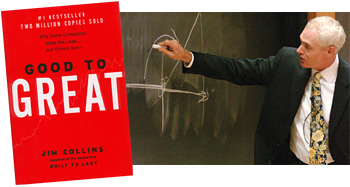
I found a Q&A session with Jim Collins in Fortune Magazine.  Jim Collins is the author of Good to Great which is one of my favorite all time leadership books.  I believe the Team leaders display many of the Good to Great principles.  One question describes the importance of building the right team before building the right business.  The more I read about the future of business the more excited I am to be involved with the Team leadership!  Here is the article’s questions.  God Bless,
Orrin Woodward

Jim Collins Book pictureIf you were to offer advice to a beginning entrepreneur, what would it be? –Francisco Romero, Albuquerque

First, don’t obsess on finding the “great idea.” In fact, our research shows a somewhat negative correlation between
pioneering a great idea and building a great company. Many of the greatest
started with either no great idea or even failed ideas.

Sony (Charts) started with a failed rice cooker. Marriott (Charts) started as a single root beer stand. Bill Hewlett and Dave Packard’s great idea was simply to work together – two best friends who trusted each other – while their first four products failed to get the company out of the garage.

They followed the “first who” approach to entrepreneurship: First figure out your partners, then figure out what ideas to pursue. The most important thing isn’t the market you target, the product you develop or the financing, but the founding team.

Starting a company is like scaling an unclimbed face – you don’t know what the mountain will throw at you, so you must pick the right partners, who share your values, on whom you can depend, and who can adapt.

“Good to Great” looked at companies with long track records. How do the ideas in the book apply to disruptive startup companies, like YouTube or Google (Charts)? –George Kim, Washington, D.C.

My colleague Morten Hansen and I are nearing completion of six years of research studying companies that went from startup to greatness in environments characterized by turbulent disruption. We’ve deliberately selected entrepreneurial companies in the most severely disruptive industries, using the following analogy: If you wake up in the security of base camp and a storm moves in, you’ll probably be fine. But if you find yourself at 27,000 feet on the side of Mount Everest, where the storms are faster moving and unpredictable, a storm just might kill you. Most leaders today feel they are moving higher on the mountain, whether in Google’s world or traditional industries, and we want to know, Why do some prevail from vulnerability to greatness in the face of turbulent disruption, while others don’t?

Most founders fail to become effective managers after the companies they started become too large for them to control. However, a few, such as Bill Gates, managed to grow into top-tier CEOs. What are the distinguishing factors between the transformed entrepreneurs and others? –Haimu Sun, Evanston,
Ill.

It’s simply a myth that entrepreneurs can’t evolve into company builders. Our research shows quite the opposite: In great companies the entrepreneurs generally grow as the company grows.

Here is a short list of those who evolved into company builders: Henry Ford, Sam Walton, Hewlett and Packard, J.W. Marriott, Sony’s Akio Morita, Walt Disney, Intel’s Robert Noyce and Gordon Moore, Southwest Airlines’ Herb Kelleher, and of course Gates and Phil Knight. They made the shift from time telling to clock building – to seeing their primary creation as the company itself: what it stands for, its culture and how it operates.

If forced to choose just one, what do you feel is the most important quality in a successful business leader? –John Mierzwa, Las Vegas

Willful humility. The best CEOs in our research display tremendous ambition for their company combined with the stoic will to do whatever it takes, no matter how brutal (within the bounds of the company’s core values), to make the company great. Yet at the same time they display a remarkable humility about themselves, ascribing much of their own success to luck, discipline and preparation rather than personal genius. 

Do you find that the leaders of great companies are less likely to be paid excessively, but more consistently with the others in their organization? –Bill Maltarich, Bonita Springs, Fla. 

Our research found no correlation between executive compensation and shareholder returns. Excessive executive pay tends to lead to one thing: even more excessive pay, not increased shareholder value.

What is the subject of your next book, and when is it due out? –Michael Sharrow, San Antonio 

I haven’t yet decided on my next book. I’ve got the two big research questions in late stages: “great to good,” which I’m writing up now, and the turbulent-disruption research. One of those might become a book, but my first focus is to make sure we successfully answer the questions we set out to answer.

PEER QUESTION

Jeff Sonnenfeld, founder of the Chief Executive Leadership Institute and professor at Yale University School of Management

The quest for greatness that you’ve studied fits well in America’s tradition of
success-absorbed self-improvement wisdom ranging from Benjamin Franklin to
Stephen Covey. Do you think we should also focus on the wisdom from failure?

Thanks, Jeff. I appreciate the question, because it gives me a chance to correct a common misinterpretation of our work. Our research is not based on studying success. We study the contrast between highly successful and less successful outcomes. We put as much weight on those that failed to achieve (or sustain) great results as on those that did, asking the question “What principles explain the difference between the successes and the failures?”

We’ll be releasing the results of a new piece of research that examines the inverse of “good to great” – namely, “great to good”: Why do some great companies fall and not others?

Posted in All News | 2 Comments »

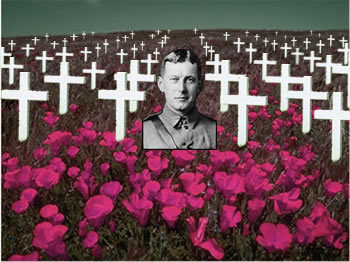
In Flanders Field by Lt. Colonel John McCrae

Posted by Orrin Woodward on January 22, 2008

Flanders Filed pictureI listened to my daughter Christina recite a poem for her school project
tonight.  I decided to research the poem and I sure am glad I did!  The poem was written by a Canadian MD during World War I.  This post is dedicated to our brothers and sisters north of the border in Canada.  Laurie and I had the honor of speaking outside of Halifax,
Nova Scotia Canada two weekends ago.  I am very proud of the hunger, attitude and leadership we witnessed.  The Canadians are making a difference and watching the courage of so many leaders tells me the men of Flanders did not die in vain.  Here is the story behind the poem In Flanders Field and here is the link.

McCrae’s “In Flanders Fields” remains to this day one of the most memorable war poems ever written. It is a lasting legacy of the terrible battle in the Ypres
salient in the spring of 1915. Here is the story of the making of that poem:

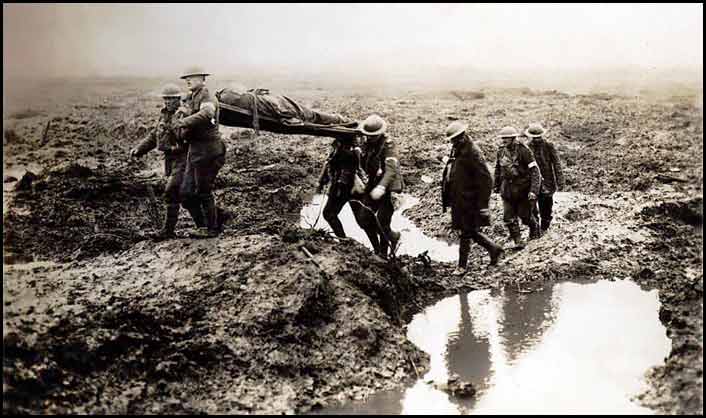
Although he had been a doctor for years and had served in the South African War, it was impossible to get used to the suffering, the screams, and the blood here, and Major John McCrae had seen and heard enough in his dressing station to last him a lifetime. 

As a surgeon attached to the 1st Field Artillery Brigade, Major McCrae, who had joined the McGill faculty in 1900 after graduating from the University of Toronto, had spent seventeen days treating injured men — Canadians, British, Indians, French, and Germans — in the Ypres salient.

It had been an ordeal that he had hardly thought possible. McCrae later wrote of it: 

Flanders Field Soldiers picture

“I wish I could embody on paper some of the varied sensations of that seventeen days… Seventeen days of Hades! At the end of the first day if anyone had told us we had to spend seventeen days there, we would have folded our hands and said it could not have been done.”

One death particularly affected McCrae. A young friend and former student, Lieut. Alexis Helmer of Ottawa, had been killed by a shell burst on 2 May 1915. Lieutenant Helmer was buried later that day in the little cemetery outside McCrae’s dressing station, and McCrae had performed the funeral ceremony in the absence of the chaplain. 

The next day, sitting on the back of an ambulance parked near the dressing station beside the Canal de l’Yser, just a few hundred yards north of Ypres, McCrae vented his anguish by composing a poem. The major was no stranger to writing, having authored several medical texts besides dabbling in poetry.

In the nearby cemetery, McCrae could see the wild poppies that sprang up in the ditches in that part of Europe, and he spent twenty minutes of precious rest time scribbling fifteen lines of verse in a notebook.

A young soldier watched him write it. Cyril Allinson, a twenty-two year old sergeant-major, was delivering mail that day when he spotted McCrae. The major looked up as Allinson approached, then went on writing while the sergeant-major stood there quietly. “His face was very tired but calm as we wrote,” Allinson recalled. “He looked around from time to time, his eyes straying to Helmer’s grave.”

When McCrae finished five minutes later, he took his mail from Allinson and, without saying a word, handed his pad to the young NCO. Allinson was moved by what he read:

“The poem was exactly an exact description of the scene in front of us both. He used the word blow in that line because the poppies actually were being blown that morning by a gentle east wind. It never occurred to me at that time that it would ever be published. It seemed to me just an exact description of the scene.” 

In fact, it was very nearly not published. Dissatisfied with it, McCrae tossed the poem away, but a fellow officer retrieved it and sent it to newspapers in England. The Spectator, in London, rejected it, but Punch published it on 8 December 1915.

In Flanders Fields

By: Lieutenant Colonel John McCrae, MD
(1872-1918)

Canadian Army

IN FLANDERS FIELDS the poppies blow

Between the crosses row on row,

That mark our place; and in the sky

The larks, still bravely singing, fly

Scarce heard amid the guns below.

We are the Dead. Short days ago

We lived, felt dawn, saw sunset glow,

Loved and were loved, and now we lie

In Flanders fields. 

Take up our quarrel with the foe:

To you from failing hands we throw

The torch; be yours to hold it high.

If ye break faith with us who die

We shall not sleep, though poppies grow

In Flanders fields.

What part are you playing in the media war to ensure these brave young men and the cause they fought for are remembered?  Let us not break faith with those who died to maintain our freedoms – they risked their lives defending freedom and we only risk rejection and derision defending ours.  We have no excuses!  God Bless, Orrin Woodward

Posted in Freedom/Liberty | 3 Comments »

Economics, Politics and Madmen – John Maynard Keynes

Posted by Orrin Woodward on January 21, 2008

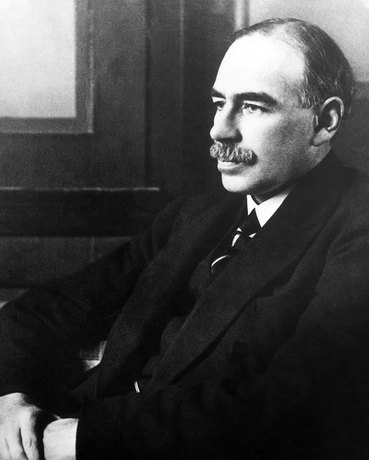
John Maynard Keynes pictureHere is a John Maynard Keynes quote that describes why we must discuss economics on this blog.  I could take the easy way
out and not discuss any controversial issue. 
But if we don’t discuss any controversial subjects—how do we learn the truths to live life by?    I understand that thinking through issues can
be tough, but I promise to not attack anyone personally and only attack error and focus on leading people to truth.  If
someone does not agree, then develop a reasoned argument of why you think differently and help me grow.  I believe
that when people go into labeling and name calling, then it signals a lack
of rational points to discuss and have resorted to attacking personalities not
principles.  I encourage all of us to not take the low road and focus on principles instead of personalities.  Let’s fear ignorance more than disagreement and focus on iron sharpening iron as we all grow on our way to serving and leading.  As Tim Marks states, “Know why you believe what you believe.”  I am proud of everyone for thinking, whether they agree or disagree is not as important to me as logically thinking through why you think what you think.  If you do not know why you believe what you believe, you may be a victim of some defunct economist or political philosopher.  John Maynard Keynes was an economist who lived in England during the Great Depression.  I personally disagree with much of his thinking, but I respect the fact that he thought deeply about economic issues.   Keynes’ ideas still hold sway in many economic circles and his thinking made an impact in our world.   Keynes quote below is an appropriate quote for our discussion on the presidential elections and will help us to hold all of our beliefs to critical reasoning.

The ideas of economists and political philosophers, both when they are right and when they are wrong, are more powerful than is commonly understood.
Indeed, the world is ruled by little else. Practical men, who believe themselves to be quite exempt from any intellectual influence, are usually the slaves of some defunct economist. Madmen in authority, who hear voices in the
air, are distilling their frenzy from some academic scribbler of a few years
back. I am sure that the power of vested interests is vastly exaggerated
compared with the gradual encroachment of ideas.

What intellectual influences have helped you develop the way you think about the economy and government?  Have you studied and read for yourself or
have you developed your ideas through parents, teachers, and the media?  Please share. God Bless, Orrin Woodward

Posted in Finances, Freedom/Liberty | 2 Comments »

Ideas Have Consequences – Economic Thought & Karl Marx

Posted by Orrin Woodward on January 21, 2008

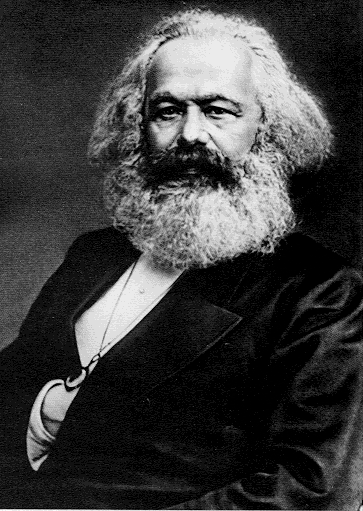
Karl Marx pictureNo economic system has been proven more wrong than Karl Marx and his communist
revolution.  With this being said, no system that has failed so miserably has so many of its ideas still in practice.  It is like a person who realizes that drinking a whole cup of poison will kill him, but determines that half a cup a poison will help him.  The
communist spent millions of dollars and years of propaganda to inject their
poison into the thinking of Americans.  It is now a documented fact that the communist worked to control the media and change the American values to communist positions.  I would like to take you back to the recognized father of modern communism, Karl Marx.  I believe economic understanding is one of the keys for the future of America.  With so much misinformation out there, I run the risk of being labeled by many sincere people who do not fully understand what is at stake.

America was founded on strong free enterprise and rule of law principles.
How few voters understand this and freely buy into communist positions
ought to concern of all us.  The whole goal of this blog is to generate discussion and a better understanding of what the media war is about.  I am not offended in the least if you disagree with our discussion.  All I ask is we think together
in an effort to learn truth.  Here is an article on the
10 Planks of the Communist
Manifesto.
  Do you recognize some of these originally radical ideas as now mainstream American thought?  The ideologies of free enterprise and
communism are polar opposites on their view of man, God, and government.  Please read carefully and think about the 10 Planks.  Does it concern anyone else that America would adopt so many principles from a communist system that is defunct, an abject failure, and Godless from an atheist economist Karl Marx?  Why have so many of us been taught these principles as the American way of life?  Some will say I am paranoid, but are we paranoid if they really are after us?  Here is the linked article with the 10 Planks of the Communist Manifesto.

Karl Marx describes in his communist manifesto, the ten steps necessary to destroy a free enterprise system and replace it with a system of omnipotent government power, so as to effect a communist socialist state. Those ten steps are known as the Ten Planks of The Communist Manifesto… The following brief presents the original ten planks within the Communist Manifesto written by Karl Marx in 1848, along with the American
adopted counterpart for each of the planks. From comparison it’s clear MOST Americans have by myths, fraud and deception under the color of law by their own politicians in both the Republican and Democratic and parties, been transformed into Communists.

Another thing to remember, Karl Marx in creating the Communist Manifesto designed these planks AS A TEST to determine whether a society has become communist or not. If they are all in effect and in force, then the people ARE practicing communists.

Communism, by any other name is still communism, and is VERY VERY destructive to the individual and to the society!!

The 10 PLANKS stated in the Communist Manifesto and some of their American counterparts are…

1. Abolition of private property and the application of all rents of land to public purposes.

Americans do these with actions such as the 14th Amendment of the U.S. Constitution (1868), and various zoning, school & property taxes. Also the Bureau of Land Management (Zoning laws are the first step to government property ownership)

2. A heavy progressive or graduated income tax.

Americans know this as misapplication of the 16th Amendment of the U.S. Constitution, 1913, The Social Security Act of 1936.; Joint House Resolution 192 of 1933; and various State “income” taxes. We call it “paying your fair share”.

3. Abolition of all rights of inheritance.

Americans call it Federal & State estate Tax (1916); or reformed Probate Laws, and limited inheritance via arbitrary inheritance tax statutes.

4. Confiscation of the property of all emigrants and rebels.

Americans call it government seizures, tax liens, Public “law” 99-570 (1986); Executive order 11490, sections 1205, 2002 which gives private land to the Department of Urban Development; the imprisonment of “terrorists” and those who speak out or write against the “government” (1997 Crime/Terrorist Bill); or the IRS confiscation of property without due process. Asset forfeiture laws are used by DEA, IRS, ATF etc…). 

5. Centralization of credit in the hands of the state, by means of a national bank with State capital and an exclusive monopoly.

Americans call it the Federal Reserve which is a privately-owned credit/debt system allowed by the Federal Reserve act of 1913. All local banks are members of the Fed system, and are regulated by the Federal Deposit Insurance Corporation (FDIC) another privately-owned corporation. The Federal Reserve Banks issue Fiat Paper Money and practice economically destructive fractional reserve banking.

6. Centralization of the means of communications and transportation in the hands of the State. 

Americans call it the Federal Communications Commission (FCC) and Department of Transportation (DOT) mandated through the ICC act of 1887, the Commissions Act of 1934, The Interstate Commerce Commission established in 1938, The Federal Aviation Administration, Federal Communications Commission, and Executive orders 11490, 10999, as well as
State mandated driver’s licenses and Department of Transportation regulations.

7. Extension of factories and instruments of production owned by the state, the bringing into cultivation of waste lands, and the improvement of the soil generally in accordance with a common plan.

Americans call it corporate capacity, The Desert Entry Act and The Department of Agriculture… Thus read “controlled or subsidized” rather than “owned”… This is easily seen in these as well as the Department of Commerce and Labor, Department of Interior, the Environmental Protection Agency, Bureau of Land Management, Bureau of Reclamation, Bureau of Mines, National Park Service, and the IRS control of business through corporate regulations. 

8. Equal liability of all to labor. Establishment of industrial armies, especially for agriculture.

Americans call it Minimum Wage and slave labor like dealing with our Most Favored Nation trade partner; i.e. Communist China. We see it in practice via the Social Security Administration and The Department of Labor. The National debt and inflation caused by the communal bank has caused the need for a two “income” family. Woman in the workplace since the 1920’s, the 19th amendment of the U.S. Constitution, the Civil Rights Act of 1964, assorted Socialist Unions, affirmative action, the Federal Public Works Program and of course Executive order 11000.

9. Combination of agriculture with manufacturing industries, gradual abolition of the distinction between town and country, by a more equitable distribution of population over the country. 

Americans call it the Planning Reorganization act of 1949 , zoning (Title 17 1910-1990) and Super Corporate Farms, as well as Executive orders 11647, 11731 (ten regions) and Public “law” 89-136. These provide for forced relocations and forced sterilization programs, like in China.

10. Free education for all children in public schools. Abolition of children’s factory labor in its present form. Combination of education with industrial production. 

Americans are being taxed to support what we call ‘public’ schools, but are actually “government force-tax-funded schools ” Even private schools are government regulated. The purpose is to train the young to work for the communal debt system. We also call it the Department of Education, the NEA and Outcome Based “Education” . These are used so that all children can be indoctrinated and inculcated with the government propaganda, like “majority rules”, and “pay your fair share”. WHERE are the words “fair share” in the Constitution, Bill of Rights or the Internal Revenue Code (Title 26)?? NO WHERE is “fair share” even suggested!! The philosophical concept of “fair share” comes from the Communist maxim, “From each according to their ability, to each according to their need! This concept is pure socialism. … America was made the greatest society by its private initiative WORK ETHIC … Teaching ourselves and others how to “fish” to be self sufficient and produce plenty of EXTRA commodities to if so desired could be shared with others who might be “needy”… Americans have always voluntarily
been the MOST generous and charitable society on the planet. 

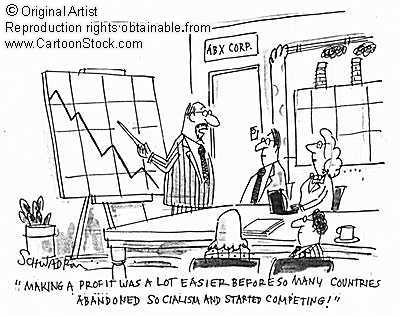
Did anyone else recognize how many of Communism Cartoon pictureMarx’s principles have been swallowed whole into the body politic of American thinking?  How do we educate Americans on the root source of much of our modern thinking on economic issues?  Although communism as a system is dead, the
ideas are alive and well in the flow of American consciousness.  Isn’t it ironic (to put it mildly) that the American ideals beat the communist ideals in the ideology war, but at the very moment the former communist countries are attempting to learn free enterprise from us – we have swallowed so much of their poison that we have forgotten what made us win the war in the first place! America is a great nation with great ideals.  I am proud to share the ideals our country was founded upon with anyone.
We must learn our heritage in order to protect our posterity.  I have said and continue to say that, “Ideas have consequences.”  What we believe as a country today, will be tomorrow’s reality.  We need a group of people with the hunger to learn the truth and the courageous leadership to share it.  Will anyone help Chris and I Launch a Leadership Revolution? God Bless, Orrin
Woodward

Update:
I want everyone to know that I believe in a limited government as the founding fathers did.  Limited government means—let the citizens accept responsibility for the greatest sphere of action and only utilize government where no individual or group of individuals can accomplish the task.  Government is by nature a monopoly and when government gets involved in an activity, it very rarely withdraws from the field.  Everyone knows that it is much easier to start a government program than to end one.  The more government is involved, the less money and influence the private sector has in that field.  People naturally learn from mistakes due to the pain of failure, but government rarely learns because they do not experience the same pain of failure as individuals and private companies.  An example would be GM, which
ran like a federal government for years, (and had a budget like some smaller
countries) but is now paying the price for failed policies and learning hard
lessons.  Our federal government when it fails, merely taxes more, increases money supply through inflation or borrows more money—this delays the lessons for our future generations.  I am not the type of person to pass the buck to our future generations and I desire a restoration of the government
principles that made our country great originally!  The founding fathers spelled out their principles of government in the Federalist Papers in three broad
categories:

1. Settling disputes according to the Rule of Law between individuals.

2. Protection from criminals attempting to steal, lie or coerce profits vs. earn them by service.

3. Ensure liberty for all by providing protection from foreign invaders.

Posted in All News, Freedom/Liberty | 7 Comments »

Thoughts on Biblical Proverbs

Posted by Orrin Woodward on January 20, 2008

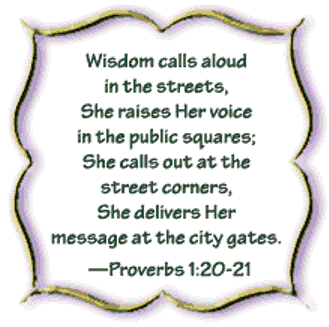
I found this article while researching for a post on the Proverbs.  I felt this had some good Proverbs1-20 pictureinformation for all of us.  I love learning truth principles and applying them to life.  I feel I have learned more truth applicable to life since 1997, (when I became Christian) than the 30 years of life prior to 1997.  Enjoy the article and please share the Biblical principles you have learned and applied to your life.  God Bless, Orrin Woodward

As with the rest of Scripture, whatever is written in the book of Proverbs is reliable and trustworthy. More than that, it is authoritative and binding in all of life. Yet being proverbs (inspired and reliable though they are), there are some characteristics which people tend to forget.

Take as an example the fact that proverbs often deal with isolated dimensions of life. In “real life,” there are many dimensions (not just one) that affect a person’s life. As a result, the full impact of the proverb will not always be immediately visible.

Consider a proverb that shows a contrast between two opposing ways of life. Usually, the proverb will describe the one way of life as bringing beneficial consequences, and the other as bringing harmful consequences. Now, these two contrasting results (from the two contrasting ways of life) are accurately described. And if there were two people who were the opposite in this one specific area yet identical in every other way, they would receive opposite consequences (at least within the scope of this one area). Yet since so many other factors are involved in life, these contrasting results are not always visible in full force. 

Such factors include more than just our own consistent obedience (or disobedience) to other proverbs and teachings found in Scripture. People do not normally live in total isolation from each other. And the sinfulness or righteousness of the community (or nation) in which one lives will also have an influence on the extent to which he experiences God’s blessing. There is also the dimension that we could call “temporary inconsistencies.” (See Psalm 73 or the book of Job.) All of these factors (which we could perhaps call “environmental factors”) must be taken into consideration.

In this life, one will not always be guaranteed that what is mentioned in any specific proverb will occur to the full extent that is stated. The multiplicity of factors that are part of one’s life – both controllable and uncontrollable – will prevent this. But the likelihood or probability of such an outcome will increase, within the context of the other factors. The more a person follows the authoritative guidelines of the book of Proverbs, the more likely he will reap the beneficial consequences. The more a person goes against them, the more likely he will experience the destructive consequences that are warned against.

There are other items to consider when examining the sayings in Proverbs. For instance, the proverbs themselves have a strong emphasis on one’s present life. They were written to teach us how to live now, not merely how to live someday in the distant future. To be sure, the future aspect of reality (which we call “eternity”) is not denied by the Proverbs. It sometimes directly referred to, but it is not the primary emphasis.

A consequence of the emphasis on the “here and now” is that even those who do not know God can experience some of the benefits of following the Proverbs! This is due to the graciousness of God, who gives good gifts to both the righteous and the unrighteous. Quite sadly, however, the good benefits are only temporary for such a person (they cease at his death, when he finds himself standing before his judge).

Another issue is that of the “time factor.” People often want immediate results. (Where is their concept of “patience,” or “perseverance?”) The Proverbs (the rest of the Bible, for that matter) do not guarantee instant results for impatient people. (Impatience would more represent the one who does not live according to the Proverbs, than one who does!)

Not all proverbs are promises or show the best way of living. Some are nothing more than observations. They merely describe aspects of life – “the way it is” – whether or not that way is good or worthy of practice. We live in an evil day, and some proverbs merely describe what we should expect in the world around us, or why certain things happen. They are in no way endorsing the evil they describe.

“Temporary inconsistencies” are just that. Even if (in the extreme) they would last a lifetime, they cease at death for the child of God. (Remember that “death” for the Christian is nothing like death for the non-Christian!) As we read in the prophetic sections of the Bible, a wonderful day is coming for those who belong to God! On that day, everything that is in any way related to the presence of sin and evil will be forever removed. And all the “temporary inconsistencies” of life will be gone forever. (In the meantime, however, while such things exist in our lives, we know that they are there for a purpose. And we know that the purpose is good.)

For those who do not submit to God and his Word, there are also “temporary inconsistencies.” This includes everything that can be called “good” or “pleasant” – the blessings of God. And the same day that the child of God eagerly awaits for will be a day of terror and distress for this group of people. For on that day, the blessings of God will be forever removed.

The blessings of the disciple of Christ are not limited to “physical” blessings. The true Christian is blessed (as it says, in Psalm 1) in all he does, under all circumstances. There may (and will) be temporary inconsistencies, as far as physical blessings are concerned, but the “spiritual” blessings in Christ cannot be altered by outward circumstances. In fact, even times of persecution can be looked on as a context for receiving the blessings of God! It has been said that it is better to be a Christian under the worst of circumstances in life, than to be a non-Christian under the best of circumstances in life. To us, the bad is temporary; to them the good is temporary.

The Proverbs of the Bible are not merely “good suggestions” or “antiquated opinions.” They do not have the fleeting value of man-made sayings, clichés, or maxims. On the contrary, they are unchangeable and inescapable wisdom. (Man-made sayings have authentic, lasting value only to the extent that they agree with the proverbs of the Bible.)

We cannot “pick and choose” among the Proverbs – accepting some and disregarding others. Remember that the Proverbs found in the Bible are not man-made; they have their origin in God. To ignore them is folly. To act as though they were not true is to choose to be a fool.

The Proverbs are life. To disregard them is death.

Posted in Faith | 2 Comments »

What This Leadership Blog Will Do for You

Posted by Orrin Woodward on January 19, 2008

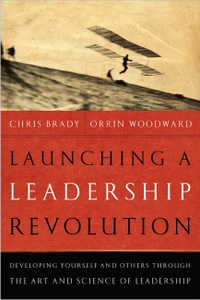
Leadership Revolution pictureI was reading the introduction to a book of quotes on wisdom and was impressed by a page called, “What This Book Will Do for You.”   I want to share with you the thoughts, but change it slightly to make it fit Chris Brady and my leadership blogs.  This introduction captures the essence of why Chris and I write blogs and books.   Here it is:

This self-help leadership blog will give
you a priceless liberal (old meaning of liberal, meaning well rounded in classic literature and thought) education, and it includes the prescriptions for successful living.  Here is a blog that will stimulate your thinking and help you to be successful in your work, your study, and in your everyday living.  The
prescriptions spelled out in these pages, will, if followed, help develop your
inner qualities, for that is where your real wealth is.

Employ your time in improving yourself by other men’s writings so that you shall come easily by what others have labored hard for. – Socrates

This blog is compiled and written for the express purpose of condensing the best thoughts and advice of the greatest men and women in history in the hope that their distilled wisdom will be a guide to inspire you to build a solid bedrock foundation for a better, nobler life. This leadership blog contains some of the most powerful and persuasive utterances of man—words that will inspire, help and delight you.

The short sayings of wise and good men are of great value.  They are like the
dust of gold or the sparkle of the diamond. – Tolstoy

Through the centuries great men and women have stood out like the beacons of a lighthouse to guide and enrich their fellows.  The examples of these greats
live on through the years; everyone can benefit by the trails they have blazed
toward a better life.  No person is great in and of themselves; they must touch the lives of other great beings who will inspire them, lift them, and push them forward.

He is a rich man who can avail himself of all men’s faculties. – Emerson

This leadership blog of wise sayings was undertaken in the belief that there was a need for a blog of practical, everyday, usable sayings, thoughts and articles—that would help modern man develop his full potential and be the person they are capable of being.  If we are to be highly successful in life, we
must look backward to learn from the experience of the greatest minds of the
past, and then apply this wisdom to the greatest fulfillment of our everyday
living.  The experience of the sages coupled with our own gives us the unbeatable combination to reach our worthy goals.

The wisdom of the wise and the experience of the ages are perpetuated by quotation. – Disraeli

Isn’t that a phenomenal introduction of why a leadership blog?  It was so good I had to share it!  Let’s develop and apply wisdom together, so we can make a difference.  God Bless, Orrin Woodward

Posted in All News | 2 Comments »

Presidential Candidates – Taxes and Private Property

Posted by Orrin Woodward on January 18, 2008

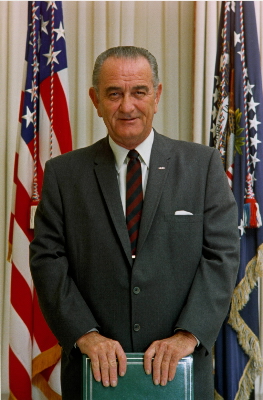
Lyndon Johnson pictureIs there anyone else sick and tired of the continuous increases in our taxes?  The average American works past July 4th before they get to keep their first penny of earnings!  Our founding fathers would be outraged for two important reasons: first, why we let it happen and second, why we haven’t done anything about it?  Does anyone honestly think the answer is to give more funds to the government to take care of our needs?  If you do, let me share with you one of the better documented cases of taxation producing results opposite of intentions.  President Lyndon
Baines Johnson was an influential president with a large ego.  Driven by a desire to leave an enduring legacy, President Johnson declared a national “War on Poverty” with an objective of a “total victory” for his Great Society. 
By its very definition “war” entails the use of violence and we should be concerned when violence is used against someone’s private property to ameliorate someone else’s living conditions.  Economically speaking, anytime poverty is rewarded—more people will become dependent on aid, where they once were dependent on their personal efforts.  Michael Tanner documents:

Since the War on Poverty began in 1965, federal, state, and local governments have spent more than $5.4 trillion fighting poverty in this country.  How
much money is $5.4 trillion?  It is 70% more than it cost to fight World War II.
For $5.4 trillion you could purchase the assets of all the Fortune 500 corporations and all the farmland in the United States.  Yet . . . the poverty rate is actually higher today [1996] than it was in 1965.

Talk about a major investment with a negative return!  Only the government could afford an investment like this.  Would any conventional business be capable of ignoring the investment vs. return on something of this magnitude?
Our politicians ought to accept responsibility and apologize to the American people for their short sighted programs.  The problem with our government is not that it makes mistakes, but that it rarely learns from them.  The more overnment promises, the more they have to take our property to pay the bills.
I am genuinely concerned every time I hear a politician promise some government benefit.  I know that means more moms off to the work place to pay for the politician’s campaign promise.  Richard Pipes conclusions on the alleged “War on Poverty” in his book Property and Freedom, is biting, on the mark and near impossible to describe any better:

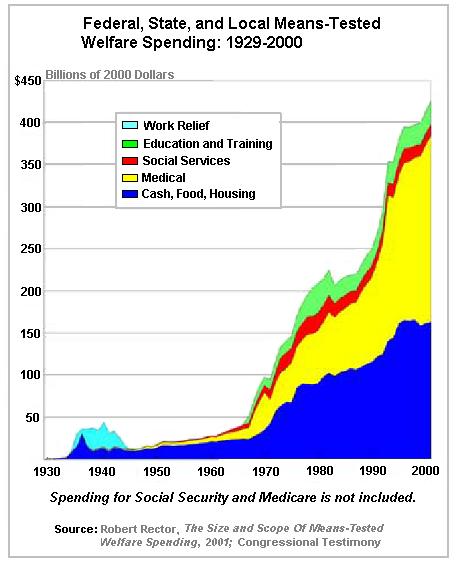
Between the launch of the Great Society in 1965 and 1993, Welfare Spending picture
the percentage of the population living below the poverty line rose from about 12.5 percent to 15 percent.  This has
occurred during a period when welfare spending increased from under $50 billion
annually to $324 billion.  The reason for this unexpected outcome is that welfare fosters dependency and dependency promotes poverty.  This trend is most
obvious in the case of the program of Aid to Families with Dependent Children.  Originally conceived as a way
of assisting widowed mothers, its main effect has been to encourage unmarried women to have children, who become government wards.  Thus, whereas in 1960 only 5.3 percent of births occurred out of wedlock, in 1990 this figure rose to 28 percent; among blacks, it was 65.2 percent.  Ninety-two
percent of families on welfare have no father present.  Bountiful welfare, welfare which does not confine itself to meeting emergencies and situations out of the recipients’ control but attempts artificially to provide them (in FDR’s words) with a “comfortable living,” is not only injurious to the principle of property, an indispensable adjunct of freedom, but self-defeating.

The right to property in and of itself does not guarantee civil rights and liberties.  But historically speaking, it has been the single most effective device
for ensuring both, because it creates an autonomous sphere in which, by mutual consent, neither the state nor society can encroach: by drawing a line between the public and the private, it makes the owner co-sovereign, as it were.  Hence, it is arguably more important than the right to vote.  The weakening of property rights by such devices as wealth distribution for purposes of social welfare and interference with contractual rights for the sake of “civil rights” undermines liberty in the most advanced democracies even as the peacetime accumulation of wealth and the observance of democratic procedures convey the impression that all is well. 

The more money we throw at poverty the more we take people’s self respect—making the problem worse than when we started.  I love people too much to take their belief in themselves’ and their ability to solve their own problems.  Yes, we may struggle at times, but we will learn and grow through the process.  Richard Epstein writes, “With a tax, the government takes property in the narrowest sense of the term, ending up with ownership and possession of that which was once in private hands. . . Taxation is prima facie a taking of private property.”  We must arrest the tax creep going on in American society.  To boil a frog, you slowly increase the temperature.  The frog will adjust to the slight increases and never attempt to jump out of the pan.  In the same way, we have been slow boiled by rising taxes.  Remember, the revolutionary war was started on a tax of less than 1%.  It is time to massively reduce taxes, just like a company would reduce their budget after a failed business line.  The welfare state has failed, socialism has failed, and communism has failed.
The only successful economic system is free enterprise tempered with
Judeo-Christian justice, charity and love.  Winston Churchill said, “The inherent vice of capitalism is the unequal sharing of blessings; the inherent virtue of socialism is the equal sharing of miseries.”  I will take a productive people with the inequalities of wealth associated with people’s different gifts, skills, and work ethic over the envy and laziness associated with a culture that demands equality through coercion.   The welfare state taxes societies’ achievers to give to the past generations temporary poor and in doing so creates a class of permanent under-achievers.  What kind of logic is this? 

Any presidential candidate must address specifically how they plan on reducing government and the multitudinous pork barrel projects now.  No household can afford to run a negative balance for long without paying heavy consequences.  Why do we allow government to routinely do what we would not and cannot do?  We need a mandated balanced budget and some leader willing to make some tough calls to reduce the budget.  I honestly believe that we stand at a precipice—if we continuing to raise taxes, we will destroy the very liberties that made America the land of the free.   Any candidate that is promising all kinds of government benefits is promising to tax Americans today or tax our children tomorrow.  Enough is enough!  Don’t give me unearned benefits—just ensure my opportunity to enter the free enterprise system and my performance will ensure my benefits.  In 1992, I was living in a trailer, but I had a dream and I knew I wasn’t lazy.  I was engaged to be married and excited about the future.  I had plenty to learn, but a willingness to fail and get up and try again.  Don’t give me a handout and take my self respect.  You can give someone encouragement, give someone money, but self respect is an inside job!  Americans are some of the hardest working people and are not looking for hand outs, but hand ups.  The Team is made up of individuals who know, “If it is to be then it is up to me.”  This is what the Team training is all about—teaching people how to help themselves and others.  As Ronald Reagan
said, “America is the last best hope for mankind.”  Are you part of the problem or part of the solution?  God Bless, Orrin Woodward

Update:
I want everyone to know that I believe in a limited government as the founding fathers did.  Limited government means—let the citizens accept responsibility for the greatest sphere of action and only utilize government where no individual or group of individuals can accomplish the task.  Government is by nature a monopoly and when government gets involved in an activity, it very rarely withdraws from the field.  Everyone knows that it is much easier to start a government program than to end one.  The more government is involved, the less money and influence the private sector has in that field.  People naturally learn from mistakes due to the pain of failure, but government rarely learns because they do not experience the same pain of failure as individuals and private companies.  An example would be GM, which
ran like a federal government for years, (and had a budget like some smaller
countries) but is now paying the price for failed policies and learning hard
lessons.  Our federal government when it fails, merely taxes more, increases money supply through inflation or borrows more money—this delays the lessons for our future generations.  I am not the type of person to pass the buck to our future generations and I desire a restoration of the government
principles that made our country great originally!  The founding fathers spelled out their principles of government in the Federalist Papers in three broad
categories:

1. Settling disputes according to the Rule of Law between individuals.

2. Protection from criminals attempting to steal, lie or coerce profits vs. earn them by service.

3. Ensure liberty for all by providing protection from foreign invaders.

God Bless, Orrin Woodward

Posted in Finances, Freedom/Liberty | 5 Comments »

Wikinomics – Creative Destruction

Posted by Orrin Woodward on January 17, 2008

I am reading a book called WIKINOMICS by Tapscott & Williams.  My good friend Bob Dickie III, the CEO of Team, bought it for me for Christmas.  I have not finished it, but the first couple of chapters were enlightening.  The world is changing and the command and control organizations are going the way of the dinosaur.  Peter Senge stated, “The only competitive advantage is your organizations ability to learn faster than the competition.”  I
have stated, “The only way for your organization to consistently learn faster is to engage as many minds in thinking and learning as possible!”  How can you get any faster than engaging the entire world to help you?   Read what the authors said in WIKINOMICS:

A new kind of business is emerging—one that opens its doors to the world, co-innovates with everyone (especially customers), shares resources that were previously guarded, harnesses the power of mass collaboration, and behaves not as a multinational but as something new: a truly global firm. . . The new art and science of wikinomics is based on four powerful new ideas: openness, peering, sharing, and acting globally. 

Corporate Transparency pictureLet’s discuss the first concept today and as I read further, we can
discuss more of the concepts.    When you think of openness, you think of candor, transparency, freedom, flexibility, access, and sharing.  The old industrial age companies believe in confidential information, hierarchical structure from top to bottom, authoritarian command and control, and contracts to control people and other companies.  Today’s informational age companies that make their boundaries porous to external ideas and human capital outperform the dinosaur companies that rely solely on their internal resources and capabilities.   Here is what the authors expressed in their book:

Yet another kind of openness is exploding: the communication of previously secret corporate information to partners, employees, customers and shareholders, and other interested participants.  Transparency—the
disclosure of pertinent information—is a growing force in the network economy. . . People and institutions that interact with firms are gaining unprecedented access to important information about corporate behavior, operations, and performance.  Armed with new tools to find out, inform others, and self-organize, stakeholders are scrutinizing the firm like never before.

Customers can see the true value of products better.  Employees have previously unthinkable knowledge about their firm’s strategy, management,
and challenges.  Partners must have intimate knowledge about each other’s operations to collaborate.  Powerful institutional investors who now own
or manage most wealth are developing x-ray vision.  And in a world of instant communications, whistle-blowers, inquisitive media, and Googling, citizens and communities can easily put firms under the microscope.  

Leading firms are opening up pertinent information to all these groups—because they reap significant benefits from doing so.  Rather than something to be feared, transparency is a powerful new force for business success.  Smart firms embrace transparency and are actively open.  Our research shows that
transparency is critical to business partnerships, lower transaction costs
between firms and speeding up the metabolism of business webs.  Employees of open enterprises have higher trust among each other and with the firm, resulting in lower cost, better innovation, and loyalty. 

Records pictureThe old adage, “information is power” has changed to “information shared is empowering.”   So why do some companies conceal and control all information from their customers?  I talked earlier of the benefits of social capital, but a firm that controls all the information loses its ability to create social capital.  The market today will reward the companies who are open and punish companies who are closed.   It is hard to trust a person or company who
keeps secrets from others.  This is why I love the NY Times test.  If what you are doing cannot be written on the front page of the NY Times, then why are you doing it?   Joseph Schumpeter described free enterprise in a concept he called, “Creative Destruction.”    Creative Destruction according to Mr. Schumpeter is what makes free enterprise so effective in creating long-term
wealth.  The underlying principle is that old wealth and ideas will be replaced by new wealth and ideas.  The new creations will destroy the old businesses.   This has happened numerous times over the years.  Look at the record industry; how is that idea doing today?   How about the carbureted automobile?  Is anyone making money with carbureted cars today?  New ideas and money moved in to create CD’s and fuel injectors. 
The opening thesis of the WIKINOMICS book is: the future will be created by the open and transparent companies and the firms who guard their information will be destroyed.   I strongly believe the future belongs to the company who will learn and adapt the fastest.  Slow companies who guard all the information necessary to improve the company are committing corporate suicide.
Is your company, job, or business in the (Open) information age or the
(Closed) industrial age?   I advise you to take Mr. Schumpeter’s principle of Creative Destruction seriously—it will make all the difference whether you are created or destroyed financially in the information age.  God Bless, Orrin Woodward

Posted in Finances | 1 Comment »

Mavens, Connectors, Salesmen – Malcolm Gladwell

Posted by Orrin Woodward on January 16, 2008

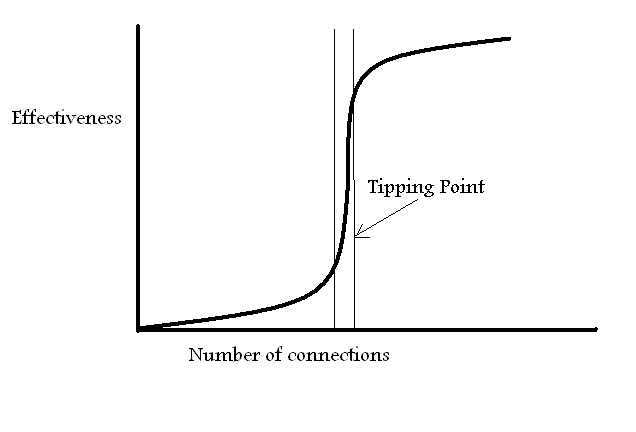
I am re-reading a fantastic book I read several years back called The Tipping Point by Malcolm Gladwell.  I believe the Team is at a tipping point and is about to explode and go mainstream.  Gladwell calls a community tipping point a social epidemic and states that there is only a small percentage (5%) who create it.  Gladwell documents three traits that cause an epidemic: contagiousness, little causes having big effects, and changes happening not
gradually but at one dramatic moment.  The third trait is called a tipping point.  There are three types of people involved in a social epidemic: Connectors, Mavens and Salesmen.  Any business that expects to grow must focus on serving these three crucial catalysts—No business will survive long-term that mistreats these irreplaceable community influencers.  Malcolm states:

In a social epidemic, Mavens are data banks.  They provide the message.  Connectors are social glue: they spread it.  But there is also a select group of
people—Salesmen—with skills to persuade us when we are unconvinced of what we are hearing, and they are critical to the tipping of word-of-mouth epidemics as the other two groups.

Tipping Point picture

To create a tipping point we need the thinking and actions of all three groups.  Not long ago, I attended a conference in Hawaii where I heard Mr. Gladwell speak live.  His concepts of the tipping point are mind expanding and ought to be read and understood by any company expecting to grow their market share.  Let’s read what Gladwell has to say about the three categories of people involved in tipping points.

Connectors

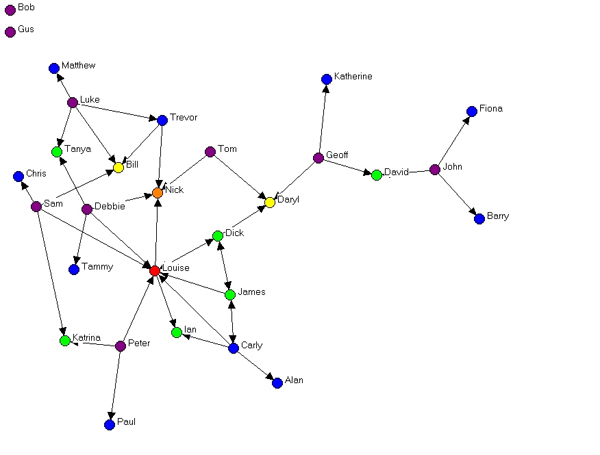
What makes someone a Connector?  The first—and most obvious—criterion is that Connectors know lots of people. . . Six degrees of freedom doesn’t mean everyone is linked to everyone else in just six steps.  It means that a very small number of people are linked to everyone else in a few steps, and the rest of us are linked to the world through those special few. . . . In fact, I go down my list of forty friends, thirty of them, in one way or another, lead back to Jacob.  My social circle is, in reality, not a circle.  It is a pyramid.  And at the top of the pyramid is a single person—Jacob—who is responsible for an overwhelming majority of the relationships that constitute my life. . . These people who link us up with the world, who bridge Omaha and Sharon, who introduce us to our social circles—these people on whom we rely more heavily than we realize—are Connectors, people with a special gift for bringing the world together. 

In the graph below, notice how Louise connects almost every other person.

Connectors Chart picture

Mavens

The word Maven comes from the Yiddish and  it means one who accumulates knowledge.  In recent years, economists have spent a great deal of time studying Mavens, for the obvious reason that if marketplaces depend on information, the people with the most information must be the most important.  For example, sometimes when a supermarket wants to increase sales of a given product, they’ll put a promotion sticker in front of it, saying something like “Everyday Low Price!”  The price will stay the same.  The product will just be featured more prominently.  When they do that, supermarkets find that invariably the sales of the product go through the roof,
the same way they would if the product had actually been put on sale. . .

But if we’ll buy more of something even if the price hasn’t been lowered, then what’s to stop supermarkets from never lowering their prices? . . . The answer is that although most of us don’t look at prices, every retailer knows that a very small number of people do, and if they find something amiss—a promotion that’s not really a promotion—they’ll do something about it.  If a store tried to
pull the sales stunt too often, these are the people who would figure it out and
complain to management and tell their friends and acquaintances to avoid the
store.  These are the people who keep the marketplace honest. . . One name for them is “price vigilantes.”  The other, more common, name for them is  “Market Mavens.”

Salesmen

Part of what it means to have a powerful or persuasive personality, then, is that you can draw others into your own rhythms and dictate the terms of the interaction. . . . I felt I was becoming synchronized with him. . . . But the essence of the Salesmen is that, on some level, they cannot be resisted.
“Tom can build a level of trust and rapport in five to ten minutes that most people will take a half an hour to do,” Moine says of Gau. . . What was
interesting about Gau is the extent to which he seemed to be persuasive in a way quite different from the content of his words.  He seems to have some kind of indefinable trait, something powerful and contagious and irresistible that goes beyond what comes out of his mouth, that makes people who meet him want to agree with him.  It’s energy.  It’s enthusiasm.  It’s charm.  It’s likability.  It’s all those things and yet something more. 

What role will you play in the tipping point of the Team leadership community?  Are you a Connector, Maven or Salesmen/Saleswomen?  Everyone plays a part on our way to 1 million and beyond!  Our communities deserve the best and it is our responsibility to develop our gifts and skills. We all have roles to play and promises to keep!
God Bless, Orrin Woodward

Posted in Life Training | 3 Comments »