Orrin Woodward on LIFE & Leadership

Inc Magazine Top 20 Leader shares his personal, professional, and financial secrets.

  • Orrin Woodward

    1
    Former Guinness World Record Holder for largest book signing ever, Orrin Woodward is a NY Times bestselling author of And Justice For All along with RESOLVED & coauthor of LeaderShift and Launching a Leadership Revolution. His books have sold over one million copies in the financial, leadership and liberty fields. RESOLVED: 13 Resolutions For LIFE made the Top 100 All-Time Best Leadership Books and the 13 Resolutions are the framework for the top selling Mental Fitness Challenge personal development program.

    Orrin made the Top 20 Inc. Magazine Leadership list & has co-founded two multi-million dollar leadership companies. Currently, he serves as the Chairman of the Board of the LIFE. He has a B.S. degree from GMI-EMI (now Kettering University) in manufacturing systems engineering. He holds four U.S. patents, and won an exclusive National Technical Benchmarking Award.

    This blog is an Alltop selection and ranked in HR's Top 100 Blogs for Management & Leadership.

  • Orrin’s Latest Book


  • 7 Day Free Access to Leadership Audios!

  • Email Me

  • NY Times Bestselling Book


  • Mental Fitness Challenge

  • Email Subscription

    Enter your email address to subscribe to this blog and receive notifications of new posts by email.

    Join 2,438 other subscribers
  • Categories

  • Archives

Archive for February, 2008

Bird Feeders & Individual Responsibility

Posted by Orrin Woodward on February 12, 2008

I was sent the following email and I thought it would be good for all the Leadership Blog readers.  I found a website that had the story and some compelling commentary in addition.  Here is the story and the commentary to laugh, think and learn from.  God Bless, Orrin Woodward


Olympus Digital Camera picture“I bought a bird feeder. I hung it on my back porch and filled it with seed. Within a week we had hundreds of birds taking advantage of the continuous flow of free and easily accessible food. But then the birds started building nests in the boards of the patio, above the table, and next to the barbeque. Then came the poop. It was everywhere: on the patio tile, the chairs, the table …… simply everywhere. Then some of the birds turned mean: They would dive bomb me and try to peck even though I had fed them out of my own pocket. And other birds were boisterous and loud: They sat on the feeder and squawked and screamed at all hours of the day and night and demanded that I fill it when it got low on food. After a while, I couldn’t even sit on my own back porch anymore.


I took down the bird feeder and in three days the birds were gone. I cleaned up their mess and took down the many nests they had built all over the patio. Soon, the backyard was like it used to be…. quiet, serene and no one demanding their rights to a free meal.


Now lets see….our government gives out free food, subsidized housing, free medical care, free education and allows anyone born here to be an automatic citizen. Then the illegals came by the tens of thousands. Suddenly our taxes went up to pay for free services; small apartments are housing 5 families: you have to wait 6 hours to be seen by an emergency room doctor: your child’s 2nd grade class is behind other schools because over half the class doesn’t speak English: Corn flakes now come in a bilingual box; I have to press “one” to hear my bank talk to me in English, and people waving flags other than “Old Glory” are squawking and screaming in the streets, demanding more rights and free liberties.


Maybe it’s time for the government to take down the bird feeder?”


We Let This Happen!


The story is funny at first but then the seriousness of its deeper meaning sets in. There is a lot of truth in it and one has to ponder what the roots of this reality are: The answer is simple:


We, the citizens of the United States of America are the roots of this reality! We let it happen! One can argue when it all started, who started it all and what the first element of this reality was.  The fact is that it has happened, not all at once, of course, but in small steps over many, many years. Some people will argue that it all started with Congress passing laws introducing ‘Individual Income Taxes’ in the early 20th century. Most will say it all started with the start of entitlement programs such as Social Security (in the 1930’s), Welfare and Medicare Programs in later years, primarily in the 1960’s and the amendments and enlargements of these and other programs (Food stamps, housing assistance, school lunches etc) in the years since then. It is easy to see that the government’s bird feeder simply got bigger and bigger over the years so that more and more “birdies” could get things for free.


While some programs, especially the Social Security system, were very noble and also needed and were built on contributions over the working life span of all individuals earning a paycheck or making a profit. When Social Security began, there were over thirty people supporting one recipient of such benefits, now there are only three people supporting one recipient. This is scary especially in light of the fact that the so called ‘baby-boomer’ generation will start soon to become recipients of monthly Social Security checks.


What is especially scary about this is the fact that the elected officials in Congress are not willing to seriously address this problem. They have been and continue to play politics with this issue wherein the Democrats will vehemently oppose anything Republicans and especially President Bush propose. On the other hand, the Republicans had control of Congress and did not make real attempts to fix this problem. They rely on estimated projections of when the Social Security trust fund will run out of money and since this date is over thirty years away from now, it is so much easier to leave it for future lawmakers to deal with. An even bigger problem is Medicare, where insolvency is estimated to occur within ten to twelve years from now.


All one can say is Shame on all of them in Congress….No Exceptions!!!  But then, as we stated earlier, it is essentially our fault, we, the people let it happen! The big question is: Will we, the people allow us to keep all the bird feeders we have right now or is it time to take some down and clean up some of the mess they have caused by simply being there.

Posted in Finances | 1 Comment »

The Role of the Entrepreneur – Brian Tracy

Posted by Orrin Woodward on February 9, 2008

I found this great article about the role of the entrepreneur in society and free enterprise by Brian Tracy.  The leaders reading this blog are entrepreneurs.  Study this article and be prepared to constantly improve your business as we move our leadership community to millions of people and change the world!   Brian Tracy has captured the essence of the central role the entrepreneur plays in the economy.  Any company or country that destroys the incentive and motivation of the entrepreneur ends up destroying themselves.  God Bless, Orrin Woodward

Brian Tracy pictureBy understanding your place in the economy, you can better position yourself for success.

Entrepreneurs occupy a central position in a market economy. For it’s the entrepreneurs who serve as the spark plug in the economy’s engine, activating and stimulating all economic activity. The economic success of nations worldwide is the result of encouraging and rewarding the entrepreneurial instinct.

A society is prosperous only to the degree to which it rewards and encourages entrepreneurial activity because it is the entrepreneurs and their activities that are the critical determinant of the level of success, prosperity, growth and opportunity in any economy. The most dynamic societies in the world are the ones that have the most entrepreneurs, plus the economic and legal structure to encourage and motivate entrepreneurs to greater activities.

For years, economists viewed entrepreneurship as a small part of economic activity. But in the 1800s, the Austrian School of Economics was the first to recognize the entrepreneur as the person having the central role in all economic activity. Why is that?

Because it’s entrepreneurial energy, creativity and motivation that trigger the production and sale of new products and services. It is the entrepreneur who undertakes the risk of the enterprise in search of profit and who seeks opportunities to profit by satisfying as yet unsatisfied needs.

Entrepreneurs seek disequilibrium–a gap between the wants and needs of customers and the products and services that are currently available. The entrepreneur then brings together the factors of production necessary to produce, offer and sell desired products and services. They invest and risk their money–and other people’s money–to produce a product or service that can be sold at a profit.

More than any other member of our society, entrepreneurs are unique because they’re capable of bringing together the money, raw materials, manufacturing facilities, skilled labor and land or buildings required to produce a product or service. And they’re capable of arranging the marketing, sales and distribution of that product or service.

Entrepreneurs are optimistic and future oriented; they believe that success is possible and are willing to risk their resources in the pursuit of profit. They’re fast moving, willing to try many different strategies to achieve their goals of profits. And they’re flexible, willing to change quickly when they get new information.

Entrepreneurs are skilled at selling against the competition by creating perceptions of difference and uniqueness in their products and services. They continually seek out customer needs that the competition is not satisfying and find ways to offer their products and services in such a way that what they’re offering is more attractive than anything else available.

Entrepreneurs are a national treasure, and should be protected, nourished, encouraged and rewarded as much as possible. They create all wealth, all jobs, all opportunities, and all prosperity in the nation. They’re the most important people in a market economy–and there are never enough of them.

As an entrepreneur, you are extremely important to your world. Your success is vital to the success of the nation. To help you develop a better business, one that contributes to the health of the economy, I’m going to suggest that you take some time to sit down, answer the following questions, and implement the following actions:

What opportunities exist today for you to create or bring new products or services to your market that people want, need and are willing to pay for? What are your three best opportunities?

Identify the steps you could take immediately to operate your business more efficiently, especially regarding internal operating systems.

Tell yourself continually “Failure is not an option.” Be willing to move out of your comfort zone, to take risks if necessary to build your business.

Use your creativity rather than your money to find new, better, cheaper ways to sell your products or reduce your costs of operation. What could you do immediately in one or both of these areas?

Imagine starting over. Is there anything you’re doing today that, knowing what you now know, you wouldn’t get into or start up again?

Imagine reinventing your business. If your business burned to the ground today, and you had to start over, what would you not get into again? What would you do differently?

Posted in All News | 3 Comments »

Don’t Survive – Thrive in Adversity

Posted by Orrin Woodward on February 6, 2008

Here is a wonderful parable on learning to thrive through adversity.  All of us will go through moments of boiling in our own life.  How we respond to these challenging times will determine our destinies.  Enjoy the parable and ask yourself which of the three items: Carrot, Egg, or Coffee Bean, best describe how you handle the boiling waters of life.   God Bless, Orrin Woodward


Boiling Water pictureYou may never look at a CUP OF COFFEE the same way again. A young woman went to her mother and told her about her life and how things were so hard for her. She did not know how she was going to make it and wanted to give up. She was tired of fighting and struggling. It seemed as one problem was solved a new one arose. Her mother took her to the kitchen. She filled three pots with water and placed each on a high fire. Soon the pots came to a boil. In the first, she placed carrots, in the second she placed eggs and the last she placed ground coffee beans. She let them sit and boil, without saying a word. In about twenty minutes she turned off the burners. She fished the carrots out and placed them in a bowl. She pulled the eggs out and placed them in a bowl. Then she ladled the coffee out and placed it in a bowl. Turning to her daughter, she asked, “Tell me, what do you see?” “Carrots, eggs, and coffee,” she replied. She brought her closer and asked her to feel the carrots. She did and noted that they were soft. She then asked her to take an egg and break it. After pulling off the shell, she observed the hard-boiled egg. Finally, she asked her to sip the coffee. The daughter smiled as she tasted its rich aroma. The daughter then asked, “What does it mean, mother?” Her mother explained that each of these objects had faced the same adversity–boiling water–but each reacted differently. The carrot went in strong, hard and unrelenting. However after being subjected to the boiling water, it softened and became weak. The egg had been fragile. Its thin outer shell had protected its liquid interior. But, after sitting through the boiling water, its inside became hardened. The ground coffee beans were unique, however. After they were in the boiling water they had changed the water. “Which are you?” she asked her daughter.  When adversity knocks on your door, how do you respond? Are you a carrot, an egg, or a coffee bean?” Think of this: Which am I? Am I the carrot that seems strong, but with pain and adversity, do I wilt and become soft and lose my strength? Am I the egg that starts with a malleable heart, but changes with the heat? Did I have a fluid spirit, but after death, a breakup, a financial hardship or some other trial, have I become hardened and stiff? Does my shell look the same, but on the inside am I bitter and tough with a stiff spirit and a hardened heart? Or am I like the coffee bean? The bean actually changes the hot water, the very circumstance that brings the pain. When the water gets hot, it releases the fragrance and flavor. If you are like the bean, when things are at their worst, you can get better and change the situation around you with God’s help. How do you handle adversity? When adversity strikes, ask yourself…ARE YOU A CARROT, AN EGG, OR A COFFEE BEAN?

Posted in All News | 2 Comments »

Multilevel Marketing – MLM/Networking – Benchmarking Study

Posted by Orrin Woodward on February 5, 2008

Here are the definitions for the terms MLM, Network Marketing and Benchmarking. 


Multilevel Marketing (MLM) – or Network Marketing, is a system for selling goods or services through a network of distributors.  The typical Multilevel Marketing program works through recruitment. You are invited to become a distributor, sometimes through another distributor of the Multilevel Marketing Company’s products and sometimes through a generally advertised meeting.  If you choose to become a distributor with the Multilevel Marketing Company, you’ll earn money both through the sales of the MLM’s products and through recruiting other distributors, by receiving a portion of the income these distributors generate.  The distributors that you sign up with your Multilevel Marketing plan are called your downline. The distributor that originally recruited you is called your upline. Often he or she will give you some help getting started, including training.


Network Marketing / MLM – is the sale of a consumer product or service, person-to-person, away from a fixed retail location, basically a home based business.  These products and services are marketed to customers by independent sales consultants. Depending on the company, the salespeople may be called distributors, consultants or various other titles. Products are sold primarily through personal relationships and one-on-one retailing.  Commissions are paid not only to the MLM Consultant that made the sale, but they are also paid to the person who referred that consultant to the Network Marketing Company in the first place.


Benchmarking – A process of searching out and studying the best practices that produce superior performance. Benchmarks may be established within the same organization (internal benchmarking), outside of the organization with another organization that produces the same service or product (external benchmarking), or with reference to a similar function or process in another industry (functional benchmarking).


Benchmarking – The process by which a company compares its own performance, products, and services with those of other organizations that are recognized as the best in a particular category. The product or service that is determined to be the industry standard is known as a benchmark.


Benchmarking – Searching for the best practices or competitive practices that will help define superior performance of a product, service, or support process.  Competitive benchmarking allows a company to know precisely where their operation is in relation to a direct competitor, to determine its competitive position, and to identify major performance gaps.  Process benchmarking searches out the best practices of a particular industry process and compares the performance of the company to a recognized performance leader. It focuses on the process not who the company is or whether or not they are a competitor.


In an industry much like the old (wild) west, with rogue companies, individuals, inflated myths & visions of grandeur—I have committed to separate the fact from fiction in the MLM industry.  As an engineer I was trained by some of the best benchmarking guru’s dating back to Xerox original developments in benchmarking.  Rochester Products, a former division of General Motors had studied extensively at Xerox Corporation located in Rochester on the new techniques (at the time-late 80’s to early 90’s) of benchmarking.  When Rochester division merged with AC/Delco to form AC Rochester, I was exposed to these techniques.   I loved the benchmarking processes developed and devoured all the literature and studies available in the field.  I accepted an assignment in the fuel systems area and through hard work, God’s Providence and an excellent team—we won a National Benchmarking Award.  Through the benchmarking process, I also created or co-created four U.S. Patents.   In my opinion the MLM industry is ripe for an extensive benchmarking study and I have volunteered to do this free of charge.   Almost ten years ago, I would charge rates of three to four thousand a day to do the same studies as an engineering consultant.  Today the rates would be upwards of five to eight thousand per day. 


You may wonder why I have volunteered for this assignment.   I feel that someone needs to perform a public service and improve the prospective business owner’s ability to make the proper choices.  I feel strongly that the future MLM businesses must quit hiding behind a cloak of secrecy and share openly the positive and negative facts about their business and industry.  If something is not positive then fix it!  Right?  Why call everything confidential and trade secret information if you have a good business?   If it is good then the last thing you would want is to keep it a secret!   If the facts are negative then no wonder the company would want to keep everything top secret and confidential.  It is time to shed some light on the good and bad of this industry and take it out of the old (wild) west stage and into a more civilized mainstream business occupation.  

The benchmarking process falls into four systematic steps:


1.  Identify –Identify all companies and processes to be studied.

2. Evaluate – Develop the criteria to evaluate from each company.

3. Analyze – Study the data and let the facts speak for themselves.

4. Implement – Announce the best practices and best companies as benchmarks.


This process works in any problem solving endeavor and I count my blessings that I was exposed to this process as a 23 year old engineer.   I will share more details on the four step process and MLM specific criteria chosen for the MLM Benchmarking Project.  God Bless, Orrin Woodward

Posted in All News | Comments Off on Multilevel Marketing – MLM/Networking – Benchmarking Study

A Parable of a Child – Power of Expectation

Posted by Orrin Woodward on February 5, 2008

I read a beautiful parable today from Steve Goodier.  Everyone one of us has an impact in others lives.  The only question is, will it be a positive or negative impact?  What makes this leadership community so special to me is the amount of people focused on making a positive impact in others lives.  This has to be the most other-people centered community on the web!  I am proud of each and every one of the readers of this blog and know the future is bright for this servant leadership spirit.  Enjoy the article and think of the students are you influencing in your life.  Students can be any age, because you are a student when you are hungry to learn.  God Bless, Orrin Woodward


“There is a difference between education and experience. Education is what you get from reading the small print. Experience is what you get from not reading it!


But isn’t it true that great learning comes from both education and experience? Let me tell you a parable:


Child and Chess pictureA young school teacher had a dream that an angel appeared to him and said, “You will be given a child who will grow up to become a world leader. How will you prepare her so that she will realize her intelligence, grow in confidence, develop both her assertiveness and sensitivity, be open-minded, yet strong in character? In short, what kind of education will you provide that she can become one of the world’s truly GREAT leaders?”


The young teacher awoke in a cold sweat. It had never occurred to him before—any ONE of his present or future students could be the person described in his dream. Was he preparing them to rise to ANY POSITION to which they may aspire? He thought, ‘How might my teaching change if I KNEW that one of my students were this person?’ He gradually began to formulate a plan in his mind.


This student would need experience as well as instruction. She would need to know how to solve problems of various kinds. She would need to grow in character as well as knowledge. She would need self-assurance as well as the ability to listen well and work with others. She would need to understand and appreciate the past, yet feel optimistic about the future. She would need to know the value of lifelong learning in order to keep a curious and active mind. She would need to grow in understanding of others and become a student of the spirit. She would need to set high standards for herself and learn self discipline, yet she would also need love and encouragement, that she might be filled with love and goodness.


His teaching changed. Every young person who walked through his classroom became, for him, a future world leader. He saw each one, not as they were, but as they could be. He expected the best from his students, yet tempered it with compassion. He taught each one as if the future of the world depended on his instruction.


After many years, a woman he knew rose to a position of world prominence. He realized that she must surely have been the girl described in his dream. Only she was not one of his students, but rather his daughter. For of all the various teachers in her life, her father was the best.


I’ve heard it said that “Children are living messages we send to a time and place we will never see.” But this isn’t simply a parable about an unnamed school teacher. It is a parable about you and me — whether or not we are parents or even teachers. And the story, OUR story, actually begins like this:


“You will be given a child who will grow up to become….” You finish the sentence. If not a world leader, then a superb father? An excellent teacher? A gifted healer? An innovative problem solver? An inspiring artist? A generous philanthropist?


Where and how you will encounter this child is a mystery. But believe that one child’s future may depend upon influence only you can provide, and something remarkable will happen. For no young person will ever be ordinary to you again. And you will never be the same.

Posted in All News | Comments Off on A Parable of a Child – Power of Expectation

Presidential Candidates 2008 – Ronald Reagan Test

Posted by Orrin Woodward on February 4, 2008

Let’s follow up Ronald Reagan’s leadership post with another on how his thoughts produced actions.  My basic thesis is that how a person thinks in their own mind will flow into their actions in their life.  As a leader, it will flow into the culture they create in everything that they lead.  Reagan believed strongly in the power of the individual to govern their life better than any third party.   This belief propelled him from a small town Illinois kid to a Hollywood star, Governor of California, and President of the United States.  Not only must we give people freedom, but we must teach people how to think about their freedoms and corresponding responsibilities.  This is why the free enterprise system cannot just be transplanted into the former communist countries without some world-view changes. 


Reagan made America freer after years of less freedom, but he also cast a vision for America.  He made Americans proud to be Americans again.  One of the most important things the President does is cast a vision from their world-view.  This is why I believe understanding how a person views themselves and the individual will tell us what they feel government’s role is.   Because Reagan believed in himself, America, and the individual—he felt his main role in government was to reduce its pervasiveness in our lives.  I will allow Reagan to speak for himself, but notice how his thoughts led to his words which led to his style of government.   In my opinion, Reagan’s views of government and the success of his administration prove that a modern president can lead with the same principles that guided our founding fathers.   This is a huge point for Americans to understand as they listen to the candidates to understand their world-view.   Here is Reagan in his own words from his autobiography, An American Life.


Reagan Berlin Wall picture“The first rule of bureaucracy is to protect the bureaucracy.  If the people running the welfare program had let their clientele find other ways of making a living, that would have reduced their importance and their budget.”


“I didn’t think much of the inefficiency, empire building, and business-as-usual attitude that existed in wartime under the civil service system.  If I suggested that an employee might be expendable, his supervisor would look at me as if I were crazy.  He didn’t want to reduce the size of his department; his salary was based to a large extent on the number of people he supervised.  He wanted to increase it, not decrease it.”


“There probably isn’t any undertaking on earth short of assuring the national security that can’t be handled more efficiently by the forces of private enterprise than by the federal government.”


“I became convince that some of our fundamental freedoms were in jeopardy because of the emergence of a permanent government never envisioned by the framers of the Constitution: a federal bureaucracy that was becoming so powerful it was able to set policy and thwart the desires not only of ordinary citizens, but heir elected representatives in Congress. . . For example, I learned the government had six programs to help poultry growers increase egg production.  It also had a seventh program costing almost as much as all six others to buy up surplus eggs.”

“No government has ever voluntarily reduced itself in size.”


“No nation in history has ever survived a tax burden that reached a third of its national income.”


“Usually with the best of intentions, Congress passed a new program, appropriated the money for it, then assigned bureaucrats in Washington to disperse the money; almost always, the bureaucrats responded by telling states, cities, counties, and schools how to spend this money.  In Madison’s words, Washington was usurping power form the states by the “gradual and silent encroachment of those in power. . . . Over time, they became so dependent on the money that, like junkies, they found it all but impossible to break the habit, and only after they were well addicted to it did they learn how pervasive the federal regulations were that came with the money.”


Ronald Reagan Speaking picture“In return for federal grants, state and local governments surrendered control of their destiny to a faceless bureaucracy in Washington that claimed to know better how to solve the problems of a city or town than the people who lived there. . . . Once started, a federal program benefitting any group or special interest is virtually impossible to end and the costs go on forever.”


“We had strayed a great distance from our founding father’s vision of America: They regarded the central government’s responsibility as that of providing a national security, protecting our democratic freedoms, and limiting the government’s intrusion into our lives—in sum, the protection of life, liberty and the pursuit of happiness.  They never envisioned vast agencies in Washington telling our farmers what to plant, our teachers what to teach, or industries what to build.  The Constitution they wrote established sovereign states, not administrative districts of the federal government.”


“The waste in dollars and cents was small compared with the waste of human potential.  It was squandered by the narcotic of giveaway programs that sapped the human spirit, diminished the incentive of people to work, destroyed families, and produced an increase in female and child poverty, deteriorating schools, and disintegrating neighborhoods.”


“My theme on the campaign stump was familiar to anyone who had heard me speak over the years: It was time to scale back the size of the federal government, reduce taxes and government intrusion in our lives, balance the budget, and return to the people the freedoms usurped from them by the bureaucrats.”


“If no one among us is capable of governing himself, then who among us has the capacity to govern someone else?”


“The same principle that affected my thinking applied to people in all tax brackets:  The more government takes in taxes, the less incentive people have to work.  What coal miner or assembly-line worker jumps at the offer of overtime when he knows Uncle Sam is going to take sixty percent or more of his extra pay?”


“I don’t think we will solve the problem of the deficit until three things happen:  We need more discipline on spending in Congress.  We need a constitutional amendment requiring Congress to balance the budget.  And we need to give our president’s a line-item veto.”


“As I have often said, governments don’t produce economic growth, people do.  What government can do is encourage Americans to tap their well of ingenuity and unleash their entrepreneurial spirit, then get out of the way.”


“Every year that I was president, I asked Congress for a constitutional amendment that would require the federal government—like any well-run household or business—to balance its budget.  But Congress (and I concede there was opposition to it on both sides of the political aisle) wouldn’t sit still for this infringement on its spendthrift ways.  There was some important progress: . . . . But never underestimate the willingness of congressman to circumvent their own rules, or the public will, in the pursuit of their enthusiasm to spend other people’s money.”


“It is a fact of life that running for political office in this country is very expensive; once in office, few incumbents want to surrender their seats in Congress, so they often trun to the special interest, who want special consideration from them, for the money to finance their campaigns.  Then, after the election, they repay the favors—with the taxpayers’ money.”


“Until presidents have a line-item veto and there is a constitutional amendment mandating a balanced budget, I think the country is likely to face never-ending deficits piled up by a profligate Congress unable or unwilling to make the hard-nosed decisions necessary to bring down spending to a level the country can afford.”


“As I have often said, governments don’t produce economic growth, people do.  What governments can do is encourage Americans to tap their well of ingenuity and unleash their entrepreneurial spirit, then get out of the way.”


“For the free market to work, everyone has to compete on an equal footing.  That way, prices and demand go up or down based on free choices of people; there are winners and losers under the system of free competition, but consumers are ultimately benefactors.
Free competition produces better products and lower prices.  However, when governments fix or control the price, impose quotas, subsidize manufacturers or farmers, or otherwise intervene in the free market with artificial restrictions, it isn’t free and it won’t work as it is supposed to work.”

“The explorers of the modern era are the entrepreneurs, men with vision, with the courage to take risks and faith enough to brave the unknown. These entrepreneurs and their small enterprises are responsible for almost all the economic growth in the United States. They are the prime movers of the technological revolution. In fact, one of the largest personal computer firms in the United states was started by two college students, no older than you, in the garage behind their home.  Some people, even in my own country, look at the riot of experiment that is the free market and see only waste. What of all the entrepreneurs that fail? Well, many do, particularly the successful ones. Often several times. And if you ask them the secret of their success, they’ll tell you, it’s all that they learned in their struggles along the way – yes, it’s what they learned from failing. Like an athlete in competition, or a scholar in pursuit of the truth, experience is the greatest teacher.”

There is Reagan in his own words.  Can you see how Reagan’s worldview led to a specific style of government based on the freedom of the people to learn, grow, fail and try again until they get it right?  This is what we desire for our children and grandchildren—the opportunity to grow and lead by their own merits.  I encourage everyone to study the candidates and give them the Reagan test for their thoughts on the role of government.  God Bless, Orrin Woodward

Posted in Freedom/Liberty | 1 Comment »

God or Mammon – Dr. Martyn Lloyd-Jones

Posted by Orrin Woodward on February 3, 2008

Martyn Lloyd Jones pictureDr Martyn Lloyd-Jones was a man of God who preached from the Bible at Westminster Chapel in London.  I can personally tell you his two classic books—Sermon on the Mount and Spiritual Depression—changed my thinking and life.  Lloyd-Jones sermons go past the mind and hit your heart.  Nothing convicts me as much as reading a Lloyd-Jones sermon on a Biblical text.  I will provide this example entitled God or Mammon.  Remember, the goal of Sunday’s articles is to get you to think about eternity and eternal things.  Don’t read this quickly, but digest contents of his sermon and examine your heart.  Here is where I found the sermon article on the web.  Worshiping God, loving others and thinking on His calling in our life is what Sundays are all about.  Count your blessing and enjoy your Sunday.   God Bless, Orrin Woodward


Do not lay up for yourselves treasures on earth, where moth and rust corrupt, and where thieves break through and steal, but lay up for yourselves treasures in heaven, where neither moth nor rust corrupt, and where thieves do not break through nor steal. For where your treasure is, there will your heart be also. The light of the body is the eye. If therefore your eye is single, your whole body shall be full of light. But if your eye is evil, your whole body shall be full of darkness. If therefore the light that is in you be darkness, how great is that darkness! No man can serve two masters, for either he will hate the one, and love the other, or else he will hold to the one, and despise the other. You cannot serve God and mammon (Matthew 6.19-24).


In our analysis of verses 19-24 we have seen that our Lord first of all lays down a proposition or a commandment, “Do not lay up for yourselves treasures on earth … but lay up for yourselves treasures in heaven.” In other words, He tells us that we are so to live in this world, and so to use everything we have, whether our possessions, or gifts, or talents, or propensities, that we shall be laying up for ourselves treasures in heaven.


Then, having given us the injunction in that way, our Lord proceeds to supply us with reasons for doing this. I would remind you again that here we have an illustration of the wonderful condescension and understanding of our blessed Lord. He has no need to give us reasons. It is for Him to command. But He stoops to our weakness, mighty as He is, and He comes to our aid and supplies us with these reasons for carrying out His commandment.


Westminster Chapel pictureHe does so in a very remarkable manner. He elaborates the reasons and presses them on our consideration. He does not merely give us one reason. He gives us a number. He works it out for us in a series of logical propositions, and, of course, there can be no doubt at all but that He does this, not only because He is anxious to help us, but also, and still more perhaps, because of the desperate seriousness of the subject with which He is dealing. Indeed, we shall see that this is one of the most serious matters which we can ever consider together.


Again we must remember that these words were addressed to Christian people. This is not what our Lord has to say to the unbeliever out in the world. This is the warning that He gives to the Christian. We are dealing here with the subject of worldliness, or worldly-mindedness, and the whole problem of the world, but we must cease to think of it in terms of people who are in the world outside. This is the peculiar danger of Christian people. At this point our Lord is dealing with them and nobody else.


You can argue if you like that if all this is true for the Christian, it is much more so for the non-Christian. That is a perfectly fair deduction. But there is nothing so fatal and tragic as to think that words like these have nothing to do with us because we are Christians. Indeed, this is perhaps the most urgent word that is needed by Christian people at this very moment. The world is so subtle, worldliness is such a pervasive thing, that we are all guilty of it, and often without realizing it. We tend to label worldliness as meaning certain particular things only, and always the things of which we are not guilty. We therefore argue that this has nothing to say to us.


But worldliness is all-pervasive, and is not confined to certain things. It does not just mean going to theatres or cinemas, or doing a few things of that nature. No, worldliness is an attitude towards life. It is a general outlook, and it is so subtle that it can come into the most holy things of all, as we saw earlier.


We might digress here for a moment and look at this subject from the standpoint of the great political interest in this country, particularly, for example, at the time of a General Election. What, in the last analysis, is the real interest? What is the real thing that people on both sides and all sides are concerned about? They are interested in “treasures on earth”, whether they be people who have treasures or whether they be people who would like to have them. They are all interested in the treasures, and it is most instructive to listen to what people say, and to observe how they betray themselves and the worldliness of which they are guilty, and the way in which they are laying up for themselves treasures on earth.


To be very practical (and if the preaching of the gospel is not practical it is not true preaching), there is a very simple test which we can apply to ourselves to see whether these things apply to us or not. When, at the time of a General or local Election, we are called on to make a choice of candidates, do we find ourselves believing that one political point of view is altogether right and the other altogether wrong? If we do, I suggest we are somehow or another laying up for ourselves treasures on earth. If we say that the truth is altogether on one side or the other, then if we analyze our motives we will discover it is because we are either protecting something or anxious to have something.
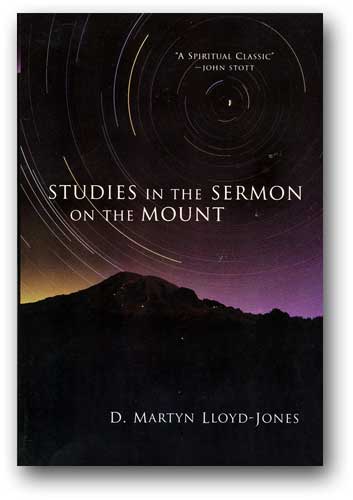
 

Sermonon the Mount pictureAnother good way of testing ourselves is to ask ourselves quite simply and honestly why we hold our particular views. What is our real interest? What is our motive? What, when we are quite honest and truthful with ourselves, is really at the back of these particular political views that we hold? It is a most illuminating question if we are really honest. I suggest that most people will find if they face that question quite honestly, that there are some treasures on earth about which they are concerned, and in which they are interested.


The next test is this. To what extent are our feelings engaged in this matter? How much bitterness is there, how much violence, how much anger and scorn and passion? Apply that test, and again we shall find that the feeling is aroused almost invariably by the concern about laying up treasures on earth.


The last test is this. Are we viewing these things with a kind of detachment and objectivity or not? What is our attitude towards all these things? Do we instinctively think of ourselves as pilgrims, and mere sojourners in this world, who of course have to be interested in these things while we are here? Such an interest is certainly right, it is our duty. But what is our ultimate attitude? Are we controlled by it? Or do we stand apart and regard it objectively, as something which is ephemeral, something which does not really belong to the essence of our life and being, something with which we are concerned only for a while, as we are passing through this life?


We should ask ourselves these questions in order that we may make quite certain whether this injunction of our Lord is speaking to us. Those are some of the ways in which we can find out very simply whether we are or are not guilty of laying up for ourselves treasures on earth, and not laying up for ourselves treasures in heaven.


When we come to consider our Lord’s arguments against laying up treasures on earth, we find that the first is one which we may very well describe as the argument of common sense, or of ordinary observation. “Lay not up for yourselves treasures upon earth.” Why? For this reason: “where moth and rust corrupt, and where thieves break through and steal”. But why should I lay up treasures in heaven? For this reason: “where neither moth nor rust corrupt, and where thieves do not break through nor steal”.


Our Lord is saying that worldly treasures do not last, that they are transitory, passing, ephemeral. “Change and decay in all around I see.” “Where moth and rust corrupt.”


How true it is. There is an element of decay in all these things, whether we like it or not. Our Lord puts it in terms of the moth and rust that tend to lodge themselves in these things and destroy them. Spiritually we can put it like this. These things never fully satisfy. There is always something wrong with them. They always lack something. There is no person on earth who is fully satisfied, and though in a sense some may appear to have everything that they desire, still they want something else. Happiness cannot be purchased.


There is, however, another way of looking at the effect of moth and rust spiritually. Not only is there an element of decay in these things, it is also true that we always tend to tire of them. We may enjoy them for a while, but somehow or other they begin to pall or we lose interest in them. That is why we are always talking about new things and seeking them. Fashions change. And though we are very enthusiastic about certain things for a while, soon they no longer interest us as they did. Is it not true that as age advances these things cease to satisfy us? Old people generally do not like the same things as young people, or the young the same as the old. As we get older these things seem to become different, there is an element of moth and rust.


We could even go further and put it more strongly and say that there is an impurity in them. At their best they are all infected. Do what you will you cannot get rid of the impurity. The moth and rust are there and all your chemicals do not stop these processes. Peter says a wonderful thing in this very connection, “Whereby are given to us exceeding great and precious promises; that by these you might be partakers of the divine nature, having escaped the corruption that is in the world through lust” (2 Peter 1.4). There is corruption in all these earthly things; they are all impure.


The last fact, therefore, about these things is that they inevitably perish. Your most beautiful flower is beginning to die immediately you pluck it. You will soon have to throw it away. That is true of everything in this life and world. It does not matter what it is, it is passing, it is all fading away. Everything that has life is, as the result of sin, subject to this process -“moth and rust corrupt”. Things develop holes and become useless, and at the end they are gone and become utterly corrupt. The most perfect physique will eventually give way and break down and die. The most beautiful countenance will in a sense become ugly when the process of corruption has got going. The brightest gifts tend to fade. Your great genius may be seen gibbering in delirium as the result of disease. However wonderful and beautiful and glorious things may be, they all perish. That is why, perhaps, the saddest of all failures in life is the failure of the philosopher who believes in worshipping goodness, beauty and truth. Because there is no such thing as perfect goodness, there is no such thing as unalloyed beauty, there is an element of wrong and of sin and a lie in the highest truths. “Moth and rust corrupt.”


“Yes,” says our Lord, “and thieves break through and steal.” We must not stay with these things, they are so obvious, and yet we are so slow to recognize them. There are many thieves in this life and they are always threatening us. We think we are safe in our house, but we find thieves have broken in and ransacked it. Other marauders are always threatening us—illness, a business loss, some industrial collapse, war and finally death itself. It matters not what it is that we tend to hold on to in this world, one or other of these thieves is always threatening and will eventually take it from us.
 

Spiritual Depression pictureIt is not only money. It may be some person for whom you are really living, your pleasure is in that one person. Beware, my friends; there are robbers and thieves who are bound to come and eventually rob you of these possessions. Take our possessions at their highest as well as their lowest, they are all subject to these robbers, these attacks. “The thieves break through and steal”, and we cannot prevent them. So our Lord appeals to our common sense, and reminds us that these worldly treasures never last. “Change and decay in all around I see.”


But look at the other, positive side. “Lay up for yourselves treasures in heaven, where neither moth nor rust corrupt, and where thieves do not break through nor steal.” This is wonderful and full of glory. Peter puts it in a phrase. He says “to an inheritance incorruptible, and undefiled, and that fades not away, reserved in heaven for you” (1 Peter 1.4). “The things which are not seen are eternal,” says St. Paul, it is the things which are seen that are temporal (2 Corinthians 4.18). These heavenly things are imperishable and the thieves cannot break through and steal. Why? Because God Himself is reserving them for us. There is no enemy that can ever rob us of them, or can ever enter in. It is impossible because God Himself is the Guardian.


Spiritual pleasures are invulnerable, they are in a place which is impregnable. “I am persuaded, that neither death, nor life, nor angels, nor principalities, nor powers, nor things present, nor things to come, nor height, nor depth, nor any other creature, shall be able to separate us from the love of God, which is in Christ Jesus our Lord” (Romans 8.38, 39).


Furthermore, there is nothing impure there. Naught that corrupts shall enter in. There is no sin there, nor element of decay. It is the realm of eternal life and eternal light. He dwells “in the light which no man can approach to”, as the apostle Paul puts it (1 Timothy 6.16). Heaven is the realm of life and light and purity, and nothing belonging to death, nothing tainted or polluted can gain admission there. It is perfect, and the treasures of the soul and of the spirit belong to that realm. Lay them up there, says our Lord, because there is no moth nor rust there, and no thief can ever break through nor steal.


It is an appeal to common sense. Do we not know that these things are true? Are they not true of necessity? Do we not see it all as we live in this world? Take up your morning newspaper and look at the death column. Look at all that is happening. We know all these things. Why do we not practice them and live accordingly? Why do we lay up treasures on earth when we know what is going to happen to them? And why do we not lay up treasures in heaven where we know that there is purity and joy, holiness and everlasting bliss?


That, however, is merely the first argument, the argument of common sense. But our Lord does not stop at that. His second argument is based upon the terrible spiritual danger involved in laying up treasures on earth and not in heaven. That is a general heading, but our Lord divides it into certain sub-sections.


The first thing against which He warns us in this spiritual sense is the awful grip and power of these earthly things upon us. You notice the terms He uses. He says, “Where your treasure is, there will your heart be also.” The heart! Then in verse 24 He talks about the mind. “No man can serve two masters” – and we should notice the word “serve”. These are the expressive terms He uses in order to impress upon us the terrible control that these things tend to exercise over us. Are we not all aware of them the moment we stop to think – the tyranny of persons, the tyranny of the world? This is not something we can think about at a distance as it were. We are all involved in this. We are all in the grip of this awful power of worldliness which really will master us unless we are aware of it.


But it is not only powerful, it is very subtle. It is the thing that really controls most men’s lives. Have you seen the change, the subtle change that tends to take place in men’s lives as they succeed and prosper in this world? It does not happen to those who are truly spiritual men, but if they are not, it invariably happens. Why is it that idealism is generally associated with youth and not with middle age and old age? Why do men tend to become cynical as they get older? Why does the noble outlook upon life tend to go? It is because we all become victims of treasures on earth, and if you watch you can see it in the lives of men.


Read the biographies. Many a young man starts out with a bright vision, but in a very subtle way – not that he falls into gross sin – he becomes influenced, perhaps when he is at college, by an outlook that is essentially worldly. Though it may be highly intellectual, he nevertheless loses something that was vital in his soul and spirit. He is still a very nice man and, moreover, just and wise, but he is not the man he was when he began. Something has been lost. Yes, this is a familiar phenomenon: “Shades of the prison house begin to close upon the growing boy.” Do we not all know something about it? It is there. It is a prison house, and it fastens itself on us unless we are aware of it. This grip, this power, masters us and we become slaves.


However, our Lord does not stop at the general. He is so anxious to show us this terrible danger that He works it out in detail. He tells us that this terrible thing that grips us tends to affect the entire personality, not merely part of us, but the whole man. And the first thing He mentions is the “heart”. Having laid down the injunction He says, “For where your treasure is, there will your heart be also.” These things grip and master our feelings, our affections and all our sensibility. All that part of our nature is absolutely gripped by them and we love them. Read John 3.19. “This is the condemnation, that light is come into the world, and men loved darkness rather than light, because their deeds were evil.” We love these things. We pretend that we only like them, but really we love them. They move us deeply.


The next thing about them is a little more subtle. They not only grip the heart, they grip the mind. Our Lord puts it in this way: “The light of the body is the eye. If therefore your eye be single, your whole body will be full of light. But if your eye be evil, your whole body will be full of darkness. If therefore the light that is in you is darkness, how great is that darkness!” (verses 22, 23). This picture of the eye is just His way of describing, by means of an illustration, the way in which we look at things. And according to our Lord, there are but two ways of looking at everything in this world.


There is what He calls the “single” eye, the eye of the spiritual man who sees things really as they are, truly and without any double view. His eye is clear and he sees things normally. But there is the other eye which He calls the “evil” eye, which is a kind of double vision, or, if you like, it is the eye in which the lenses are not clear. There are mists and opacities and we see things in a blurred way. That is the evil eye. It is colored by certain prejudices, colored by certain lusts and desires. It is not a clear vision. It is all cloudy, colored by these various tints and taints. That is what is meant by this statement which has so often confused people, because they do not take it in its context.


Our Lord in this picture is still dealing with the laying up of treasures. Having shown that where the treasure is, the heart will be also, He says that it is not only the heart but the mind as well. These are the things that control man.


Let us work out this principle. Is it not amazing to notice how much of our thought is based on these earthly treasures? The divisions in thought in almost every realm are almost entirely controlled by prejudice, not by pure thought. How very little thinking there is in this country at the time of a General Election for example. None of the protagonists reason. They simply present prejudices. How little thought there is on every side. It is so obvious in the political realm. But alas, it is not confined to politics. This blurring of the vision by love of earthly treasures tends to affect us morally also! How clever we all are at explaining that a particular thing we do is not really dishonest. Of course if a man smashes a window and steals jewelry he is a robber, but if I just manipulate my income tax return …. ! Certainly that is not robbery, we say, and we persuade ourselves that all is well. Ultimately there is but one reason for our doing these things, and that is our love of earthly treasures. These things control the mind as well as the heart. Our views and our whole ethical outlook are controlled by these things.


Even worse than that, however, our religious outlook is controlled by these things also. “Demas has forsaken me”, writes Paul. Why? “Having loved this present world.” How often this is seen in the matter of service. These are the things that determine our action, though we do not recognize it. Our Lord says in another place, “Take heed to yourselves, lest at any time your hearts be overcharged with surfeiting, and drunkenness, and cares of this life, and so that day come upon you unawares. For as a snare shall it come on all them that dwell on the face of the whole earth. Watch you therefore, and pray always, that you may be accounted worthy to escape all these things that shall come to pass, and to stand before the Son of man” (Luke 21.34-36). It is not only evil doing that dulls the mind and makes us incapable of thinking clearly. The cares of this world, settling down in life, enjoying our life and our family, any one of these things, our worldly position or our comforts – these are equally as dangerous as surfeiting and drunkenness. There is no doubt but that much of the so-called wisdom which men claim in this world is nothing, in the last analysis, but this concern about earthly treasures.


But lastly, these things not only grip the heart and mind, they also affect the will. Says our Lord, “No man can serve two masters”; and the moment we mention the word “serve” we are in the realm of the will, the realm of action. You notice how perfectly logical this is. What we do is the result of what we think, so what is going to determine our lives and the exercise of our wills is what we think, and that in turn is determined by where our treasure is – our heart.


So we can sum it up like this. These earthly treasures are so powerful that they grip the entire personality. They grip a man’s heart, his mind and his will. They tend to affect his spirit, his soul and his whole being. Whatever realm of life we may be looking at, or thinking about, we will find these things are there. Everyone is affected by them. They are a terrible danger.


But the last step is the most solemn and serious of all. We must remember that the way in which we look at these things ultimately determines our relationship to God. “No man can serve two masters, for either he will hate the one, and love the other; or else he will hold to the one, and despise the other. You cannot serve God and mammon.” This is indeed a very solemn thing, and that is why it is dealt with so frequently in Scripture. The truth of this proposition is obvious. Both make a totalitarian demand upon us. Worldly things really do make a totalitarian demand as we have seen. How they tend to grip the entire personality and affect us everywhere! They demand our entire devotion. They want us to live for them absolutely.


Yes, but so does God. “You shall love the Lord your God with all your heart, and with all your soul, and with all your mind, and with all your strength.” Not in a material sense necessarily, but in some sense or other He says to us all, “Go, sell all that you have, and come, follow me.” “He who loves father or mother more than me is not worthy of me, and he that loves son or daughter more than me is not worthy of me.” It is a totalitarian demand.


Notice it again in verse 24. “Either he will hate the one, and love the other, or else he will hold to the one, and despise the other.” It is “either—or”. Compromise is completely impossible at this point. “You cannot serve God and mammon.”


This is something which is so subtle that many of us miss it completely at the present time. Some of us are violent opponents of what we speak of as “atheistic materialism”. But lest we may feel too happy about ourselves because we are opponents of that, let us realize that the Bible tells us that all materialism is atheistic. You cannot serve God and mammon. It is impossible. So if a materialistic outlook is really controlling us, we are godless, whatever we may say. There are many atheists who speak religious language, but our Lord tells us here that even worse than atheistic materialism is a materialism that thinks it is godly. “If the light that is in you be darkness, how great is that darkness!”


The man who thinks he is godly because he talks about God, and says he believes in God, and goes to a place of worship occasionally, but is really living for certain earthly things – how great is that man’s darkness! There is a perfect illustration of that in the Old Testament. Study carefully 2 Kings 17.24-41. Here is what we are told. The Assyrians conquered some area. Then they took their own people and settled them in that area. These Assyrians of course did not worship God. Then some lions came and destroyed their property. “This”, they said, “has happened to us because we do not worship the God of this particular land. We will get priestly instruction on this.” So they found a priest who instructed them generally in the religion of Israel. And then they thought that all would be well. But this is what Scripture said about them, they “feared the Lord, and served their graven images.”


What a terrible thing that is. It alarms me. It is not what we say that matters. In the last day many shall say, “Lord, Lord, have we not done this, that and the other?” But He will say to them, “I never knew you”. “Not every one who says to me Lord, Lord, will enter into the kingdom of heaven, but he who does the will of my Father.” Whom do you serve? That is the question, and it is either God or mammon. There is nothing in the last analysis that is so insulting to God as to take His name on us and yet to show clearly that we are serving mammon in some shape or form. That is the most terrible thing of all. It is the greatest insult to God; and how easily and unconsciously we can all become guilty of this.


I remember once hearing a preacher tell a story which he assured us was simple, literal truth. It illustrates perfectly the point which we are considering. It is the story of a farmer who one day went happily and with great joy in his heart to report to his wife and family that their best cow had given birth to twin calves, one red and one white. And he said, “You know I have suddenly had a feeling and impulse that we must dedicate one of these calves to the Lord. We will bring them up together, and when the time comes we will sell one and keep the proceeds, and we will sell the other and give the proceeds to the Lord’s work.”


His wife asked him which he was going to dedicate to the Lord. “There is no need to bother about that now,” he replied, “we will treat them both in the same way, and when the time comes we will do as I say.” And off he went. In a few months the man entered his kitchen looking very miserable and unhappy. When his wife asked him what was troubling him, he answered, “I have bad news to give you. The Lord’s calf is dead.” “But”, she said, “you had not decided which was to be the Lord’s calf.” “Oh yes,” he said, “I had always decided it was to be the white one, and it is the white one that has died. The Lord’s calf is dead.”


We may laugh at that story, but God forbid that we should be laughing at ourselves. It is always the Lord’s calf that dies. When money becomes difficult, the first thing we economize on is our contribution to God’s work. It is always the first thing to go. Perhaps we must not say “always”, for that would be unfair, but with so many it is the first thing, and the things we really like are the last to go. “We cannot serve God and mammon.” These things tend to come between us and God, and our attitude to them ultimately determines our relationship to God.


The mere fact that we believe in God, and call Him, Lord, Lord, and likewise with Christ, is not proof in and of itself that we are serving Him, that we recognize His totalitarian demand, and have yielded ourselves gladly and readily to Him. “Let every man examine himself.”


Assignment:  What part of this sermon convicted you the most? 

Posted in Faith | Comments Off on God or Mammon – Dr. Martyn Lloyd-Jones

Presidential Candidates – Leadership and Vision

Posted by Orrin Woodward on February 2, 2008

In our continuing series on the Presidential Candidates for 2008, I would like to look at leadership and vision.  No matter how impressive the candidate’s rhetoric is, the rubber hits the road in execution.  Can they implement the lofty programs espoused during the campaign?  The best platform of the right ideas without implementation will damage the truth and bring the lesser platforms and the wrong ideas to the front.  America needs a leader with character, honor, vision and courage.   Let’s go back to the last of the great presidents America has had – Ronald Reagan.  I find reading the autobiographies of great achievers to be inspirational and educational.  I just finished reading for the second time, Ronald Reagan’s autobiography called An American Life.  It is an incredible book and I highly recommend to all aspiring leaders.  


My strong belief is America needs a leader who can develop other leaders.  The way government can do this is by giving more back to the people and allowing free enterprise to give everyone an equal opportunity to perform.  The president should be evaluated on how his administration executes on providing people the freedoms to pursue meaning and wealth.  Government does not generate the wealth, but creates and environment where entrepreneurs can create wealth for the benefit of all.  Ronal Reagan did this task marvelously and we need to relearn his methods.  My goal in reading autobiographies is to determine the underlying principles or world-view that the achiever has developed in life.  After reading Reagan’s book, you feel that you know him.  It was less of a book than it was listening to a friend share his story.  Many times in the book, Reagan would pause and share his personal beliefs.  By compiling his personal beliefs, it helps you see the world through Reagan’s eyes.  Ronald Reagan created a freer America and the entrepreneurs responded to the freedoms with increased productivity.  The Soviets could not keep up with the wealth creation of the U.S. and the Cold War unceremoniously ended with the collapse of communism.   Ronald Reagan’s beliefs, led to his world-view, which led to his legendary conviction and courage.  Let’s review some of Reagan’s beliefs and how his beliefs shaped his view of government, people and the roles of each.


Ronald Reagan President picture“I was raised to believe that God has a plan for everyone and that seemingly random twists of fate are all a part of His plan.  My mother—a small woman with auburn hair and a sense of optimism that ran as deep as the cosmos—told me that everything in life happened for a purpose.  She said all things were part of God’s Plan, even the most disheartening setbacks, and in the end, everything worked out for the best.  If something went wrong, she said, you didn’t let it get you down: You stepped away form it, stepped over it, and moved on.  Later on, she added, something good will happen and you’ll find yourself thinking—‘If I hadn’t had that problem back then, then this better thing that did happen wouldn’t have happened to me.’”


“I grew up observing how the love and common sense of purpose that unites families is one of the most powerful flues on earth and that it can help them overcome the greatest of adversities.  I learned that hard work is an essential part of life—that by and large, you don’t get something for nothing—and that America was a place that offered unlimited opportunity to those who did work hard. . . . I have always wondered at this American marvel, the great energy of the human soul that drives people to better themselves and improve the fortunes of their families and communities.  Indeed, I know of no greater force on earth.”


“The dreams of people may differ, but everyone wants their dreams to come true.  Not everybody aspires to be a bank president or a nuclear scientist, but everybody wants to do something with one’s life that will give him or her pride and a sense of accomplishment.  And America, above all places, gives us the freedom to do that, the freedom to reach out and make our dreams come true.”


“My parents constantly drummed into me the importance of judging people as individuals.  There was no more grievous sin at our household than a racial slur or other evidence of religious or racial intolerance.”


“My mother of course, repeated her old dictum that everything works out for the best and that every reverse in life carries the seeds of something better in the future.”


“Throughout my life, I guess there’s been one thing that’s troubled me more than any other: the abuse of people and the theft of their democratic rights, whether by a totalitarian government, an employer, or anyone else.  I probably got it from my father; Jack never bristled more than when he thought working people were being exploited.”


“For so long, I had shared the reverence most Americans have for that historic building; back when I was a kid in Dixon, I’d imagined what the private part of the White House must be like; but I had never imagined myself actually living there.  Now, we had gone in the front door, gotten on an elevator, and we were here to stay—at least for four years.  If I could do this, I thought, then truly any child in America had an opportunity to do it.”


Can you see how these beliefs helped Reagan overcome any setbacks?  I am always amazed at how many people will gloss over the key nuggets the author shares in their autobiographies.  Leaders cannot tell us everything about themselves, but they do wish to share the key thoughts that make them who they are.  Reagan understood that people were not perfect, but believed a free people would choose better than a bureaucratic government on the key issues in their lives.  He understood that a leader’s role is to create the vision, develop the culture and get out of the way!  Reagan was less concerned about being the star and more concerned with giving people the freedom to become stars themselves.  This was one of the key secrets to Ronald Reagan’s success.   Ronald Reagan knew government could not create societies wealth, but it could create a level playing field where the most talented and courageous entrepreneurs would create societies wealth.  Reagan deeply believed in America and in the ability of the average man and woman to improve their lot by hard work and discipline.  Anything that took away a person’s self worth was detrimental to the person and America.   I will have a follow up article on how Reagan’s world-view transformed America.   Reagan developed a plan for our country based upon unleashing the latent talents hidden inside of the American people and it worked.   I will share with you some of the specific of the Reagan Revolution in the next installment.  I believe we need to finish the revolution Reagan started.  The plan will work again because the principles of economics and people never change.  God Bless, Orrin Woodward


Assignment:  I have stated repeatedly that ideas have consequences and Reagan’s autobiography confirms this well proven thought.   How does your world-view compare to Reagan’s.  What beliefs would you add to Reagan’s list?  Does your world-view lead to convictions and courage? 


Posted in Freedom/Liberty | 4 Comments »

Classical Education – Christian Virtues & Leadership

Posted by Orrin Woodward on February 1, 2008

I feel strongly that a classical education undergirded with Christian principles will be a major plank in the restoration of our countries.  I feel I have learned so much more after I finished formal training than I did in school.  I am not knocking my education more than I am conveying an urgent need to be a generalist and a specialist.   We will all specialize in our certain areas, but we must be educated generally to be part of what Mortimer Adler called the Great Conversation.  I believe the reason we see people so divided today is because they have no way of communicating across their specialties.  Reading the classics will give us the common ground to communicate about the great ideals from our past to take with us into our futures.  I have attached a portion of an article that describes the value of a classical education.  When I read this, I thought of this community and how we are enjoying reading and thinking together.  Our goal is to help each other think, not to force people to think like us.  If we all are thinking and communicating respectfully, we will all gain knowledge, understanding, and wisdom.   Here is the thought provoking article:


Signing of Declaration of Independence picture

Overview of Classical Education


Those who assume that methods used for millennia can be dismissed within a generation forget that time is the best laboratory, especially regarding human behavior.


It has taken modern educators only 50 years to disassemble an educational system that took thousands of years to refine and establish. The classical method was born in ancient Greece and Rome, and by the 16th century, it was used throughout the Western world. This system educated most of America’s founding fathers as well as the world’s philosophers, scientists and leaders between the 10th and 19th centuries. What other period can claim so many advances in science, philosophy, art, and literature?


Why Classical Education?


For education to be effective, it must go beyond conveying fact. Truly effective education cultivates thinking and articulate students who are able to develop facts into arguments and convey those arguments clearly and persuasively. Parents from Seattle to Orlando are recognizing that classical education adds the dimension and breadth needed to develop students’ minds. Rigorous academic standards, a dedication to order and discipline, and a focus on key, “lost” subjects is fueling the rapid growth of the nation’s classical schools.


There is no greater task for education than to teach students how to learn. The influence of “progressive” teaching methods and the oversimplification of textbooks make it difficult for students to acquire the mental discipline that traditional instruction methods once cultivated. The classical method develops independent learning skills on the foundation of language, logic, and tangible fact. The classical difference is clear when students are taken beyond conventionally taught subjects and asked to apply their knowledge through logic and clear expression.


In 1947, Dorothy Sayers, a pioneer in the return to classical education, observed, “although we often succeed in teaching our pupils ‘subjects,’ we fail lamentably on the whole in teaching them how to think.” Beyond subject matter, classical education develops those skills that are essential in higher education and throughout life – independent scholarship, critical thinking, logical analysis, and a love for learning.


We hope you agree that this movement “back to and beyond” classical education develops timeless skills that are as important in today’s rapidly changing world as they were to our founding fathers.


A Love For Learning


Occasionally, parents who are interested in classical education express concern that it will be too difficult or too demanding for their children. Disciplining and challenging students is certainly part of the classical method. However, we believe that education is inherently enjoyable for children. The classical method is based on the philosophy that students should be encouraged to do what they naturally enjoy during particular phases of their life.


In Dorothy Sayers’ essay “The Lost Tools of Learning,” she promotes teaching in ways which complement children’s natural behavior. For example, young children in grammar school are very adept at memorizing. They enjoy repeating songs, rhymes, and chants to the extent that they often make up their own. In classical education, the “Grammar” phase corresponds with this tendency by focusing on the teaching of facts. During the junior high years, children often become prone to question and argue. Classical education leverages this tendency by teaching students how to argue well based on the facts they have learned. We call this the “Logic” phase. During the high school years, students’ interests shift from internal concerns to the external. Teenagers become concerned with how others perceive them. This stage fits well into the “Rhetoric” phase of classical education, where students are taught to convey their thoughts so that they are well received and understood by others. The education culminates with the debate and defense of a senior thesis.


The classical method not only “cuts with the grain,” but it develops a true sense of accomplishment in students. Many educators are artificially positive and soften grading scales in an effort to bolster their students’ self-esteem. We believe that a sense of self-worth comes from accomplishment. The student who excels after working hard achieves a greater sense of accomplishment than one who is given the grade. By holding students to an objective standard, they gain a true understanding of their abilities. Where self-esteem offers an artificial appreciation, classical education provides a realistic and true estimation of a child’s ability. Students who work hard to achieve a “C” based on accomplishment are more satisfied than a class of students who all receive “A”’s and “B”’s.


Finally, we believe that learning, hard work, and fun are not mutually exclusive. Learning should be a joyful endeavor – one that presents a challenge. A visit to Foundations Academy quickly demonstrates the delight of students who love to learn. Learning is exciting, especially for children. In our experience, children who transfer from a conventional classroom to a classical classroom usually develop an increased appreciation for education and for the pursuit of knowledge.

Posted in Faith, Family | Comments Off on Classical Education – Christian Virtues & Leadership