Orrin Woodward on LIFE & Leadership

Inc Magazine Top 20 Leader shares his personal, professional, and financial secrets.

Archive for June, 2012

Andrew Jackson’s Courage

Posted by Orrin Woodward on June 30, 2012

Here is part one of a two part series on battle Andrew Jackson faced against the USA Second National Bank. What a powerful example of courageous leadership in action. The Mental Fitness Challenge is a key part of any potential leaders plan to help in developing this type of courage and character. I am proud to say that the LIFE Business is filled with this type of leadership throughout its ranks.

Sincerely,

Orrin Woodward

Andrew Jackson

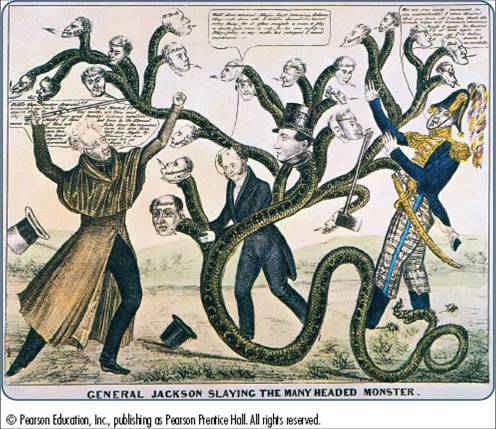
Andrew Jackson Slays Multi-Headed Monster

Andrew Jackson, when he was right and when he was wrong, was always a man of strong convictions. He stood by his love of liberty even when it hurt him politically to do so. It takes courage to stand by one’s convictions, especially when a person is offered peace and financial rewards to surrender them. Courage isn’t the absence of fear; rather, it’s the acknowledgement that one’s principles are bigger than one’s fears, regardless of the consequences.

In today’s “situational ethics” society, principles are sold out for pragmatism, making courageous stories like Andrew Jackson’s as rare as gold-backed currency. Consequently, much could be learned by the study of Andrew Jackson’s stand against the “moneyed interest” drive to re-charter the Second National Bank. Indeed, through reading Jackson’s battles against the Bank, one yearns to find leaders with similar backbones to break  the Federal Reserve monopoly on America’s money. Let’s examine this historic battle between the President Andrew Jackson of the United States of America versus President Nicholas Biddle of the Second National Bank. Several questions come to mind. First, what are the leadership lessons learned from this historic struggle between the statist and anti-statists philosophies of money? Second, how do the lessons from Jackson’s battle apply in today’s battle for monetary freedom?

Inflationary Policies

Jackson resided in the thriving American West, witnessing first hand the dire effects of inflationary banking policies in the western land prices.  Jackson learned the salutary lesson of hard money (gold and silver coins) vs. the prevalent paper based inflationary policies loved by bankers and wealthy merchants.  Inflationary methods allowed banks to print paper, pretending the paper had value, even though it wasn’t backed by gold or silver.  Without a check on the banks, like requiring banks to submit gold for paper dollars when requested, one can easily see how banks would fall into the trap of printing more paper than could possibly be redeemed on demand.  Profits for banks can increase greatly in the short term by interest collected on nothing more than paper, causing more money to flow into the marketplace which raises the prices of consumer goods as more printed dollars are available.  The splurge of printed money only corrects  itself when consumers become aware of the inflationary policies of banks, quickly requesting gold for their inflated paper dollars before the banks runs out their reserves.

In theory, paper money should be a promissory note, representing gold, but easier to carry on one’s person.  The minute the promissory note is not backed by real value (gold, silver etc), it becomes fraudulent with the bank benefitting by printing monopoly money at the expense of all consumers who now own dollars less valuable than before the fraudulent activity. For example, if we doubled the amount of dollars in circulation today, giving everyone twice as much money as they have currently, each dollar would quickly fall to half of its former value, prices would rise as each person’s dollars bid up the prices in an attempt to purchase the means for living.  Printing money does not produce wealth, but it can benefit the few at the expense of the many, a temptation too lucrative to be left in the hands of government politicians and their wealthy patrons.

Big Banks Marry Big Business

When Jackson was elected President of the United States, one of his missions was to end the syndicate of control over America’s money supply by three power hungry groups: foreign interests, big business, and big politicians.  Jackson believed that banks ought to run like any other businesses, having to sink or swim based upon their own business acumen, needing reserves to secure their loans provided.  But when a national bank receives the protection of the federal government to ensure its solvency, this is no longer free enterprise, but a form of fascism where government and business partner, reducing competition amongst banks, and increasing the cost of the entire system.

This would be similar to all automotive companies agreeing to fix prices on cars, certainly improving the profits for manufacturers, while decreasing the downside risk of the manufacturers, all of this, at the expense of the customers.  The Second National Bank received the deposits of the American Treasury Department, ensuring its solvency, providing a special deal for the bank and its investors at the expense of other banks and all customers.  Nicholas Biddle, the president of the Second National Bank, was not alarmed, at first, with Jacksons rhetoric, having heard many politicians boast of drastic changes when entering office, only to conform into the system when elected.  But Jackson character was different, his campaign promises before aligned with his actions after election, necessitating a showdown between the President and the money interest behind the Bank.

Nicholas Biddle versus Andrew Jackson

Biddle and Jackson were opposites in upbringing and temperament. The former, a scion of a high-society Philadelphia family, did not like the rough and tumble behavior of the American political process. Choosing to avoid the masses, he preferred instead to do his work behind the scenes. Jackson, on the other hand, loved the volatile political process and was elected by the populist mass of voters across America. No two people better contrasted the opposing viewpoints in the American political arena. One, a believer in wealth and privilege for the chosen few; the other, an equal opportunity for all to rise based upon merit. Jackson shared his disdain for the Bank in his first Presidential message proclaiming, “Both the constitutionality and the expediency of the law creating this bank are well questioned by a large portion of our fellow citizens, and it must be admitted by all that it has failed in the great end of establishing an uniform and sound currency.”  Biddle, however, seemingly unconcerned initially, responded to Jackson’s message with a cool indifference. He wrote of Jackson, “They should be treated as the honest though erroneous notions of one who intends well.”  Clearly, Biddle did not believe Jackson had the courage or fortitude to fight against the entrenched money-interest feeding off America’s body politic.

Biddle quickly discovered that Jackson’s courage was even greater than his rhetoric, when he confirmed Jackson’s intentions to end the Bank’s charter. Undaunted, he quickly rallied his political supporters to his cause. Two of the biggest and brightest political stars, Henry Clay and Daniel Webster, were enlisted by the Bank in support of the recharter initiative. With Clay and Webster’s help, the Bank moved for an early renewal of its charter, hoping to force Jackson’s hand before his second term election. Jackson, the moneyed-interest believed, would not risk his re-election on a veto of the Bank’s charter. Once again, the special-interest elites had underestimated Jackson courage. The Bank bill, with Clay and Webster’s support, passed both houses and arrived on Jackson’s desk for approval. Most people would have bowed to the “inevitable” and approved the bill to ensure his re-election; Jackson however, was not like most people. In his historic veto address, Jackson declared war on the wealthy aristocracy attempting to subvert the American Republic.  His veto address should be read by everyone concerned with freedom and equality of opportunity. Jackson, in part, stated:

It is to be regretted that the rich and powerful too often bend the acts of government to their selfish purposes. Distinctions in society will always exist under every just government. Equality of talents, of education, or of wealth can not be produced by human institutions. In the full enjoyment of the gifts of Heaven and the fruits of superior industry, economy, and virtue, every man is equally entitled to protection by law; but when the laws undertake to add to these natural and just advantages artificial distinctions, to grant titles, gratuities, and exclusive privileges, to make the rich richer and the potent more powerful, the humble members of society-the farmers, mechanics, and laborers-who have neither the time nor the means of securing like favors to themselves, have a right to complain of the injustice of their Government. There are no necessary evils in government. Its evils exist only in its abuses. If it would confine itself to equal protection, and as Heaven does its rains, shower its favors alike on the high and the low, the rich and the poor, it would be an unqualified blessing.

To be continued in the next blog post.

Posted in Freedom/Liberty, Leadership/Personal Development | 55 Comments »

Bill Sankbeil: Cook-Friedman Civility Award

Posted by Orrin Woodward on June 26, 2012

Bill Sankbeil

William “Bill” Sankbeil, my good friend and legal counsel, is not just another lawyer. Without exaggeration, I can say his advice, strategy, and encouragement has been pivotal to me personally and professionally. When I first met him, I sensed right away that he was honest, hard-working, and possessed a top legal mind. Now, after working with him for five years, his consistent professionalism and competency has only deepened my respect.

Essentially, what separates Bill is his willingness to go the extra mile for his clients. Indeed, I remember the first week I met him, apologizing for having to call him at his lake house in Northern Michigan. He ended up working most of the weekend on an urgent matter without complaint. I wasn’t just impressed; I was blown away. Think about it. Here is one of the perennial “Who’s Who” top legal counsels dropping his weekend plans to help out a new client he hardly knows. Over time, I realized this high-level of personalized service was standard operating procedure for Bill.

Predictably, a person cannot sow into others lives for multiple decades like Bill has without reaping a bountiful harvest in return. Bill Sankbeil is reaping that harvest and recently received the much-deserved prestigious Cook-Friedman Civility Award. According to the Federal Bar Association (FBA) in the Eastern District of Michigan:

This award will be called the Julian Abele Cook, Jr.- Bernard A. Friedman FBA Civility Award, in recognition of the dedication to civility of two outstanding jurists: former Chief Judge Julian Abele Cook, Jr.,  who, in 1998, constituted the first Civility Committee in the Eastern District of Michigan and fostered the implementation of the Court’s Civility Principles; and Chief Judge Bernard A. Friedman who formed the Court’s second Civility Committee in 2007, and fostered the implementation of the Eastern District’s “Lawyer’s Commitment of Professional Civility.”

The Julian Abele Cook, Jr. – Bernard A. Friedman FBA Civility Award shall be awarded yearly at the Chapter’s Annual Dinner.

In selecting an attorney to receive the award, the following criteria shall be utilized:

1. The attorney has been significantly engaged in the practice of civil law;
2. The attorney demonstrates the highest levels of legal competency and Professionalism;
3. The attorney’s conduct is in accordance with the highest standards of professional integrity and personal courtesy as set forth in the Civility Principles of the United States District Court for the Eastern District of Michigan;
4. The attorney has demonstrated, while fulfilling the fundamental duty to represent clients vigorously, a mindfulness of the equally important obligation to the administration of justice, which is a truth-seeking process designed to resolve human and societal problems in a rational, peaceful and efficient manner; and
5. The attorney is guided by a fundamental sense of dignity, decency, candor and fair play.

This award is a fitting capstone for the Bill’s prolific career of character-centered service to numerous firms and individuals. It is added to his already impressive list of accomplishments documented below:

Mr. Sankbeil is a Fellow of the American College of Trial Lawyers and served as the Chair of the Michigan State Committee (2002-2004). He is listed in the Bet the Company Litigation, Commercial Litigation and Antitrust Law categories in the “Best Lawyers in America” (in all editions since its inception), “Chambers USA – America’s Leading Lawyers for Business”, and in “Michigan Super Lawyers”.  He is also a Fellow of the Michigan State Bar Foundation, a former President of the Wayne State Law Alumni Association (1985-1987), is currently serving on the Executive Committee, Board of Visitors Wayne State University Law School. He is a member of the State Bar of Michigan and served as the Chairperson, Antitrust Law Section in 1981-1982 and was a member of the Mediation Rule Committee, appointed by the Michigan Supreme Court in 1994. He is a member of the American Bar Association and served as a Council member of the Antitrust Law Section from 1992-1995, was Vice Chair of the Antitrust Law Section in 1995-1996, Chaired or was Vice Chair of various other committees, and served on numerous other task forces. Mr. Sankbeil is also a member of the Litigation Section. He is listed in “An International Who’s Who of Competition Lawyers” and in “A Guide to the World’s Leading Competition and Antitrust Lawyers”. Mr. Sankbeil has been a speaker at numerous seminars and programs concerning various aspects of litigating complex cases. Mr. Sankbeil is a graduate, cum laude, of Wayne State University Law School. He received his undergraduate degree in Business Administration from Michigan State University.

For me, no matter how impressive Bill’s awards are, what I am most impressed with is for forty-plus years, Bill practiced the legal profession with class and character. Few, in the rough and tumble legal atmosphere, can claim that victory. Congratulations Bill Sankbeil, your dignity, decency, and integrity are a model for the next-generation of barristers around the world.

Sincerely,

Orrin Woodward

Posted in All News | Tagged: , | 61 Comments »

The Ugly Duckling

Posted by Orrin Woodward on June 25, 2012

My youngest son, Jeremy, loves soccer. He watches, plays, and talks about it daily. For many years he was just an average player, but over the last six month he has blossomed. He average nearly three goals per game during his spring league and is making even more rapid gains since being in Michigan. Yesterday afternoon, Rob Hallstrand and I took on Jeremy and Rob’s son, Austin, in a soccer match in our indoor gym. We got killed! The boys took a tied 10-10 game at half and won 20-14. One of the best explanations of watching Jeremy and Austin change is in Hans Christian Andersen’s Ugly Duckling story, where the goose mis-labeled himself and needed time to realize how special he was.

In the same way, many people in the world have special talents and skills, but no avenue in which to reveal them. This is where LIFE enters the picture, giving people the opportunity to display their special gifts to the greater community. Read the Ugly Duckling story and share how this story relates in your life.

Sincerely,

Orrin Woodward

The Ugly Duckling

Once upon a time down on an old farm, lived a duck family, and Mother Duck had been sitting on a clutch of new eggs. One nice morning, the eggs hatched and out popped six chirpy ducklings. But one egg was bigger than the rest, and it didn’t hatch. Mother Duck couldn’t recall laying that seventh egg. How did it get there? TOCK! TOCK! The little prisoner was pecking inside his shell.

“Did I count the eggs wrongly?” Mother Duck wondered. But before she had time to think about it, the last egg finally hatched. A strange looking duckling with gray feathers that should have been yellow gazed at a worried mother. The ducklings grew quickly, but Mother Duck had a secret worry.

“I can’t understand how this ugly duckling can be one of mine!” she said to herself, shaking her head as she looked at her last born. Well, the gray duckling certainly wasn’t pretty, and since he ate far more than his brothers, he was outgrowing them. As the days went by, the poor ugly duckling became more and more unhappy. His brothers didn’t want to play with him, he was so
clumsy, and all the farmyard folks simply laughed at him. He felt sad and lonely, while Mother Duck did her best to console him.

“Poor little ugly duckling!” she would say. “Why are you so different from the others?” And the ugly duckling felt worse than ever. He secretly wept at night. He felt nobody wanted him.

“Nobody loves me, they all tease me! Why am I different from my brothers?”

Then one day, at sunrise, he ran away from the farmyard. He stopped at a pond and began to question all the other birds. “Do you know of any ducklings with gray feathers like mine?” But everyone shook their heads in scorn.

“We don’t know anyone as ugly as you.” The ugly duckling did not lose heart, however, and kept on making inquiries. He went to another pond, where a pair of large geese gave him the same answer to his question. What’s more, they warned him: “Don’t stay here! Go away! It’s dangerous. There are men with guns around here!” The duckling was sorry he had ever left the farmyard.

Then one day, his travels took him near an old countrywoman’s cottage. Thinking he was a stray goose, she caught him.

“I’ll put this in a hutch. I hope it’s a female and lays plenty of eggs!” said the old woman, whose eyesight was poor. But the ugly duckling laid not a single egg. The hen kept frightening him.

“Just wait! If you don’t lay eggs, the old woman will wring your neck and pop you into the pot!” And the cat chipped in: “Hee! Hee! I hope the woman cooks you, then I can gnaw at your bones!” The poor ugly duckling was so scared that he lost his appetite, though the old woman kept stuffing him with food and grumbling: “If you won’t lay eggs, at least hurry up and  get plump!”

“Oh, dear me!” moaned the now terrified duckling. “I’ll die of fright first! And I did so hope someone would love me!”

Then one night, finding the hutch door ajar, he escaped. Once again he was all alone. He fled as far away as he could, and at dawn, he found himself in a thick bed of reeds. “If nobody wants me, I’ll hid here forever.” There was plenty a food, and the duckling began to feel a little happier, though he was lonely. One day at sunrise, he saw a flight of beautiful birds wing overhead. White, with long slender necks, yellow beaks and large wings, they were migrating south.

“If only I could look like them, just for a day!” said the duckling, admiringly. Winter came and the water in the reed bed froze. The poor duckling left home to seek food in the snow. He dropped exhausted to the ground, but a farmer found him and put him in his big jacket pocket.

“I’ll take him home to my children. They’ll look after him. Poor thing, he’s frozen!” The duckling was showered with kindly care at the farmer’s house. In this way, the ugly duckling was able to survive the bitterly cold winter.

However, by springtime, he had grown so big that the farmer decided: “I’ll set him free by the pond!” That was when the duckling saw himself mirrored in the water.

“Goodness! How I’ve changed! I hardly recognize myself!” The flight of swans winged north again and glided on to the pond. When the duckling saw them, he realized he was one of their kind, and soon made friends.

“We’re swans like you!” they said, warmly. “Where have you been hiding?”

“It’s a long story,” replied the young swan, still astounded. Now, he swam majestically with his fellow swans. One day, he heard children on the river bank exclaim: “Look at that young swan! He’s the finest of them all!”

And he almost burst with happiness.

Posted in Leadership/Personal Development | 90 Comments »

Tony Cannuli of MLMIA Interview

Posted by Orrin Woodward on June 21, 2012

About a month ago, I did an enjoyable radio interview with Tom Chenault. One of the listeners was Tony Cannuli, a board member of the MLMIA. The MLMIA is the not-for-profit, worldwide, professional trade association, started in 1985 by industry professionals, for Network Marketing/Direct Sales/Multi-Level Marketing Companies, focused on making a difference in our great profession.

Tony reached out to me and over the last month we have had some great conversations on leadership, network marketing, and the future of free-enterprise. Tony has an impressive track-record in network marketing, having cut his teeth in the Yager training system and then branching out to build large communities in several companies. In other words, when talking about the value of leadership, he gets it! When Tony asked me to do an hour long interview on the subject of leadership, I gladly accepted.

In my opinion, Network Marketing is the greatest field for leadership development remaining in the West. Why? Because you cannot fake a following in Network Marketing. A person can hype about how great he is, but when he does a meeting, how many people show up is the true measurement of his leadership. Tony and I got into a great discussion on all of these subjects and more. Here is the link to the interview. I hope you enjoy listening and learning as much as I enjoyed talking and teaching.

Sincerely,

Orrin Woodward


Posted in Leadership/Personal Development | 51 Comments »

Ludwig Von Mises Predicts Credit Crisis

Posted by Orrin Woodward on June 18, 2012

Updated: After finishing Too Big to Fail by Andrew Sorkin, I had to update this post!

If the 1989 breakup of the Soviet Bloc countries didn’t humble all the Keynesian economists, then the 2007 credit-crisis finished the process. The Keynesian economists were confronted, yet again, with the difference between economic law and the fallacies bandied about in their numerous textbooks.

First, the Keynesians, with the communist bloc in near starvation, learned that communism didn’t work – something Mises had pointed out eighty years previous. Mises irrefutable theoretical answers – he proved that without a free market there was no price system; therefore, no economic calculations were possible – are now confirmed with hard data from the numerous failed communistic nations. China, shockingly, has more economic freedom than the United States today! This is what happens when America continues to dabble in Keynesianism (socialism light) and China, in an effort to improve results, rejected hard-line communism in favor of free-enterprise concepts. The world truly has been turned upside down. 🙂

Second, the Keynesians learned the banking system is a “house of cards,” surviving on a “confidence game,” where only the insiders know how highly leveraged the banks truly are. Without the $1.1 trillion bailout (TARP) from the USA government, the banking system would have “dominoed to destruction” – Bear-Stearns to Lehman Brothers, to Merrill Lynch, to AIG, to Morgan Stanley, even Goldman-Sachs was on the precipice before TARP.  Andrew Sorkin’s book Too Big To Fail provides the reader with a front row seat and play-by-play descriptions of the events during the 2007-08 credit-crisis.

Third, and a preview of coming attractions, the Keynesians will learn that even all-powerful governments must obey economic law. They will witness a government “domino to destruction,” similar to banking systems near collapse; however, the governments have no one to backstop their violations of economic law and the collapse will be on a much greater scale. In other words, the government bailouts only delayed, rather than killed, the day of reckoning. The highly-linked leveraged debt dominos between countries are set up in precarious fashion. It will only take one country (Greece anyone?) to renege on its payments causing the next weakest country to follow suit, leading eventually to a world-wide economic collapse of the highly leveraged governments. 

For the overly taxed citizens, “Humpy-Dumpty’s” fall will upset the markets and livelihoods in the short term. But, over time, it will free citizen leaders to create market-place solutions, rather than submit to the unworkable Statist-Keynesian global mindset. Essentially, history will teach the Keynesian that their measures were the problem, not the solution as advertised. Only a few voices, mainly Ludwig Von Mises with a nod to Friedrich Von Hayek, predicted the cycle of inflationary spending in the early twentieth century! Truth, in other words, was right under the global powers noses over 100 years ago, but it was denigrated because it went against their desire for FREE money and increased Statist’s control. I wrote about this in my book RESOLVED: 13 Resolutions for LIFE on how the whole credit-crisis is symptomatic of a bigger issue: the character-crisis.

Remember, when the Big Banks and Big Government first proposed taking over our nations money system, it was to eliminate the credit cycles; however, truth be told, it didn’t eliminate cycles, but only delayed them, making the waves bigger and the destruction greater when they finally crash upon the economy. Thankfully for the modern power-pundits, the masses remain ignorant of the Federal Reserve’s dismal track record. Unaware of the danger, the people’s lethargy is the power-brokers’ best security, allowing the inflationary money scam to consistently rob the producers for the benefit of the exploiters.

Indeed, it must be asked: why doesn’t anyone stand for truth in today’s modern age? I believe a huge part of it is that few people believe in truth anymore, and of the few who do, few are willing to do the heavy mental work involved to learn it. The goal of the Mental Fitness Challenge is to awaken people to the need for personal development and developing a foundation in which to learn, apply, and change oneself. Here is a fantastic article on Mises by Mark Spitznagel.

Sincerely,

Orrin Woodward

By MARK SPITZNAGEL

Ludwig von Mises was snubbed by economists world-wide as he warned of a credit crisis in the 1920s. We ignore the great Austrian at our peril today.

Mises’s ideas on business cycles were spelled out in his 1912 tome “Theorie des Geldes und der Umlaufsmittel” (“The Theory of Money and Credit”). Not surprisingly few people noticed, as it was published only in German and wasn’t exactly a beach read at that.


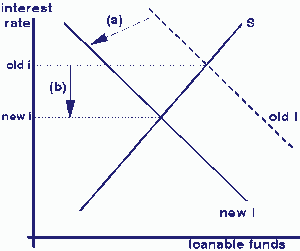
Taking his cue from David Hume and David Ricardo, Mises explained how the banking system was endowed with the singular ability to expand credit and with it the money supply, and how this was magnified by government intervention. Left alone, interest rates would adjust such that only the amount of credit would be used as is voluntarily supplied and demanded. But when credit is force-fed beyond that (call it a credit gavage), grotesque things start to happen.

Government-imposed expansion of bank credit distorts our “time preferences,” or our desire for saving versus consumption. Government-imposed interest rates artificially below rates demanded by savers leads to increased borrowing and capital investment beyond what savers will provide. This causes temporarily higher employment, wages and consumption.

Keynesian economics picture

Ordinarily, any random spikes in credit would be quickly absorbed by the system—the pricing errors corrected, the half-baked investments liquidated, like a supple tree yielding to the wind and then returning. But when the government holds rates artificially low in order to feed ever higher capital investment in otherwise unsound, unsustainable businesses, it creates the conditions for a crash. Everyone looks smart for a while, but eventually the whole monstrosity collapses under its own weight through a credit contraction or, worse, a banking collapse.

The system is dramatically susceptible to errors, both on the policy side and on the entrepreneurial side. Government expansion of credit takes a system otherwise capable of adjustment and resilience and transforms it into one with tremendous cyclical volatility.

“Theorie des Geldes” did not become the playbook for policy makers. The 1920s were marked by the brave new era of the Federal Reserve system promoting inflationary credit expansion and with it permanent prosperity. The nerve of this Doubting-Thomas, perma-bear, crazy Kraut! Sadly, poor Ludwig was very nearly alone in warning of the collapse to come from this credit expansion. In mid-1929, he stubbornly turned down a lucrative job offer from the Viennese bank Kreditanstalt, much to the annoyance of his fiancée, proclaiming “A great crash is coming, and I don’t want my name in any way connected with it.”

We all know what happened next. Pretty much right out of Mises’s script, overleveraged banks (including Kreditanstalt) collapsed, businesses collapsed, employment collapsed. The brittle tree snapped. Following Mises’s logic, was this a failure of capitalism, or a failure of hubris?

Mises’s solution follows logically from his warnings. You can’t fix what’s broken by breaking it yet again. Stop the credit gavage. Stop inflating. Don’t encourage consumption, but rather encourage saving and the repayment of debt. Let all the lame businesses fail—no bailouts. (You see where I’m going with this.) The distortions must be removed or else the precipice from which the system will inevitably fall will simply grow higher and higher.

Mises started getting some much-deserved respect once “Theorie des Geldes” was finally published in English in 1934. It is unfortunate that it required such a disaster for people to take heed of what was the one predictive, scholarly explanation of what was happening.

But then, just Mises’s bad luck, along came John Maynard Keynes’s tome “The General Theory of Employment, Interest and Money” in 1936. Keynes was dapper, fresh and sophisticated. He even wrote in English! And the guy had chutzpah, fearlessly fighting the battle against unemployment by running the currency printing press and draining the government’s coffers.

He was the anti-Mises. So what if Keynes had lost his shirt in the stock-market crash. His book was peppered with fancy math (even Greek letters) and that meant rigor, modernity. To add insult to injury, Mises wasn’t even refuted by Keynes and his ilk. He was ignored.

Fast forward 70-some years, during which we saw Keynesianism’s repeated disappointments, the end of the gold standard, persistent inflation with intermittent inflationary recessions and banking crises, culminating in Alan Greenspan’s “Great Moderation” and a subsequent catastrophic collapse in housing and banking. Where do we find ourselves? At a point of profound insight gained through economic logic, trial and error, and objective empiricism? Or right back where we started?

With interest rates at zero, monetary engines humming as never before, and a self-proclaimed Keynesian government, we are back again embracing the brave new era of government-sponsored prosperity and debt. And, more than ever, the system is piling uncertainties on top of uncertainties, turning an otherwise resilient economy into a brittle one.

How curious it is that the guy who wrote the script depicting our never ending story of government-induced credit expansion, inflation and collapse has remained so persistently forgotten. Must we sit through yet another performance of this tragic tale?

Mr. Spitznagel is the founder and chief investment officer of the hedge fund Universa Investments LP, based in Santa Monica, Calif.


Posted in Finances, Freedom/Liberty | 116 Comments »

George Guzzardo: Lifetime Learner

Posted by Orrin Woodward on June 14, 2012

George Guzzardo pictureGeorge Guzzardo has become a professor of history over the last 18 years along with one of the top business builders in LIFE. He went from not reading at all, to reading the Team Top 5 books in order to build a huge business and now reads many of the classics. What happened to George? The same thing that will happen to anyone who starts a self-directed education through the LIFE Business. The Mental Fitness Challenge is a 90-day kickstart to get your brain off and running on a new course of growth and change. If a physical therapist from Ironwood, Michigan can make the change, so can you! Enjoy George’s latest video.

Sincerely,

Orrin Woodward

Posted in Leadership/Personal Development, LIFE Leadership | 86 Comments »

Power-Player Promotions

Posted by Orrin Woodward on June 12, 2012

It’s summer time in Michigan! Enjoying our properties in both Florida and Michigan, Laurie and I find it difficult to determine which we like better. In truth, when I am in Michigan, I don’t want to leave; however, when I am in Florida in the wintertime, I am glad I did. 🙂

My goal for this summer is to shake hands with every Power-Player on the team. Since Power Player is the most effective way to build communities for the long haul, I am running mainly power player promotions this summer. Of course, some of the groups are double Power Players and above because of the size, but the objective is the same – to keep the main thing the main thing.

The Team is on its way to 1 million people through the LIFE Business because we keep Power-Player the main thing. The Mental Fitness Challenge, LIFE & LLR subscriptions, and the EDGE series are all amazing, but they are not the main thing. Only Power-Player ensures the community grows through depth which leads to numbers and then volume. LIFE has nearly 9,000 customers (not including the tens of thousands of members) since November 1, 2011, mainly because anyone out starting conversations about LIFE and the MFC will stumble across customers. Even so, the number one point of focus for anyone desiring a long-term business plan for success is Power-Player.

This is going to be a wonderful summer and I hope you are planning on going Power-Player and introducing yourself at one of the summer time promotions. The Team has one play that scores a touchdown every time we call it: Hut 1, Hut 2, Power-Player!

Sincerely,

Orrin Woodward

Posted in LIFE Leadership, Life Training, Mental Fitness Challenge (MFC) | 100 Comments »

LIFE Business: Keeping Score

Posted by Orrin Woodward on June 6, 2012

I flew back to Michigan on Monday to attend several days of PC meetings with the LIFE Founders and enjoyed myself immensely. First of all, because the PC is such a fun-loving group that we bounce numerous ideas off of each other, but end up laughing at the eventual humorous way someone will see the idea. It’s kind of hard to explain, but when you are a PC, you will understand what I am saying.

The good news for everyone is volume is up 42% in the last two months since we announced the trip-tracking process for FREE vacations.  Also, the Mental Fitness Challenge has been a huge success as our flagship product.  Testimonials continue to pour in on the changes people are experiencing from implementing the 13 Resolutions into their lives. In addition, the pattern is solidifying with MFC playing a part in the contacting, several MFC videos to explain the concept, then showing our standard plan. For a sign up cost of $130 dollars, people can “hold their spot” and start enjoying the benefits of team approach and power-player tracking on their way to trip tracking by the end of their second month.

I love systems and the Team business system married to the LIFE/MFC personal development system promises to launch the community onward to one million people. With the pattern/system set, now the scoreboard becomes essential. Keeping score is what separates those make things happen from those who wonder what happened. 🙂 Anyway, the scoreboard is all wrapped around power-player which is the same as ever:

1. How many customers did you acquire?
2. How many levels in depth did you go?
3. How many systems counts did you increase?
4. What is your subscription count for opens and seminars?
5. What is you end of month volume per leg?

It’s as simple as that. Increase your depth and your numbers will increase. Increase your numbers and your volume will increase, both customers and members. Increase your volume and you will be qualifying for free trips and One-Time-Cash-Awards. In other words, build communities, serve communities, and everyone wins!

Sincerely,

Orrin Woodward

Posted in Fun, LIFE Leadership | 185 Comments »

Chris Brady: A Month of Italy

Posted by Orrin Woodward on June 3, 2012

When Chris Brady called me last year and told me he was working on another book, that didn’t surprise me as he loves writing and has produced a series of wonderful books; however, when he sent me over a draft copy, I knew immediately this one was different. Chris, although certainly one of the top leaders in the personal development field is, in truth, difficult to fit into the typical leadership expert genre.  Indeed, because of his versatility developed through numerous experiences, innovations, and interests, Chris talents flow in so many directions – he’s artistic, witty, philosophical, humble, and the most creative person I have ever met!

Chris applies all of these qualities in writing this book. In fact, Laurie and I have toured Italy several times in my life, but we felt reading A Month of Italy was as enjoyable, if not more so, than us actually being there. How is that possible? Because Chris, through his creative writing style, gives you a seat in the Brady mini-bus as they tour the Italian countryside. In addition to the informative history and gut-splitting humor shared during the day trips around Italy, Chris will also have you pondering the finer distinctions in life, like the difference between the urgent and important, as you “experience” renewal within the context of the Brady family vacation. I laughed; I cried; I thought; but most importantly, I changed after reading this book. Below is Chris’s description of his new book.

Sincerely,

Orrin Woodward

Italy Book pictureHave you ever felt overworked, overstressed, maxed out, and out of focus?

Have you ever needed a break from it all, and by that, I mean something more than a frenzied weekend or busy plastic vacation?

Have you ever had enough of your cell phone, emails, social networks, texts, and the like?

Have you ever felt like you were out of balance and needed some serious restoration?

Have you ever considered the fact that you could take a career break – a sabbatical – to allow you to clear your head and restore your focus?

Have you ever dreamed of traveling through the back roads of Italy and seeing the famous Tuscan countryside?

Have you ever wanted to sample Italy’s cuisine, sunsets, culture, art, architecture, and history?

Are you entertained by humorous narrative and adventure stories?

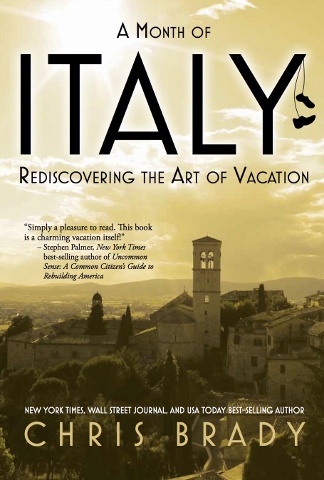
For anyone who can answer “yes” to even one of these questions, I am happy to announce that my latest book, A Month of Italy: Rediscovering the Art of Vacation, is set to debut this July. For just a little taste, here is the dust jacket inscription:

What can possibly be said about Italy that hasn’t been already? Primarily, that you can enjoy it too! Refreshingly relate-able in a genre previously populated by wealthy expats and Hollywood stars, this book chronicles an ordinary family taking an extraordinary trip, and most importantly, paves the way for you to take one of your own! With hilarious wit and fast-paced narrative, Brady thrills with honest commentary on what a “trip of a lifetime” actually feels like, and most endearingly, he succeeds in convincing you that not only should you take a similar one, but that you will!  Within a few pages you’ll be visualizing panoramic Tuscan vistas and breaking open the piggy bank, laughing as you turn the pages and dreaming of your own escape.  This story is one of going slow in order to go fast; it’s about rediscovering and brining back into favor a lost art, namely, the art of vacation, and it is, or rather should be, a story about you.

Here are some of the early reviews:

“I was intrigued from the first sentence clear through the book! It teaches so many life and leadership lessons—about family, relationships, learning, improving, and becoming better. I’ll read it again and again, and I’ll read it on the plane on every vacation I ever go on.” – Oliver DeMille, NY Times best selling author of A Thomas Jefferson Education, Freedom Shift, and 1913

“A beautiful story and pivotal idea for a book!” – Richard Bliss Brooke, author of Mach II, The Art of Vision and Self Motivation and The Four Year Career

“With humor, Brady guides you through heart-warming history, incredible beauty, the most gracious people, and of course, the world’s most delicious food and wine! After reading his entertaining work, you will be charting your own course to Italy.”  –Sharon Lechter, Co-author of Outwitting the Devil, Three Feet From Gold and Rich Dad Poor Dad

 “Extremely engaging and delightful – a well told story!” – Chris Gross, CEO Gabriel Media Group, Inc., cofounder of Networking Times.

 “This is a book every traveler should read and bring along in order to experience the best of Italy.” – Dr. Gaetano (Guy) Sottile, President and Founder, Italy for Christ, Inc.

“Witty, funny, and at points downright hilarious, but mixed with profound truths shared in a way that makes one pause and ponder.” – Orrin Woodward: Winner of the 2011 IAB Top Leadership Award

“A spell-binding lesson in learning how to live again, with real purpose. You can’t stop turning the pages . . . .” – Art Jonak, founder MastermindEvent.com

“I have never read a book that teaches so much while being this fun at the same time.” – Tim Marks, best-selling author of “Voyage of a Viking”

“This is the best work Chris Brady has written to date. If this is a vacation handbook, it has redefined the vacation experience.” – Venkat Varada, Silicon Valley Executive

“Vacationing truly is a lost art, and Brady poignantly and beautifully illustrates why it is so vital for driven leaders. A timeless treatise on ‘sharpening the saw,’ A Month of Italy is a book I will sip and savor, ponder and reflect on time and time again. Not only are Chris’s insights powerful and refreshing, but his vivid and witty writing is simply a pleasure to read. Reading this book is a charming vacation itself, and it will inspire you to vacation deliberately, effectively, and joyfully.” – Stephen Palmer, New York Times best-selling author of “Uncommon Sense: A Common Citizen’s Guide to Rebuilding America”

“In our hectic lives we are rarely 100% present in any situation. Chris Brady shows that with proper play time, our work time is so much more effective. He has freed my spirit!” – Jason Ashley, country singer/songwriter (Texas Songwriter of the Year 2008)

“Italy is unique. Moreover, it is a country where the traveler can en- joy the most various experiences. Chris Brady’s book has the ability, astonishing even for an Italian, to convey to the reader that variety, that richness of feelings, sights, perfumes, tastes . . . and people.” – Senator Lucio Malan, Senior Secretary of the Presidency of the Italian Senate

In early July, look for it in bookstores and online stores everywhere, and of course, here. I sincerely hope you enjoy it!

Chris Brady

Posted in Faith, Family, Fun | Tagged: | 81 Comments »

Why I LOVE Team

Posted by Orrin Woodward on June 1, 2012

Do not pray for easy lives. Pray to be stronger men (people). Do not pray for task equal to your powers. Pray for powers equal to your tasks. – Philip Brooks

I love the Team for many reasons, but the month of May was a huge confirmation in many ways. The LIFE Business had its best volume month since the LIFE launch, despite rolling out three huge initiatives that each required massive learning curves for the Team communities. I am impressed because the Team community made it look so easy. However, I know it wasn’t easy because what is easily done is seldom excellently done and what the Team accomplished was excellently done. It only looked easy because a great deal of leadership experience and emotional intelligence was applied by so many leaders within the community.

As the leader of the Team community and LIFE Business, I can promise everyone that the leaders will not take the easy path, but will, to the best of our abilities, take the proper path needed to grow! Changing open meetings to personal development seminars and challenge groups, along with rolling out the Mental Fitness Challenge are each, by themselves, enough change to discombobulate the best of organizations; instead, the Team responded as only leaders do, growing their numbers and volume in the midst of three major programs!  All I can say is WOW! The LIFE Business through the Team community is now prepared to march onward to one million plus people because we have transformed ourselves from a networking company into a personal development/leadership company with compensated communities, practically overnight.

People who seize change grow into winners, while people who resists change shrink into whiners. I have seen both responses in business, but I am thankful only the winners and people wanting to grow into winners stay with the Team. Consequently, the Team seized these changes and displayed by their actions, rather than words, that they are champions on their way to one million people. I, and the rest of the PC, congratulate you on a first-class example of how communities should thrive through change!

Sincerely,

Orrin Woodward

Posted in LIFE Leadership, Life Training | 94 Comments »