Writer Adam Levin shared some sobering statistics on debt and the loss of the American dream. Unfortunately, government cannot and will not supply the answers for these challenges. If anything, government debt is exacerbating the problems, not leading to the solutions. In reality, the only viable solution is for each citizen to learn financial literacy and escape the Financial Matrix. When enough people do this, then, and only then, will we be in a position to expect government to practice financially sane principles also.
LIFE Leadership has the produce (Financial Fitness Program) to teach people the defense, offense, and the playing field for financial success. There is not better time than today to start your journey to debt-free.
Sincerely,
Orrin Woodward
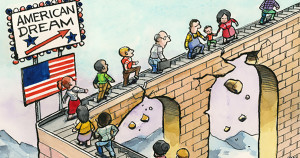
The Vanishing American Dream
A great number of Americans are redefining the American Dream. That was the takeaway from a recent Credit.com poll, which showed that nearly one in four people between the ages of 18 and 24 defined the American Dream as being debt-free. Shockingly, that’s more than those who dream of owning a home.
The poll underscores something I have long suspected — there’s a great deal of nostalgia for a promise that increasingly and tragically looks to be further out of reach for newer generations. Once upon a time, the American Dream was a Technicolor affair, replete with two and a half thriving, college-bound kids, a dog or cat and not one, but two cars in the garage that were owned outright, or would be before they were ready for the crusher. Finally, and most importantly, for generations of Americans the American Dream was about owning a home.
“The value of homeownership is deeply ingrained in American public culture,” write William M. Rohe and Harry L. Watson in the introduction to their book, Chasing the American Dream: New Perspectives on Affordable Homeownership. “From early laws requiring landownership for the right to vote, to nineteenth-century homestead legislation, to contemporary real estate brochures, the ownership of a home has long been presented as a crucial part of the ‘stake in society’ expected of full fledged members of American communities.”
Now it appears that for millions of Americans, the American Dream is looking different. Our study found while 27.9% of respondents see the American Dream as retiring at 65 and 18.2% see it as owning a home, 23% view the American Dream as being debt-free.
How Did We Get Here?
The Great Recession affected all of us. The irrational exuberance of the mortgage boom and investment portfolios yielding 10% growth year after year led to a burst bubble, downsizing and various kinds of over-corrections. At the height of the boom, USA Today published a poll in which 81% of young adults said getting rich was their top priority (and 51% gave the same priority to becoming famous). Americans now face a new personal finance reality.
For millions, fame and fortune is probably out of the question absent a win on reality television. To them, financial survival equals success and the American Dream is about staying above water while the kids pile up an average $27,000 student loan debt, mortgages are upside-down, and not enough money is finding its way into retirement portfolios.
Today, more Americans dream not of affluence, but of basic financial stability. That’s what both retirement and freedom from debt have in common. When Americans dream of retirement and freedom from debt, they dream of being able to exhale. Homeownership is a little different. Rohe and Watson frame it as an aspirational component of American citizenship. Others believe that you haven’t really “made it” until you own a home. However, the failure to own a home is generally not a source of stress in the same way that drowning in debt and the inability to retire are.
In another section of the survey, in fact, we see just how important debt is to consumers. When we asked what financial goals are most important to respondents right now, being free of debt/credit card debt was at the top (33.4% of responses). The runners-up weren’t even close: Retiring at age 65 (11.6%), buying or paying off a car (11.3%), sending a kid to college (8.1%), buying a home (6.8%), paying off student loans (6.2%), paying off a mortgage (5.6% ) and buying a vacation home (3.2%). (And 13.8% had no response, for those of you doing the math).
Finally, the poll found that nearly one in six respondents felt that it was unlikely that they would ever be debt-free in their lifetime. That’s a troubling number and one we’re going to have to watch over time.
Are We in Denial?
This is all sobering news, but there’s further evidence in this study that most of us aren’t really grasping. An interesting contradiction in the data lies in the fact that the latent pessimism described above is not reflected in any age group when it comes to the question of whether the American Dream is within reach. In the study, 78% of respondents said that the American Dream was either within reach or they had already achieved it, compared to 17.7% who said that it wasn’t within their reach. Meanwhile, 55% said that the American dream wasn’t within reach for most Americans. That means a good portion of us are either overly optimistic about our own prospects, or overly pessimistic about the prospects of others. My bet is the former.
Here’s my takeaway: Most of us still believe in the American Dream — but the nature of that dream seems to be changing. Debt is now woven into the fabric of our society. While some debt is absolutely vital for a healthy American economy, the way many of us experience debt is anything but positive. We’ve all seen the statistics about record-breaking credit card and student loan debt. Those numbers are troubling for some and sources of enormous personal stress for others. Many of us don’t take the time to consider how this new financial reality has changed our expectations of what’s possible for each of us to achieve. Even though we call these things dreams, what’s always been special about the American Dream is our ability to make them come true. When we’ve lost that, we’ve lost a little bit of what it means to be an American.