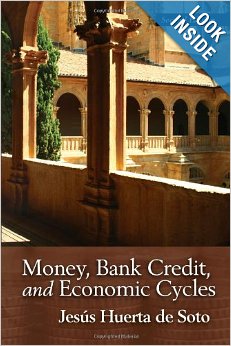
Jesus Huerta de Soto
The perpetual booms and bust we see in Capitalism are not caused by the free market. Rather, they are the direct result of interventions in the natural rate of interest by Big Banks and the State (yes, it’s the dreaded Financial Matrix). These centrally planned interventions into the free markets cause the booms and bust, but in an ironic twist, the free market is blamed when the predictable dismal outcome occurs. Hence more central planning is proposed to fix the allegedly broken free market. The illogicalness of this argument almost makes me lose my emotional intelligence. 🙂
For it reminds me of the story of a drunk suffering from a hangover who blames his pain, not on too much drinking, but rather believes his body’s natural systems are imbalanced. Thus, he surmises to drink even more because he must make up for his body’s deficient natural system. When the pain goes away temporarily, he proclaims his intervention successful because he is pain-free. Unfortunately, the party (boom) always ends and when tomorrow morning hits, the cycle will repeat itself with even more rationalizations about the inherently unstable bodily systems and the need for more drugs. Of course, this leads to even worse cycle of temporary joy and longterm pain until the drunk either wizens up or dies. I wish I were exaggerating here, but the drunk’s logic is the same as our modern day politicians and economists (owned mouthpieces of the Financial Matrix controllers) who increase interventions into the economy which cause increasingly disruptive boom/bust cycles.
Nonetheless, further government intervention within the free market is always the answer when the previous intervention fails. Regretfully, many seemingly intelligent people buy into this line of thinking because it is promoted across the mainstream media outlets by the hired hands of the elites. As for me, I could care less how many “authorities” state their opinions because no matter how many people with whatever titles say something foolish, it’s still foolish. Even a majority doesn’t change this because foolish plus foolish is foolish, not wisdom. As an aside, if anyone is seeking rational discussion on this subject, he or she need look no further than de Soto’s fantastic book on money, banking, and business cycles displayed on this blog post.
To wet your appetite, I will attach a short description of the Austrian Business Cycle theory that I found online. In my nearly 15 years of research into the Austrian School of economics, I have not found an economic philosophy that reasons clearer and states the facts better regardless of the political costs than this group does. LIFE Leadership is on a quest for truth and the Austrian School has much truth to share.
Sincerely,
The article below was written by Ben Best and describes the Austrian Business Cycle Theory:
Austrian Business Cycle
Austrian analysis asserts that in a world of hard money and free banking, the inflationary forces of credit expansion due to fractional reserve banking would not exist. If banks were warehouses of commodity money — gold, for example — then currency would consist of bank notes representing claims on the gold held by a bank. Any bank that made loans in excess of its reserves (fractional reserve banking) would soon find itself insolvent when other banks demanded hard money in exchange for checks & banknotes issued by that bank. This effect on banks is entirely analogous to the effects on countries that occurred after World War I when most nations attempted to implement a fractional reserve gold standard for their currencies. Countries issuing large amounts of currency backed by small amounts of gold found themselves in trouble when other countries sought to exchange currency to obtain gold. (See History of Modern Monetary Standards.) Banks in a free banking system would face similar pressures against fractional gold backing for their banknotes.
According to Austrian Economists, fractional reserve banking only became possible through the outlawing of private money and the creation of central (ie, government-controlled) banks — which allowed governments to control money supply and bank credit expansion.
In a free market interest rates are determined by subjective time-preference and the supply & demand of loanable money. If there is a low rate of savings the quantity (supply) of loanable money will be low and competition for this money (demand) by potential borrowers will result in high interest rates. High interest rates will encourage more savings and thereby bring the price of loans (interest rates) downward. As with supply & demand for any good or service, a free market will find a “clearing price” for the supply & demand of loanable funds. This clearing price is the natural rate of interest.
The natural rate of interest plays an extremely important role in the capital structure of an economy. Entrepreneurs/capitalists base decisions on whether to begin long-term capital projects based on interest rates. If interest rates are low, then borrowing to build a new factory, invest in a telecommunications network or assemble the capital goods for a new business venture appears feasible. Supply & demand of loanable funds will respond gradually to adjustments in business activity. If business investment (competition for loanable funds) rises, so too will interest rates — reducing borrowing for investment.
Central bank control of money & short-term interest-rates in national economies is at the root of contemporary business cycles. (For background on the mechanics of short-term interest-rate manipulation by central banks, see Money-Creation by Banks and A “Managed Economy” Under the Federal Reserve System.) When central banks artificially lower short-term interest rates below natural market levels, this results in two major distortions in capital markets. First, those who would save money receive less than the natural rate of interest — and this disincentive to save actually reduces the amount of loanable funds in real (as distinct from nominal) terms. Second, those who would borrow money for large capital projects are paying less than the natural rate of interest — thus encouraging borrowing investors to believe that capital projects are more sustainable than they really are.
Artificial lowering of interest rates by central banks is thus accompanied by expansion of the money supply — resulting in an artificial stimulus to spending for both consumer goods and capital goods. This artificial stimulus results in an inflationary boom which is not sustainable. Central banks are ultimately forced to raise short-term interest rates to counteract the inflation, resulting in a bust. Supporters of central bank monetary manipulation justify the practice as a means of leveling-out the business cycle when, in fact, central banker monetary manipulation is the cause of the business cycle!
In the 19th century, when money was based on gold & silver rather than government fiat, economic growth was mildly deflationary — because increased productivity lowers production costs. Inflation follows from government expansion of money supply and is not the result of an “overheating” economy that is growing rapidly. A distinction should be made between non-inflationary economic growth due to enterprise & technology and inflationary unsustainable booms due to central bank interest-rate cuts. Lack of clarity about this distinction has misled many economists into believing that there is an upper limit to growth (about 3%) above which growth is inflationary and unsustainable. Artificially low interest rates increase consumption spending, reduce incentives to save and increase investment spending with new fiat money that creates the illusion of new wealth. After having expanded the money supply with credit-expansion, central bankers worry that economic growth is “overheating” the economy, and the bankers then increase interest rates to “fight inflation”.