Orrin Woodward on LIFE & Leadership

Inc Magazine Top 20 Leader shares his personal, professional, and financial secrets.

Archive for December, 2012

King Pyrrhus & the Rise of the Romans

Posted by Orrin Woodward on December 31, 2012

Here is the beginning of my study of the Roman’s. King Pyrrhus  was the first to learn that the Roman city-state was different than its Greek forerunners. In a similar fashion, the LIFE Business is different than its community building forerunners. Offering a product that every single person in the world needs, regardless of whether they realize it or not, the LIFE Business is quickly becoming the highest quality and best value leadership answer for corporations, churches, communities, and individuals. 2013 is fast approaching, be sure to make this your personal best year. This can start the moment you choose to turn off the TV set, turn on the CD player and press play. Here is the story of King Pyrrhus and the Romans.

Sincerely,
Orrin Woodward

King Pyrrhus & the Dream of Empire
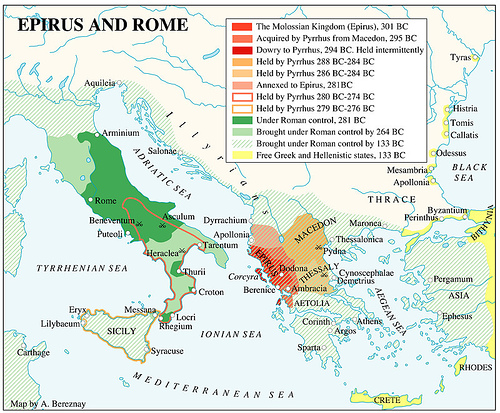
King Pyrrhus dreamed of conquering the known world. Indeed he had the ability, as he is considered one of the three greatest military commanders of the ancient world along with Alexander the Great and Hannibal. Consequently, when he received a request from Tarentum (a Greek city in Italy), to help defend the Greek cities from the advancing Romans, he happily complied, believing his moment of destiny had arrived. Cineas, however, Pyrrhus friend and wisdom-filled counselor, who had mentored under the Greek orator Demosthenes, responded stoically, seeking to comprehend the king’s thirst for empire. According to Plutarch, Cineas reflected:

“The Romans, O Pyrrhus, are said to be good fighters, and to be rulers of many warlike nations; if, then, Heaven should permit us to conquer these men, how should we use our victory?” And Pyrrhus said: “Thy question, O Cineas, really needs no answer; the Romans once conquered, there is neither barbarian nor Greek city there which is a match for us, but we shall at once possess all Italy, the great size and richness and importance of which no man should know better than thyself.” After a little pause, then, Cineas said: “And after taking Italy, O King, what are we to do?” And Pyrrhus, not yet perceiving his intention, replied: “Sicily is near, and holds out her hands to us, an island abounding in wealth and men, and very easy to capture, for all is faction there, her cities have no government, and demagogues are rampant now that Agathocles is gone.” “What thou sayest,” replied Cineas, “is probably true; but will our expedition stop with the taking of Sicily?” “Heaven grant us,” said Pyrrhus, “victory and success so far; and we will make these contests but the preliminaries of great enterprises. For who could keep his hands off Libya, or Carthage, when that city got within his reach, a city which Agathocles, slipping stealthily out of Syracuse and crossing the sea with a few ships, narrowly missed taking? And when we have become masters here, no one of the enemies who now treat us with scorn will offer further resistance; there is no need of saying that.” “None whatever,” said Cineas, “for it is plain that with so great a power we shall be able to recover Macedonia and rule Greece securely. But when we have got everything subject to us, what are we going to do?” Then Pyrrhus smiled upon him and said: “We shall be much at ease, and we’ll drink bumpers, my good man, every day, and we’ll gladden one another’s hearts with confidential talks.” And now that Cineas had brought Pyrrhus to this point in the argument, he said: “Then what stands in our way now if we want to drink bumpers and while away the time with one another? Surely this privilege is ours already, and we have at hand, without taking any trouble, those things to which we hope to attain by bloodshed and great toils and perils, after doing much harm to others and suffering much ourselves.”

Plunder over Peace – Bastiat’s Law
The reasoning of Cineas, although accurate, did not convert Pyrrhus to peace. Instead, it merely troubled him by pointing out the great happiness he was sacrificing to pursue objectives that could only result in enduring conflict. Bastiat’s Law, in other words, was so deeply embedded within the would-be conquerer, that renouncing his plans for war and plunder wasn’t feasible, despite believing Cineas had spoken truth. Interestingly, even though war and plunder has produced the same bitter fruit since the beginning of recorded history, few seem to learn from this lesson. As a result, the Five Laws of Decline has tempted each generation of leaders to plunder his neighbors for personal gain, ruining the peace and prosperity of all.

To add insult to Pyrrhus’s perceived injury, Latin Italy, despite the Roman’s suffering defeats in several contested battles and Pyrrhus marching into Latium (40 miles from Rome), refused to abandon Rome’s cause. They remained loyal to the Romans because the Romans had not plundered the allies, but instead had treated them as equals with full rights within Latium. Consequently, the peace offer delivered to the Senate by the Pyrrhus’s confidante Cineas was rejected, mainly through the resolve of the blind Appius Claudius, who reminded the Romans that they had never treated with an enemy on their soil. Inspired, the Romans refused further negotiations and nobly returned the 2,000 Roman prisoners that Pyrrhus had released in anticipation of an amicable settlement. Cineas, in awe at the nobility and bravery of the Romans and its allies, returned to Pyrrhus, declaring that the Roman senate was an assembly of kings. Indeed, the Roman senate’s treatment of defeated cities, forming alliances, not subjects, was a huge competitive advantage of Rome over its various enemies. Historian Tenney Frank explains:

The liberal behavior toward subject states was one of Rome’s first contributions to civilization and marks a great forward step in the history of government. We need not assume that this liberalism was based on sentiment or emotion. It was rather due to wise insight into human nature. The Romans somehow learned that subjects can readily be ruled only by fair treatment. It was the example set by these great legislators that made Rome the first city-state capable of building an enduring empire, and it is a pity that we do not know their names.

Rome, Allies, & Pyrrhic Victories
Because the Romans had not plundered their allies, they remained, for the most part, loyal during the crucial early wars with the Etruscans, Greeks, and Carthaginians. In a word, the Romans just treatment of its allies kept the five laws of decline in check during the formative period of the Roman city-state and allowed them to defeat enemies with greater wealth and resources, but less trust amongst its allies. Evidently, honesty, integrity, and character are essential for building trust, that in the long-run, is the key difference maker. King Pyrrhus, after another hard fought victory over the Romans replied to one of his men when he announced they were victorious over the Romans, “one more such victory would utterly undo him.” Pyrrhus realized his key commanders and soldiers were either wounded or dead and would be difficult, if not impossible, to replace. In contrast, Rome and its allies, because of the trust built within the alliance, had a practically unlimited supply of talented commanders and men to replace their losses. In other words, even in defeat, the Romans were gaining victory. Pyrrhus predicament is what led to the term “Pyrrhic victory,” defined as someone who wins a victory, but the price paid is so great that it negates any sense of achievement or profit. Eventually, King Pyrrhus exited Italy and returned to Epirus, realizing he could not defeat the unified Romans with the constantly bickering and dis-unified Greek cities of Italy.


Posted in All News, Freedom/Liberty | 25 Comments »

Bill Lewis: Thinking Before Speaking

Posted by Orrin Woodward on December 29, 2012

Bill Lewis, my good friend and LIFE Founder, shares his wisdom on thinking and speaking. It’s almost 2013 and this is the time of year that people set New Year’s resolutions. What areas of life do you want to change next year? Bill’s thoughts on thinking before speaking would greatly improve the relationships in your life and business. I know that pausing before speaking is one of the biggest areas I work on everyday. In fact, before blurting out anything, I ask myself – is it worth it? If the outcome for saying the remark is detrimental then why say it? Bill shares many key nuggets in this short video that relate to this. The LIFE Business is your personal wisdom developing machine if you will apply the principles being taught. Remember, principles are proven through performance, so you will know its a good principles by the changes in relationships and results you see. 2013 is going to be a great year for LIFE and I pray it’s a great year for you!

Sincerely,

Orrin Woodward

Posted in All News, Leadership/Personal Development | Tagged: | 36 Comments »

Private Achievements Lead to Public Achievements

Posted by Orrin Woodward on December 26, 2012

I received the following email from Vivian, the wife of my good friend Michael Holloway. A year ago, they joined LIFE (thanks to Laurie sharing LIFE materials with Vivian) to improve their marriage, finances, and friendships. This emails confirms the first year was a HUGE success. Interestingly, what makes the LIFE Business so different than conventional network marketing companies is the product is a better you. This can be achieved even if the person doesn’t become a celebrated millionaire. In fact, the whole purpose of LIFE is to help people achieve personal goals, whether these goals revolve around having fun, making money, or making a difference is up to them. Michael and Vivian started the business with Mike recently out of work. However, they didn’t use lack of money as an excuse not to read, listen, and associate. Indeed, with the finance pack, family pack, and Mental Fitness Challenge, they transformed their home life, leading to rewards greater than any dollar figure.

Mike and Vivian are champions because they are leading their families based upon principles today. The LIFE Business didn’t change their lives, but they did by using he principles learned from the business. Mike applied the PDCA process to acquiring his GED and received his high school diploma, ending year of living with regret for not finishing school. Moreover, he changed his leadership methods and joined the coaching staff of the local soccer club. In truth, his leadership and encouragement of his team was nothing short of amazing and made me proud to be one of the LIFE Founders because I could see firsthand the effects it was having on Michael’s life, and through his changes, he changed his family and community. Today, Mike is gainfully employed, reducing his debt monthly, and experiencing the inner joy that leads to peace. When a person changes his life, he subsequently changes the lives of everyone around him. This is why the LIFE Business is changing the world one person at a time! I am so proud of the Holloway family for living the Biblical principles that lead to real growth and change! Here is the heartwarming email from Vivian.

Sincerely,

Orrin Woodward

This email has been a long time coming. My husband Michael is an amazing man. I don’t believe I could have said that and meant it a little over a year ago. Last year he recommitted his life to Christ and through prayer we were led to you and LIFE. Today, Michael has his high school diploma, has read countless amounts of books and we couldn’t be more proud of him. Through the material he has learned so much that he now has a real relationship with our daughter. Who would have thought that a man that didn’t like to read would learn patience, understanding, about relationships and so much more through Books and CDs’?

As you know he was coaching Steven’s soccer team. Due what he has learned it turned out to be a wonderful season. It was great watching other coaches yelling and getting upset and my husband would smile and say something like “that would have been me a year ago”. He is continuously confronted with situations that he would have handled in a completely different way. We all saw the changes in the players and the team as a whole through the encouraging emails he would send the players weekly. He was able to use what he had learned to boost the teams’ confidence. Even the parents requested to be copied to the emails. It’s was amazing to see the mutual respect that they developed over time.

Riding in the car with him is no longer stressful because, I know that he is not going to yell at another driver. He now smiles and makes some funny remark. He no longer agrees with us to keep the peace he truly listens to us. Life at home isn’t perfect but through the materials we are able to see where changes need to be made and because of what Michael has learned we make adjustments. Instead of thinking that he knows everything he constantly tells me that he still has growing to do. One change that has really made a big difference in our marriage is that he no longer tries to fix things or find solutions when I tell him about a problem. He just listens and supports me and that means a lot.

FYI, we still have more PDCA on our family meetings but we do not give up. We thank you and Laurie for allowing us the opportunity to help ourselves and others.

Vivian Holloway

Posted in All News, Leadership/Personal Development | 55 Comments »

Dan Hawkins: Shark Fishing

Posted by Orrin Woodward on December 22, 2012

Captain Bill Howard and I took my friend and co-founder of the LIFE Business, Dan Hawkins, on a shark fishing expedition earlier this week. I like to catch and release the big boys after getting them up to the boat to marvel at their power and design. I have caught Reef, Nurse, HammerHead, Tiger, Bull, and even had a Mako Shark on the line; however, this day 0f fishing would be unique. Incidentally, it was unique for Cap Howard as well and he was a fishing guide in the Dry Tortugas for over 15 years, helping to catch 18 foot Tiger Sharks, monster Hammerheads, and beastly Bull Sharks. Rarely, in other words, is something going to surprise him.

Nevertheless, less than two hours into the trip, I set the hook on what seemed a mild bite and handed the top of the line, practically unbreakable pole, to Dan Hawkins. Dan was not able to make up any ground on this shark, so, assuming he wasn’t applying the proper pressure, I started fighting it. After an hour of making no headway, exhausting myself in the process, I realized this Bull Shark was bigger than any other shark I had ever faced. I surrendered the pole to Cap Howard, who for the next 45 minutes battled the beast to a standstill, but no progress. He simply could not move the Bull Shark’s head in the slightest degree in our direction. In fact, he exclaimed in all his years of fishing, that he had never seen a shark of this bulk and power. Indeed, the longest shark ever battled on the Dreambuilder II required less than two hours to bring into the boat (a nearly 500 pound HammerHead), but after three hours and counting, we resembled spitballs hitting a battleship. 🙂

Finally, at the 3 1/2 hour mark, and the fish made another huge run, taking out 200 more yards of line.  I set the pole in the rod holder, hoping to rest a bit as we strategized how to bring in this potential world-record Bull Shark. Curiously, in the Florida Keys this summer, a researcher tagged a 1,000 pound Bull Shark, shattering the previously believed world-record of 700 pounds for a Bull Shark. Evidently Bull Sharks are much bigger than previous research indicated. Without exaggeration, I am convinced we had a Bull Shark of this on the line. Nonetheless, Cap and I had no idea how Dan could get this monster up to the boat to take a picture.  As we contemplated our options, the shark dove down to the bottom, snapping the base of the pole while in “rested” in the rod holder! Literally, the force of this fish bent the pole with such energy that it snapped my lifetime guaranteed Ugly Stick. Now, things were getting desperate.

With no ability to rest, we took turns fighting the increasingly upset shark, ultimately requiring two at a time –  one, fighting the shark’s power and the other reeling in when possible. Meanwhile, to make matter worse, the weather turned uncooperative with the wind and waves picking up, making it difficult to maintain our footing and hold the pole. Knowing we were now in a race against weather, time and wills – the Bull Shark against ours – we tightened the drag to the breaking point. At the four hour mark, we optimistically believed the shark was running out of gas. The attack intensified as we flexed the pole and line to its limits in the hope of breaking the shark’s will. Instead, we  helplessly, watched the shark, who had fought twice as long as any other shark in my fishing history, strung an awe-inspiring run of another 150 yards! Cap, Dan, and I, at that moment, realized we had, in reality, not caught the Bull Shark, but that it had caught us!

Needless to say, we didn’t catch this unbelievable fish, for not long after this run, he frayed the 220 pound monofilament line and convincingly swam away. The shark simply refused to be caught. Thankfully, however, it’s still out there, just outside the Port St. Lucie inlet, waiting for you to be invited fishing. I am calling for reinforcements to help us catch, take a picture, and release this and other sharks. 🙂 Any volunteers? LIFE is great!  I love the Christmas season because we can gather with family and friends and dream together. Merry Christmas everyone and if you dream of helping me catch the big sharks, be sure to start working out now!

Sincerely,

Orrin Woodward

Posted in All News, Fun | 40 Comments »

The Athenian Empire & Bastiat’s Law

Posted by Orrin Woodward on December 19, 2012

I love reading history and examining the principles learned from it to the principles I have learned over twenty years of entrepreneurship. The parallels are amazing! In fact, it’s not an exaggeration to say that the LIFE Business was developed by incorporating the proven principles from history. The Five Laws of Decline (FLD) are real and at work within thousands of organization right now. The key is to check them before they rot out the productive capacities of the company or community. In my book RESOLVED: 13 Resolutions for LIFE, I share more detail on the FLD. Anyway, here is a segment on Bastiat’s Law for your reading pleasure. 🙂

Sincerely,

Orrin Woodward

Delian League & Bastiat’s Law

Golden Age of Athens

Bastiat’s Law predicts that most people, given an opportunity, will choose the easier path of plunder over the more difficult path of productivity. The allies, jolted by Athenian abuses, were confronted with the new realities of the Delian League when the city of Naxos disputed Athenian control. With Aristides out of the picture, the complaints against Athenian arrogance and mismanagement had increasingly grown among the allies. Naxos, however, was the first to act upon these complaints by withdrawing from the league, terminating its tribute, and removing its ship from the league control in 470 BC. Athens, rather than allowing the independent city to exit peacefully, instead sent Cimon to blockade, siege, and force the submission of the once proud city. Thus, the league’s true colors were exposed, no longer an alliance of equals, but tyranny of Athens over weaker cities to provide revenue for the burgeoning Athenian Empire. Bastiat’s Law predicted that Athens, with unlimited power, would plunder the allies productive resources and Thucydides corroborates it, “This was the first allied State which was reduced to subjection contrary to the league constitution.” Strangely enough, Athens, who had previously sacrificed for Greek freedoms, now, for empire’s sake, sacrificed Greek freedoms for increased power and plunder.

Bastiat’s Law distorted the Athenian leaders thinking. Whereas before they fought to maintain the freedoms of the greater Hellas against the Persian oppressors, given the taste of tributes and unchecked power, they now became the oppressors of Greek freedoms, hypocritically denying to other Greeks what they valued so highly themselves. Author Evelyn Abbot describes the increasing compulsion of Athens over its “allies”:

The Athenians were extreme in their exactions, and caused great irritation by using compulsion upon men who had never been accustomed to endure any hardship. And by this time they were not so popular in the command as they had been. They were not content with their old position as an equal among equals, and they found it easy to reduce those who revolted. For this the allies were themselves to blame. Owing to their aversion to service, which took them from home, the greater part preferred  paying money to providing ships, and thus they not only supplied the Athenians with money to increase their fleet, but when they revolted, they were as deficient in skill as in resources.

Indeed, by providing monetary tributes to Athens, the allies enslaved themselves in two ways. First, Athens enjoyed the extra income to fund ships and men, increasing its power. Second, the allies lost the martial skills necessary to defend themselves. As a result they surrendered control of their fate to Athenian goodwill. The Delian league had transformed into the Athenian empire, held together by force if necessary. Still, Athens justified its power politics when, shortly after the fall of Naxos, the battle of Eurymedon in 466 B.C resulted in Cimon’s forces routing Persia. Eurymedon effectively ended Persian resistance to the Delian league in a decisive victory in which 200 enemy ships were destroyed in a combined sea and land battle.

At any rate, after the battle of Eurymedon, Athens owned the Aegean, like the sea had become an Athenian lake, in which they controlled trade with little external interference. And, even though Athens viewed their success at Naxos and Eurymedon as confirmation of their imperial policies, the allies viewed it  differently. Since Athens now enjoyed unlimited power to plunder allies, it resorted to threats, intimidation, and blockades against resisting “allies” when needed. For example, take the Thasians who rebelled from the league in 465 BC. After a bitter two year siege, Cimon’s ships forced Thasos to surrender. Athens demanded a heavy tribute to compensate for them for the cost of the siege and helpless Thasos submitted to the tyrannous terms. Ironically, the terms of settlement were significantly worse than the Persian had offered to Thasos a generation before. Athens, once the greatest defender of Greek freedoms, was now its greatest oppressor. For, in reality, Athenian freedoms and commerce thrived on the subjection of fellow Greeks. Athens violation of the sovereignty of other Greek city-states earned Athens the contemptible title, “enslaver of Hellas.”  In hindsight, it was this contradiction between liberty and empire that ended Athens Golden Age and ultimately destroyed Greek society.

Posted in Freedom/Liberty | 23 Comments »

Christian Gospel: The Good News

Posted by Orrin Woodward on December 16, 2012

Since it’s Sunday morning, and I have a few minutes before heading out to church, I want to share a Gospel message from a Sunday morning service at our Leadership Convention. The Gospel message is the message of hope for mankind. The Christmas season is a reminder to everyone that grace has overcome sin and is saving ruined sinners through Christ’s sacrifice. After studying the Five Laws of Decline all week, I am thankful for God’s grace to save sinners like me. All of us need God’s grace because apart from His grace, we are lost. The LIFE business cannot save anyone; only Jesus Christ can do that. However, the LIFE business can surround you with a community of people who have experienced this grace personally and can model love and encouragement to you as Christ commands us to do. Is LIFE or Team perfect? Of course not. Are we improving? I certainly hope so, but each person must be the judge of that.

Sanctification is a life-long process, and I look at the LIFE business as a great way for me to work on my sanctification and help others with theirs. We are commanded to love God with all our hearts and souls and love others as ourselves. Imagine the revolution in society if 10% of the people truly lived these principles! Furthermore, when mistakes were made, they would sit down in Christian love and work things out to glorify our Creator. Tough assignments, I know, but nothing about sanctification is easy. Justification was a free gift; sanctification is a work in progress. Life is too short to be bitter; let’s get better by renewing our minds and hearts in Christ. If you don’t understand what I am saying, ask one of the leaders on your team. At any rate, I will let the video share the rest. Have a blessed Sunday and Merry Christmas!

Sincerely,

Orrin Woodward

Posted in All News | 49 Comments »

Seeds of the Five Laws of Decline

Posted by Orrin Woodward on December 15, 2012

I am still working away on my study of the Five Laws of Decline in history. In this short piece, the Spartan General Pausanias is bit by the bug for power, wealth, and status. Abraham Lincoln probably said it best when he stated (and I paraphrase), “Many people can handle failure. If you truly want to know a person’s character, then give him success.”  When a person experiences success, then one can identify if it went to his head, or on the contrary, if he recognizes it as a blessing to be thankful for. The LIFE business can help people become successful in their teams, but each person must build his own character. I have watched leaders like Claude Hamilton, George Guzzardo, and many more experience public success; however, their public achievements were founded upon private achievements as discussed in my All-Time Top 100 Leadership Book RESOLVED: 13 Resolutions for LIFE. In other words, build your private victories so you will be ready for the public ones.

Sincerely,

Orrin Woodward

Seeds of the Five Laws of Decline
During the Persian War, when Sparta and Athens were still allies and on friendly terms, Pausanias, the Spartan general over the confederated Greek army, defeated the Persians at Plataea. In the process, he captured the tent of the Persian commander Mardonius. Although the battle terminated the Persian threat by routing the enemy, interestingly, it also initiated the FLD by whetting the appetite for wealth among the Greeks. Historian Evelyn Abbot explains the Greek’s surprise when they comprehended the level of wealth and luxury enjoyed by the invaders:

This was no other than the tent of Xerxes which at his departure the King had left for the use of his successor in the command. It was, of course, constructed with royal magnificence, resplendent with gold, and the richest embroidery; a sight such as had never before come under the eyes of the astonished Greeks. When Pausanias saw it, he bade the attendants prepare a meal as they were accustomed to prepare it for Mardonius, and at the same time gave orders to his Helots to cook a common Spartan supper. Then he summoned the captains of the Greeks to see the difference, “How foolish,” he exclaimed, “were the men who while they enjoyed the one sought to rob the Greeks of the other!” The sight of this magnificence seems to have sunk deeply into the mind and memory of Pausanias. Forgetting the infinite difference between freedom and slavery, he contrasted the bare and dreary life of a Spartan with the softness and splendor of a Persian satrap. His successes in the last two years had raised him to the foremost rank in Greece, and he had felt no scruple in claiming for himself the honors which had been won by the devotion of others. Was he to abandon his “great place” and return to Sparta, to be the subject of an infant king?

These seeds which took root within Pausanias’s mind, sprouted several years later when, with mainland Greece safe, the Greek confederation aimed to remove Persian influence from Greater Hellas. Accordingly, Spartan Pausanias, even though Athens had more ships and experienced leaders, was assigned Commander of the allied Greek navy. After another impressive victory at Byzantium over the beleaguered Persian fleet, the united Greeks were on the verge of accomplishing their goal. Curiously, however, Pausanias stopped the offensive strategy, and rumors began circulating out of Asia that he was in negotiations with the Persian King. In truth, they weren’t rumors. Pausanias had schemed with the Great King to marry one of his daughters and serve as a satrap in the Persian Empire. Not surprisingly, the allied Greek forces were not amused, and Pausanias, after having lost the confidence of his men, was recalled to Sparta to face charges of treason. The members of the Greek alliance transferred their loyalties to the Athenian contingent led by Aristides and Cimon.

Posted in Freedom/Liberty | 29 Comments »

Shark Fishing

Posted by Orrin Woodward on December 13, 2012

One of the best fishing days of my life was several years back when this video was made. In one four-hour period, we caught several Hammerheads, a Bull Shark, and a Tiger Shark! These fishing poles are warranted for life,and yet watch how far they are bent over fighting these 400-to-500-pound monsters. Since we catch and release, these sharks are still out there waiting for you to go PP Top Gun and come shark fishing! I will give you one caveat: Once you catch a monster shark, you will never enjoy catching small fish again. 🙂

Dan Hawkins is down enjoying a month of the Florida sun, and a couple of his RTs (RT is level to qualify) visited to go shark fishing. We hooked into several big ones, but didn’t get one to the boat. It’s just the way fishing and life goes—do all the right things long enough, and success must eventually surrender. Indeed, success is showing up day after day prepared, with the right attitude, planning to win. Then it’s only a matter of time. Likewise, fishing is doing the right things consistently, and eventually you are fighting a 500-pound beast that is much stronger than you! The LIFE Business is helping people achieve their dreams and goals through the LIFE Business Compensation Plan. What are you dreaming about? Better yet, what are you doing about it? At any rate, here is the video that gives you just a taste of what shark fishing is like.

Sincerely,

Orrin Woodward

Posted in Freedom/Liberty, Fun | 45 Comments »

LIFE Business Leadership Seminars

Posted by Orrin Woodward on December 10, 2012

On Saturday, the LIFE business conducted its December leadership seminars. Numbers are up in December, and people are gearing up for the January Leadership Conventions. I had the honor of being in St. Louis in a packed house (standing room only in fact) and had the opportunity to hear Raymond and Tina Abernathy bring down the house! What powerful speakers for a couple that isn’t even RT level yet. I say yet because they will certainly zoom past this goal in the coming months. Posture, belief, and enthusiasm shined in every sentence spoken by this amazing couple. Impressively, St. Louis had a brand new 30-day Double Power Player. That is smoking fast new growth! In addition, there were new Turbo 25s and Turbo 10s. Many new LIFE pin levels were hit by participants as well, so a good day was had by all.

What seminar did you attend on Saturday? Who were the speakers? What were some key nuggets you took away from the experience? Indeed, that is the correct word. LIFE Seminars aren’t attended as much as they are experienced! I look forward to hearing from you.

Sincerely,

Orrin Woodward

Posted in Leadership/Personal Development, LIFE Leadership, Life Training | 138 Comments »

Six Duties of Society & Five Laws of Decline

Posted by Orrin Woodward on December 6, 2012

Roman Ruins

I am working on a personal assignment to learn what made the Greco-Roman civilizations succeed for periods, though each, in truth, failed with time. In addition, I am searching for what the Anglo-Saxons copied from the Greco-Romans. Through learning what worked and what didn’t, perhaps we can improve the weakest portions of the foundation and strengthen society today.  This is one of the reasons I love the LIFE business so much, namely, having the time to develop models to improve people’s lives. The LIFE business is a system, just as society is. Therefore, by studying what works in one context, I learn what may work in another. When I add in the Plan, Do, Check, and Adjust (PDCA) steps, I can determine if the hypothesis is workable or not. Here are two paragraphs of a much longer analysis that the readers will see soon.

Sincerely,

Orrin Woodward

The Six Duties of Society are the key functions that society must consistently perform to prosper. By contrast, the Five Laws of Decline are inherent within mankind and must be checked, or society will eventually fall through plundering its former prosperity. Both will be identified and explained through the study of Greco-Roman and Anglo-Saxon history. Because the Greco-Roman culture laid the foundation for Western society and the Anglo-Saxon cultures built upon it, they have many similarities. However, despite their valuable contributions to modern times, both the Greek and Roman societal foundations ultimately failed. Therefore, since today’s West is built upon this Greco-Roman foundation, isn’t it also probable that the modern West is built upon the fragile, as well as the secure, portions of the foundation? Perhaps through retracing the roots of Anglo-Saxon society, the foundation can be reinforced at its weakest parts through understanding the failure modes of the Greco-Roman past. In effect, leaders must learn from the past so they don’t ignorantly repeat it. In general, leaders have two essential tasks when dealing with systems and society. First, they must ensure the SDS are functioning properly; otherwise, society will neither prosper nor last. Second, they must design society to work with human nature, not against it. Society, in a word, must reward proper behaviors and punish improper ones in clearly defined ways. Since the FLD are natural laws of human behavior, inherent within every person to varying degrees, leaders who build society without comprehending the FLD are designing for disaster. Moreover, every successful civilization that failed did so through enabling the FLD. Originally, the society satisfied the SDS; however, at some point the FLD were ignited, cracking society’s foundation, and societal collapse predictably followed. In fact, it’s not an exaggeration to say that every single historical rise-and-fall example displays similar laws of decline activity—evidently because, although many things have change over time, human nature isn’t one of them.

The FLD are to the SDS what gravity is to airplanes: a constant impetus downward. However, there is good news. Just as a plane can overcome gravity temporarily, the SDS can overcome the FLD as well. Nonetheless, the plane must come down, as will every society, when the FLD are ignored. I don’t share the SDS and the FLD pessimistically; rather, the goal is to sober up an American society inebriated with personal “peace and affluence” while the FLD rot out the foundations. An understanding of the FLD will help leaders predict outcomes of various policies upon the SDS, similar to a cientist predicting the trajectory of a ball tossed in the air through comprehending gravitational constants. Interestingly, applying the laws of human nature to societal events isn’t new. Insurance companies, for instance, routinely predict human nature when assessing insurance rates for drivers. True, not all 18 year olds are poorer drivers than 35 year olds with several children; however, since the average 18 year old is a worse driver than the average 35 year old, the insurance rates are adjusted accordingly, thus proving the old adage: man as an individual is unpredictable, but man in mass is extremely predictable. Accordingly, the FLD cannot predict how any specific person will respond to certain policies; nevertheless, it’s remarkably effective at predicting how society in mass will respond. In fact, if politicians comprehended and applied the Six Duties of Society along with the Five Laws of Decline, they would rapidly improve society by creating rewards for behavior promoting the SDS and developing checks upon any behavior promoting the FLD.

Posted in Freedom/Liberty | 36 Comments »