Orrin Woodward on LIFE & Leadership

Inc Magazine Top 20 Leader shares his personal, professional, and financial secrets.

Archive for September, 2014

Beyond Relationship Marketing: Friendship Branding

Posted by Orrin Woodward on September 26, 2014

Here is a segment of a LIFE Leadership talk I gave in Texas on the importance of business owners moving beyond relationship marketing and into friendship branding. A company can serve a customer, but the best service is when friends serve friends. Thus, the reason why every business ought to move from treating customers as customers and start treating them as you would a friend.

In a sense, they are your business’s best friend and should be teated accordingly. Can you give an example where a business person treated you beyond just a customer and treated you as a friend?

Sincerely,

Orrin Woodward

Posted in Leadership/Personal Development, Orrin Woodward | 8 Comments »

Financial Fitness Pack is Breaking Sales Records

Posted by Orrin Woodward on September 18, 2014

The Financial Fitness Pack (FFP) is LIFE Leadership‘s #1 selling product. Why? Because practically everyone you talk to can benefit from applying the step-by-step principles taught in the FFP program. Understanding the Offense, Defense, and the Playing Field for financial success is essential to free a person from financial bondage.

To share the value of the FFP program to improve lives, CEO Chris Brady and his LIFE Leadership staff produced an amazing video that interviews leaders who have applied the principles. Where else can your customer purchase a life-changing financial program that pays for itself (it’s only $99 for crying out loud) from what most people save on interest debt alone! To truly be free, one must be free economically, politically, and spiritually. The FFP points a person onto the path to financial freedom.

In fact, many of LIFE Leadership‘s customers have converted to members after realizing they are saving enough from the FFP information (defense) to start funding their own business (offense). This is why I love LIFE Leadership so much. While most alleged “leaders” in society  are bantering back and forth pointing out who is to blame, the LIFE leaders are progressively changing their own lives so they can inspire others to change.

LIFE will model and message the proper principles in each area of life to help people solve life challenges rather than be frozen in fear because of them. This is why I am so proud to be in business with the LIFE Leadership community.

To purchase a Financial Fitness Pack and begin the journey to financial freedom click here.

Sincerely,

Orrin Woodward

Posted in Finances, Freedom/Liberty, LIFE Leadership | 16 Comments »

Ice Adidas: The Power of Belief

Posted by Orrin Woodward on September 15, 2014

It was a warm summer day in 1992 and I was shooting baskets in Columbiaville, Michigan. While practicing three pointers, I noticed three middle-school age boys start practicing on the other side of the court. After a few minutes, I assessed the boys playing capabilities – two of the boys could play fairly well for middle-schoolers, but the third one looked like he hadn’t played basketball at all. Nonetheless, rather than continue to shoot by myself, I invited them to play a fun game of 2-on-2.

I chose the inexperienced basketball player as my teammate and called “Ice Adidas” since he was wearing an Adidas hat and one of my favorite players back in the day was George “Ice Man” Gervin. Remember, this was 1992, before I was into leadership development at all. I didn’t listen to positive CDs, didn’t read leadership books, and had no idea what a limiting belief was. Nevertheless, I was about to learn a great lesson on leadership that I want to share.

Because it wasn’t a competitive game, I decided not to shoot unless I was given a layup. Thus, “Ice Adidas” had to carry the main load for scoring our points if we planned on winning. Of course, I had watched “Ice Adidas” practice and I don’t think he was making more than one out of ten. I realized this might not be much of a game, but decided to roll with it and, to entertain myself, I decided to do a play-by-play of the game. The two competent players quickly jumped out to the lead and with me refusing to shoot, it looked like it was going to be a blowout.

Although at first the other two boys laughed at my incessant build up of their friend, “Ice Adidas,” I kept speaking it into existence.  Empowering words like – the player who is smooth as silk; the one who has ice in his veins; and the star who can carry his team – were spoken over and over as I drove to the basket and popped it back out to Ice. He was getting closer to the basket but he was still missing.

Then everything changed. “Ice Adidas” made on of his shots! I poured it on just like the TV broadcasters did stating, “Ice Man” is hot! Watch out! When he gets in a groove he is unstoppable! “Ice Adidas” is on the loose and now the game is now up for grabs. We were playing buckets, which meant if you make a basket, then you get the ball back again. This permits a team that gets behind to come back quickly if they get on a roll and that is exactly what the “Ice Man” did.

I would drive to the hole and pop it back to “Ice Adidas” and he started hitting EVERYTHING! The smile on his face seemed permanent as he proceeded to live up to everything I was saying. I had no idea the power words had to change lives, but I experienced it first-hand that day. His two friends started bickering about who was supposed to cover Ice and said to each other that you can’t leave him open or he will score.

I am not exaggerating, this same kid could barely hit the backboard, not he was hitting layups, jumpers, and anything else he shot up. To make a long story short we won three straight games and when the boys left, they treated “Ice Adidas” with deference. One of the kids asked him where he learned to shoot like that. I was wondering the same myself, but he had told me he had only played a couple of times. I am convinced “Ice Adidas” left that court a changed person. His friends treated him with deference and were amazed at his shooting prowess.

What happened on the basketball court that day? That’s a good question. Especially when one considers that I had practically forgotten about the whole incident until I started studying leadership. After countless CDs, books, and events, I realized that my words to “Ice Adidas” had helped change his beliefs. Although I had not idea what I was doing, my words of encouragement to the young man transformed him from a inexperienced player and into “Ice Adidas”. My belief in George “Ice Man” Gervin abilities became his belief in his abilities. “Ice Adidas” lived up to the words I spoke and played way above his former capabilities.

In fact, this is one of the leader’s main roles – help people see themselves the way the leader sees them. I invest my time seeing the greatness in my leaders and then sharing that greatness back to them. Over time, they replace their limiting views of themselves with a more accurate assessment of their leadership abilities. When this happens, everything changes just like it did for “Ice Adidas.” Information is important, but not until they have been provided the inspiration. The leader provides the inspiration for the people to seek the right information needed to win.

In sum, treat a person as he is and he will act accordingly, but treat a person as he can be and he will move heaven and earth to act accordingly. This is the power of belief. Have you ever experienced the power of changed beliefs in your life? Please share.

Sincerely,

Orrin Woodward: LIFE Leadership Chairman of the Board

Posted in Leadership/Personal Development, LIFE Leadership | 16 Comments »

Murray Rothbard: The Banking Cartel

Posted by Orrin Woodward on September 8, 2014

Murray Rothbard is my favorite economist to read for several reasons. First, his extensive knowledge in economics, history, and business help him see connections where few others would. Second, his style of writing drives home his points in an enjoyable fashion and, even the few times where I believe he goes too far, I still marvel at his ability to muster the facts in a logical fashion to argue his point. to

As Chairman of the Board for LIFE Leadership, I am constantly reading, writing, and speaking. Identifying the top thinkers to read in each field is a high-priority for me and why Murray Rothbard is one of my favorites. For his thinking and writing clear the fog of ignorance on my different subjects. As an example, here is Rothbard’s description of how and why America cartelized its corporations in the late 19th century.

The Five Laws of Decline are alive and well in America and a return to the Six Duties of Society is going to take an active group of people who know leadership, history, and economics.

Sincerely,

Orrin Woodward
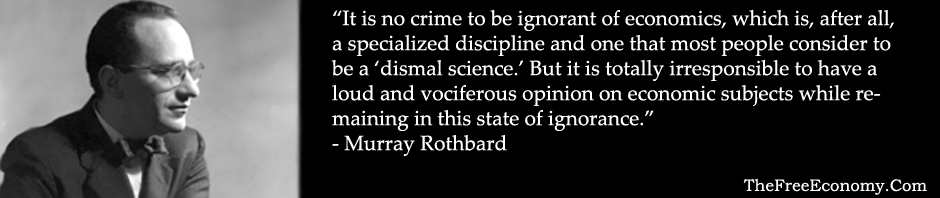
Murray Rothbard

Murray Rothbard

By the late 19th century, the Morgans took the lead in trying to pressure the US government to cartelize industries they were interested in — first railroads and then manufacturing: to protect these industries from the winds of free competition, and to use the power of government to enable these industries to restrict production and raise prices.

In particular, the investment bankers acted as a ginger group to work for the cartelization of commercial banks. To some extent, commercial bankers lend out their own capital and money acquired by CDs. But most commercial banking is “deposit banking” based on a gigantic scam: the idea, which most depositors believe, that their money is down at the bank, ready to be redeemed in cash at any time. If Jim has a checking account of $1,000 at a local bank, Jim knows that this is a “demand deposit,” that is, that the bank pledges to pay him $1,000 in cash, on demand, anytime he wishes to “get his money out.” Naturally, the Jims of this world are convinced that their money is safely there, in the bank, for them to take out at any time. Hence, they think of their checking account as equivalent to a warehouse receipt. If they put a chair in a warehouse before going on a trip, they expect to get the chair back whenever they present the receipt. Unfortunately, while banks depend on the warehouse analogy, the depositors are systematically deluded. Their money ain’t there.

An honest warehouse makes sure that the goods entrusted to its care are there, in its storeroom or vault. But banks operate very differently, at least since the days of such deposit banks as the Banks of Amsterdam and Hamburg in the 17th century, which indeed acted as warehouses and backed all of their receipts fully by the assets deposited, e.g., gold and silver. This honest deposit or “giro” banking is called “100 percent reserve” banking. Ever since, banks have habitually created warehouse receipts (originally bank notes and now deposits) out of thin air. Essentially, they are counterfeiters of fake warehouse receipts to cash or standard money, which circulate as if they were genuine, fully backed notes or checking accounts. Banks make money by literally creating money out of thin air, nowadays exclusively deposits rather than bank notes. This sort of swindling or counterfeiting is dignified by the term “fractional reserve banking,” which means that bank deposits are backed by only a small fraction of the cash they promise to have at hand and redeem. (Right now, in the United States, this minimum fraction is fixed by the Federal Reserve System at 10 percent.)

Fractional Reserve Banking

Let’s see how the fractional-reserve process works, in the absence of a central bank. I set up a Rothbard Bank, and invest $1,000 of cash (whether gold or government paper does not matter here). Then I “lend out” $10,000 to someone, either for consumer spending or to invest in his business. How can I “lend out” far more than I have? Ahh, that’s the magic of the “fraction” in the fractional reserve. I simply open up a checking account of $10,000 which I am happy to lend to Mr. Jones. Why does Jones borrow from me? Well, for one thing, I can charge a lower rate of interest than savers would. I don’t have to save up the money myself, but can simply counterfeit it out of thin air. (In the 19th century, I would have been able to issue bank notes, but the Federal Reserve now monopolizes note issues.) Since demand deposits at the Rothbard Bank function as equivalent to cash, the nation’s money supply has just, by magic, increased by $10,000. The inflationary, counterfeiting process is under way.

“Unfortunately, while banks depend on the warehouse analogy, the depositors are systematically deluded. Their money ain’t there.”

The 19th-century English economist Thomas Tooke correctly stated that “free trade in banking is tantamount to free trade in swindling.” But under freedom, and without government support, there are some severe hitches in this counterfeiting process, or in what has been termed “free banking.”

First, why should anyone trust me? Why should anyone accept the checking deposits of the Rothbard Bank?

But second, even if I were trusted, and I were able to con my way into the trust of the gullible, there is another severe problem, caused by the fact that the banking system is competitive, with free entry into the field. After all, the Rothbard Bank is limited in its clientele. After Jones borrows checking deposits from me, he is going to spend that money. Why else pay for a loan? Sooner or later, the money he spends, whether for a vacation, or for expanding his business, will be spent on the goods or services of clients of some other bank, say the Rockwell Bank. The Rockwell Bank is not particularly interested in holding checking accounts on my bank; it wants reserves so that it can pyramid its own counterfeiting on top of cash reserves. And so if, to make the case simple, the Rockwell Bank gets a $10,000 check on the Rothbard Bank, it is going to demand cash so that it can do some inflationary counterfeit pyramiding of its own.

But, I, of course, can’t pay the $10,000, so I’m finished. Bankrupt. Found out. By rights, I should be in jail as an embezzler, but at least my phoney checking deposits and I are out of the game, and out of the money supply.

Hence, under free competition, and without government support and enforcement, there will only be limited scope for fractional-reserve counterfeiting. Banks could form cartels to prop each other up, but generally cartels on the market don’t work well without government enforcement, without the government cracking down on competitors who insist on busting the cartel, in this case, forcing competing banks to pay up.

Posted in Freedom/Liberty, LIFE Leadership | 17 Comments »