Since the dawn of civilization, freedom and force have fought for mastery in human societies. Freedom, to the liberty-lover, implies the ideal way to freely reward people for serving others. Each society is set up to follow the laws of the land (just laws that permit no person or group to receive a special deal), a society where the State’s role is like referee rather than a participant, ensuring a level playing field for all competitors. The ideal of ordered freedom is the best mankind can aspire to this side of heaven, or so the liberty-lovers claimed.
To Statist controllers, in contrast, freedom leads to chaos, greed, and an unholy desire to separate one’s self from the herd. Absolute force is the Statist’s answer to ensure society remains peaceful, compliant, and equal. Naturally, the State must be given this absolute power, a power entrusted to a group of ruling-elite, who will make decisions not based upon personal advantages but only for the good of society. The masses must simply trust and obey, or so the Statist controllers claimed.
Interestingly, the battle between liberty and force has a celebrated history. Force/Freedom battles between the Pharaoh vs. Moses, Caesar vs. Cicero, Jesus vs Pharisees, are just a few of the legendary conflicts that come to mind. In one sense, the history of the world can be viewed as a series of particular battles in the universal struggle between the State and Society to secure either force or freedom.
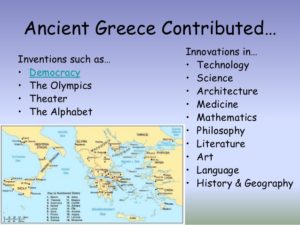
Ancient Greece Innovations
For most of human history, the controllers have had the upper hand. The Egyptians, Babylonians, and Persians elites ruled absolutely as god-kings though centrally-controlled oppressive civilizations. Although there were flickers of freedom scattered throughout society, the flame was snuffed out before it could catch fire. Something, however, changed with the birth of Greek civilization, for the pendulum clearly moved towards liberty. While many explanations have been suggested for freedom’s growth, perhaps the most significant was the multitude of Greek city-states increased the number of competitors seeking centralized control over Greek society. Whereas in previous civilizations the State controlled vast swaths of territory extending for thousands of miles, the Greek landscape, mountainous with few inland rivers, made centralized control over the whole are extremely difficult.
As a result, smaller units of centralization, the city-state, prospered. Each city-state’s laws were only enforced within the confines of its territory, effectively creating hundreds of mini-states ruling over a fragmented Greek society. This was the dreaded conditions for chaos that the absolutist controllers feared. However, instead of collapsing into chaos, the competition amongst city-states for political, economic, and military power, created innovation and improvements like never seen before. The competition amongst the city-states led to cooperation within them.
Instead of the oppressive standardization experienced by cities within the former centralized tyrannical States, the fragmented, decentralized city-states, shockingly, through the competition for power and glory, created, as it were, a free market environment for State services – each city seeking to impress the other Greek city-states with its ability to solve the political, economic, and religious challenges better than its neighbors. Of course, this led to a significant increases in freedom for the people since ideas were favored, not because the bureaucratic representatives of the god-king issued it, but rather because the idea worked to solve the challenge it intended to address. The city-state that solved the most issues and served its people the best would rise in this free market environment against its rivals.
Talent, effort, and innovation became the buzz words that drove the Greeks forward in their mission to achieve their rational and aesthetic objectives. Practically every field of the arts and sciences saw levels of innovation and discovery never witnessed before as society’s cream rose to the top made possible by the increased societal freedom. The monolithic State no longer controlled every city, and thus, the brightest minds with the best ideas were rewarded as each city sought to outdo its competitors in the arts, sciences, and even the sporting events of its day.
The Greek miracle, according to historian Michael Grant, was accomplished by the work of less than 500 individuals. In other words, although millions lived and died in Greece, freedom enabled 500 people to use their gifts to bless everyone in the Greek communities. Where previously, talented individuals had lived and died in obscurity, the freedom allowed this cream to rise for the benefit of all. This created the world’s first Renaissance, not repeated until the Italian Renaissance over a millennia afterwards.
Perhaps the biggest lesson to learn from the Greek experience is the importance of competition, namely, when the number of competitors in any field increases, society benefits. Of course, the antithesis is true also – when the number of competitors is limited in any field, society is harmed. The monolithic State, not surprisingly, is the peak of reduced competition since there is no competition. The State, in a word, is like one contestant in a beauty contest, and she always takes first place. 🙂 This does not mean the author believes in anarchy; rather, the goal should be a fragmented state similar to the ancient Greeks. In fact, this is what Oliver DeMille and I proposed in our New York Times bestseller LeaderShift. Stay tuned for Part 2 where I unpack the fragmented state and how to protect against anarchy. Happy Memorial Day!
Sincerely,
Orrin Woodward: LIFE Leadership Chairman of the Board