Orrin Woodward on LIFE & Leadership

Inc Magazine Top 20 Leader shares his personal, professional, and financial secrets.

Archive for March, 2013

LeaderShift & the Power Pendulum

Posted by Orrin Woodward on March 29, 2013

Here is another snippet of the introduction I am working on for a future book on freedom. I received 10 copies of the final version of the LeaderShift book yesterday and I am so pumped. It looks great and it is going to have such an impact. I am loving LIFE and ready to help move the Power Pendulum back into concord! Here is a couple of paragraphs describing the Power Pendulum.

Sincerely,

Orrin Woodward

Mankind’s quest for concord (peace and harmony) within society is as old as human civilization. Concord, the ideal balance between force and freedom, lies between the extremes of chaos and coercion. The freedom and force movements in every society between chaos, concord and coercion is remarkably similar to a pendulum’s trajectory. As a result, the author developed the Power Pendulum to track the trajectory between force and freedom within society. Society is defined as a community of individuals who combine together to pursue common objectives. However, within any working society there must be a power strong enough to ensure justice internally and externally. To meet this responsibility, society forms a government (State) to apply force when any of societies members attempt injustice upon other members. While free societies secure the cooperation of most of its members through persuasion, the State is the watchman provided to protect its peaceable members from those who attempt to plunder others for personal gain. In other words, the state is given the power of coercion to ensure disobedience to laws is punished. The question becomes how much coercion is necessary to ensure internal and external peace without the government itself becoming the plunderers of its people.

In healthy societies, the Power Pendulum moves away from the radical edges (either chaos or coercion) into the center position of concord. The Power Pendulum measures the State force applied within society, ranging from too little on one side (leading to chaos) to too much on the other side (leading to coercion). The quested for resting spot of the Power Pendulum is concord – limited force applied only to maintain internal and external peace and justice. Indeed, society thrives when the pendulum is balanced in concord because sufficient power is present to ensure order-liberty, but not enough to drift the pendulum towards coercion and loss of liberties. Although the State is part of the Society, society is a voluntary organization while the State operates through coercion. The State and Society can be summarized in the following way. The State is part of society and they overlap in many instances. However, society uses the principle of voluntary cooperation, working through good will of its members. The State, on the other hand, uses the principle of compulsion, working with force or threatened force upon its members. Paraphrasing historian Ernest Barker, society’s method is elasticity while the State’s method is rigidity. But, if society is divided between methods of force and freedom, how can it remain free, especially when part of society (the State) is given a force monopoly? Isn’t this force just as likely to be used against society as for its benefit? The answer to this State/Society paradox is the key to resolving the Power Pendulum. Through ending the trajectory swings between chaos and coercion, Western Society can finally complete the 2500 year quest for concord.

Posted in Freedom/Liberty | 45 Comments »

Leadership Soft Skill: Motivating & Engaging Others

Posted by Orrin Woodward on March 28, 2013

Leadership Soft Skill: Motivating & Engaging Others

Leadership Motivation

Leadership Motivation

The seventh leadership soft skill, according to the Center for Creative Leadership, is motivating and engaging others. This is the crux of leadership. For if a person cannot inspire others to achieve more, he is not truly leading.

Before leaders can inspire others, they must be inspired themselves. Reading, listening, and associating is essential for any leader because, as Ronald Reagan once said, “I am not a great man; I’m just committed to great ideas.” In essence, when a person swims in great ideas, the world-view, mindset, and attitude soak into him.

Unfortunately, few people understand this. Most run from business to business, seeking the shortcut to success. When actually, success is a matter of immersion into the greatest thoughts and leaders one can find. Why I love the LIFE community is that it provides the association necessary to learn the great ideas from great leaders so that people can do great things. The testimonies of the changed lives in LIFE is amazing even though I have been witnessing this first hand for years.

There is an old saying that expresses a candle must be lit before it can light another one. In the same way, a person must set himself on fire with great ideas and then light others on fire by his passion, belief, and vision. The greatest leaders, in other words, were first great followers. In fact, I have said for years that if you are too big to follow then you are too small to lead.

The world needs a leadershift. It won’t happen until enough people immerse themselves into the greatest ideas on leadership available today. Each generation has its own challenges that require responses. The founding generation responded by creating a company. The civil war generation responded by ending slavery. The WWII generation responded by winning a global conflict. Today’s generation must respond by launching the leadershift!

Sincerely,

Orrin Woodward

Posted in Leadership/Personal Development | 53 Comments »

A Leader’s Heart & Words

Posted by Orrin Woodward on March 27, 2013

Developing the Heart for Leadership

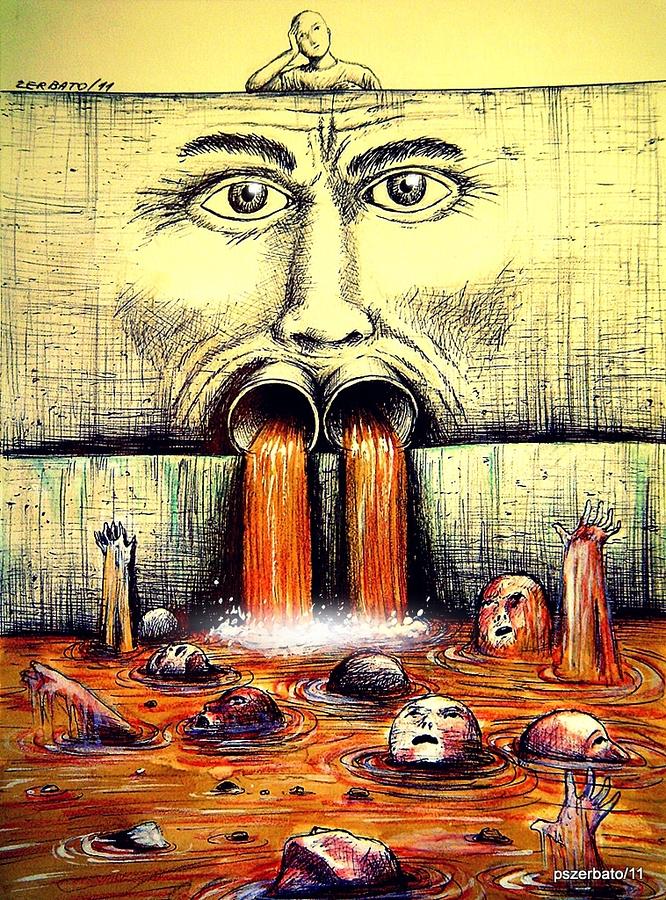
The Mouth Speak: Paulo Zerbato

The Mouth Speak: Paulo Zerbato

Give me thirty minutes with anyone and through asking a series of simple questions, his words will reveal his heart. Whatever the heart dwells upon will ultimately be what the mouth speaks about. Consequently, when a person desires to change his attitude, he must dive into the recesses of his own heart. In other words, a person cannot fake love for people for long before the fakers hypocrisy is revealed. Indeed Abraham Lincoln said similarly, “You can fool some of the people some of the time, but you cannot fool all of the people all the time.”

Although people with bad hearts can achieve a level of success in community building, it only last for a season because the community rejects false leadership. These people tend to jump from network to network instead of looking within their own heart or, worse yet, blame networking for their problems and hide from their sinful heart by playing the victim card.

In fact, community builders, who have maintained a solid business for a decade or longer, are extremely rare because few leadership culture’s work on heart issues. The LIFE Business, on the other hand, begins with the heart. For, in reality, a person’s heart  is the essence of his leadership. Leadership is who you are more than what you do. Does a leader truly love his people? Does he truly desire to serve them or just himself? Is he willing to sacrifice for them when sacrifice is necessary?

Everyone can say what he will do under these situations, but a community experiences first-hand the behavior of its leader when challenging circumstances arise. Today’s lesson is simple, but not easy. While learning the techniques to build a solid community, be sure to also pray for a Christ-centered heart that desires good for everyone that you come into contract with. Remember, at the end of the day, the relationships are infinitely more important than the task.

The LeaderShift demands leaders with loving hearts in order to lead communities. Below is a short article I wrote on the words flowing out of the mouth. My book RESOLVED covers much more on this subject.

Sincerely,

Orrin Woodward

Out of the Abundance of the Mouth

For out of the abundance of the heart the mouth speaks. – Matthew 12:34

It’s amazing how much one can learn from a person just by listening.  People who believe that they have a positive attitude, give away their negativity when they speak. I like to begin mentoring sessions with, “Tell me the good, the bad, and the ugly.  The good we will celebrate, the bad we will make adjustments, and the ugly we will pray about.”  This is sure to get people talking, helping me to identify, not just what happened, but how they are thinking about what happened.  Which, in the end, is more important than the event; since the event happens only once, but how they think about the event repeats over and over in their minds and hearts.  Painful experiences happen to both achievers and non-achievers.  The difference is in the responses, achievers learning from the bad cards, choose to draw more; while non-achievers complaining about the cards of life being stacked against them, choose to quit the game.  But what’s actually stacked against them is their own thinking. Winners received the same stimulus, but chose to respond differently than the non-winners.

When something bad happens to a winner, he immediately focuses on minimizing its effects, learning anything he can from the situation.  No pity parties, no woe is me attitudes, just resolution and teachable moments.  The extent a person wins in life, is many times, related to how quickly he can go from problem identified to problem solved, learning through the pain of the process.  When people stay down for weeks, months, sometimes even years at a time, can they honestly expect a positive outcome?  There is only so much mental energy, when it’s spent dwelling on negative thoughts, allowing them to enter the heart, eventually pouring out of the mouth, why is anyone shocked that so little is accomplished in life?  The key is pulling the weeds (negative thoughts) upon entering the mind, not allowing them to move into the heart and out the mouth.  Weeds are much easier to pull when immediately seized when they enter the mind, but much tougher when allowed to root in the heart, eventually flowing out of the mouth.  Don’t provide fertile soil in the mind for weeds; don’t allow weeds to seed into the heart; and whatever you do, don’t allow negative seeds to spread out of your mouth, infecting other people. The former leader literally becoming a carrier of negativity.

Leaders are gardeners of their own minds, identifying and pulling weeds quickly.  True leaders are never down period, choosing to pull weeds promptly.  But if they ever were down, they certainly wouldn’t spread the disease to their communities, since they know that pulling weeds is an inside job.  If a weed is extra difficult, then leaders have the discipline to seek out their mentors for help, refusing to contaminate others with their weed seeds.  One of the first, and most important, assignments of any would-be leader is consistent and prompt pulling of his own weeds.  It’s not an option if he plans on inspiring others, since no one is inspired by a bitter attitude and sour faced person.  Pull your weeds, guard your mind, protect your heart, for out of the abundance of the heart the mouth speaks.  Leadership occurs when people having confidence in the leader, if a person’s attitude is unpredictable, he disqualifies himself for leadership, until he learns to pull his own weeds. Leaders are dealers in hope, change, and growth, beginning inside of them.  Perhaps it’s time that we launched a leadership revolution, let’s start the revolution by tending to our own gardens.  God Bless, Orrin Woodward

Posted in Leadership/Personal Development | 52 Comments »

Transformed by the Renewing of Your Mind

Posted by Orrin Woodward on March 26, 2013

The Bible states people are transformed by the renewing of their minds. The LIFE Business provides truth in the 8F’s of life to do just that. Here is an article I wrote several years back that discusses why so few people seem hungry to transform themselves. Nonetheless, I cannot think of anything else that a person can do where he can have a bigger impact than to help lead people to truth. I know the huge difference it has made in my life and many others. The LeaderShift is coming and I am so looking forward to April 16th!

Sincerely,

Orrin Woodward

I can remember growing up, watching the Dallas Cowboys religiously every Sunday afternoon.  I watched every game possible, as I was sure that my (yes, I owned them in my imagination) Cowboys played better when I cheered them on.  Year after year, I supported the team, collecting the football cards, studying all the statistics, and buying every football magazine to keep abreast of the latest roster developments.  What was I paid for this magnificent display of loyalty you ask?  Absolutely nothing, in fact, I paid out money, an item in short supply, for the joy of vicariously being part of the Tom Landry’s legendary Cowboy organization.  As I grew older, my fanaticism diminished slightly, but even as a newly married young man, with responsibilities of my own, working all week, getting my MBA at night, I still watched the games.  While the game was on, in an attempt to impress my friends and family, I would predict the plays by studying the Cowboy’s formations.  My fans would ‘ooh’ and ‘ah’ in approval at another play predicted successfully.  When the Cowboys started winning Super Bowls, Troy Aikman received a huge salary increase, Emmitt Smith hit the pay dirt with his new contract, and so did Michael Irvin, but I, on the other hand, was still busted, offered no loyalty bonus as the Cowboys biggest fan (Ok, I had plenty of competition here).  There are times in a person’s life, just a few, where truth whispers to you, not quite audible, but  distinctly there.  Most choose to ignore it, changing the channel on the TV, turning up the radio, or grabbing another beer, which is what I tried to do, but I couldn’t shake it.  Eventually, the whisper turned into a roar, it blared in my mind, consuming my thoughts, making me nauseous, unable to enjoy the game, so I walked into the another room to think.  Many question arose in my mind. Why was I spending so much time watching other people win in life, while I plodded along in anonymity.  Why is my life seemingly incomplete, unless I catch the latest game?  Is this huge time commitment really taking me where I want to go in life?

Thankfully, I had parents who had taught me the American Dream, the belief in our country and the ability for anyone willing, to accomplish anything that they set their heart and mind to do.  I had, only months before, been introduced to a community building business, and had started reading and listening to grow myself.   That day, I made a decision to stop watching other people’s success and start creating my own success.  Through God’s grace, a loving wife, hard work, and great friendships developed along the way, Laurie and I converted the hours spent watching sports into the hours necessary to build our business, eventually leaving our jobs, freeing up lots of time.  Over the years, I have seen many other people, faced with the same time challenges, make different decisions, choosing the sports teams success over their own success.  If that is what someone wants to do, then more power to them, as I believe in freedom that strongly.  But I knew, that many of my friends, really wanted to win, but didn’t seem capable of overcoming the inertia of their LazyBoy chair to get into action.  They wanted to win, would have loved the results of winning, but never seemed to do what it takes to be a champion.  This success paradox puzzled me for years.   But as a leader, I focused on serving those who were ready to change, while loving and encouraging the rest of the community who weren’t ready to make that level of commitment to success, hoping that eventually they would come around.

Several days ago, while contemplating why nearly everyone loves sports excellence, yet only a few love personal excellence, I had an epiphany, finally answering the success paradox.  The more I thought about it, the stronger I feel that my hypothesis, for why more people don’t pursue personal success, will stand the scrutiny of reason and time.  I believe human beings are designed to win, being hard wired to strive for excellence in life, but, due to man’s fallen nature, the wires are crossed, being misconnected at birth.  People do not strive for success because they believe they are unworthy and incapable of winning, so they seek out victories vicariously through people, teams, or bands that are winning around them.  Here is how the Bible explains the consequences of man’s violations of God’s law and the subsequent fall from grace, Genesis 3:18/19 reads:

Thorns also and thistles shall it bring forth to thee; and thou shalt eat the herb of the field; In the sweat of thy face shalt thou eat bread, till thou return unto the ground; for out of it wast thou taken: for dust thou [art], and unto dust shalt thou return.

God’s original hard wiring proceeded from dream development directly to dream accomplishment, with little struggle to bring forth results.  But after man’s fall, work was brought work into the equation, forcing man and woman to work hard (thorns and thistles), enduring pain to bring children and the fruits of all labor into the world.  Mankind still loved winning, but now had this alien principle, of painful labor to overcome, in order to experience victories.  One cannot go from dream to victory without experiencing the struggle step, earning a living by the sweat of your brow.   Thus my hypothesis, because of the faulty wiring due to the fall, people want success, but not the hard work and long hours associated with it. In an effort to obtain the results without the work, people are drawn to the perceived shortcut, living vicariously off of other people’s victories through being a fan, not a performer.  In other words, people experience a feeling of success through their favorite sports team, without having to endure the level of pain and discipline needed to really win.  This is the vicarious victory, the feeling of accomplishment when the team wins, sharing in the celebration, feeling part of the winning team, but conveniently skipping the pain of the process involved in becoming a winner.  But the real victory in life is who people become in the dream, struggle, victory process, so by shortcutting the process, they shortcut their own personal development.

One might be thinking, if the struggle is now part of the process after the fall, why not just rewire the brain to achieve success according to the new rules of life?  That is a great question, leading me to the next success thought.   We are all born to win, even after the painful fall, but desperately need reprogramming from the Master programmer.  Without His reprogramming, people believe that they are unworthy of greatness, believing life’s trials and tribulations beyond their ability to overcome, misunderstanding the effects of the fall, they internalize the pain, believing they are worthless, instead of allowing the pain of rebellion to lead them back to their Maker, a Maker who would reveal to them their true destiny.  The truth is that we are made in the image of God and have endless potential inside of us, accomplishing greatness when we serve our Maker and others.  The reminds me of the inspiring poem written my Myra Brooks Welch called The Touch of the Master’s Hand:

It was battered and scarred,
And the auctioneer thought it
Hardly worth his while
To waste his time on the old violin,
But he held it up with a smile.
“What am I bid, good people”, he cried,
“Who starts the bidding for me?”
“One dollar, one dollar, Do I hear two?”
“Two dollars, who makes it three?”
“Three dollars once, three dollars twice, going for three”,

But, No,
From the room far back a grey haired man
Came forward and picked up the bow,
Then wiping the dust from the old violin
And tightening up the strings,
He played a melody, pure and sweet,
As sweet as the angel sings.

The music ceased and the auctioneer
With a voice that was quiet and low,
Said “What now am I bid for this old violin?”
As he held it aloft with its’ bow.
“One thousand, one thousand, Do I hear two?”
“Two thousand, Who makes it three?”
“Three thousand once, three thousand twice,
Going and gone”, said he.

The audience cheered,
But some of them cried,
“We just don’t understand.”
“What changed its’ worth?”
Swift came the reply.
“The Touch of the Masters Hand.”

And many a man with life out of tune,
All battered with bourbon and gin,
Is auctioned cheap to a thoughtless crowd
Much like that old violin.
A mess of pottage, a glass of wine,
A game and he travels on.
He is going once, he is going twice,
He is going and almost gone.
But the Master comes,
And the foolish crowd never can quite understand,
The worth of a soul and the change that is wrought
By the Touch of the Master’s Hand.

My dear reader, you are the the beautiful violin, having a worth beyond any asking price, lacking only the touch of the Master’s hand to accomplish your life’s purpose.  Inside of each person is talents and skills beyond imagination, but unless the wires are reconnected to the new conditions of life, people will wander aimlessly, wondering why life is so hard, and their dreams seem so far away. Do not succumb to the negativity surrounding you, but search out the Master to be reprogrammed for true greatness.

But can’t you just reprogram yourself, without the need of the Master’s help?  Sadly, to a certain extent, yes.  But the problem is that self programmed people move through life with themselves as the center of existence.  A person can become moral, hardworking, and successful financially without the master, literally becoming prideful at his own work, but can never experience true joy, unless he is one of the Master’s instruments.  I have lived portions of my life in all three conditions.  For a time, I believed that I was junk, acting out this faulty belief system, hurting myself and others. For a time, I believed I was the programmer, developing a pride in my professional success, while attempting to ignore my personal misery.  But finally, mercifully, came the touch of the Master, and my life has never been the same since.  From my vantage point, the one essential attribute, lacking in our modern world is belief.  Belief, not in yourself through your own reprogramming, but a belief in the God of the universe and in his Son, the Master who touches the human hearts, changing them forever.  No longer will one need to pursue victories vicariously through their favorite sports teams, movie stars or rock bands, as they will have the Master Himself, pursuing victories for Him in their lives.  I still enjoy winning sports teams, but they are no longer define my life, as I have my own life to live, focusing on winning the race set before me, pressing towards my mark in life.  No longer will you feel unworthy of success, because you will know that you were designed by the Master with a specific purpose in mind.  No longer will you run to experience the elation of success vicariously, because you will live the Dream, Struggle, Victory process in your own life, developing into a leader so that you can serve the Master and others.  Moreover, when people truly believe in themselves, they will pursue their own personal and professional excellence with as much ardor and passion as they formerly pursued their vicarious excellence?  Don’t misunderstand me, I think being fans of successful people is important and I encourage my kids to have heroes, not to displace their own success, but merely as models for what is possible to those who dream, believe and achieve.

Imagine if all of sports fans, who love watching successful coaches lead their teams, chose to live a life of excellence to the same standards of excellence that they hold their sports teams up to?  Can you imagine if all of the fans, fans who expect nothing less than excellence from their favorite teams, developed the same high expectations for their families and work teams?  Fans that pay good money to see excellence in sporting events, will, in their personal and professional lives, no longer tolerate mediocrity, holding to the same success standards in their own lives, that they expect from their favorite sports teams?  The paradox of success is solved only when we view life through a Biblical lens.  Several day ago, I asked why the paradox existed.  Why fans, who love excellence in competitive sports enough to pay for the right to experience it, will not apply the same standards of excellence in their own competitive professions, even though others are paying for the right to experience it.  The answer to the paradox is lack of belief in themselves and their purpose in life.  The are beautiful people, with amazing potential, with great passion (we can see that at every sporting event), but missing out on their purpose in life, due to the faulty wiring at birth.

As a life coach, for the last 18 years, I have mentored many people through the reprogramming process.  Nothing brings greater joy to me on this earth, than having a front row seat, watching the Master hands restore a work of art to its original beauty.  I used to be a fan of a sports team, a team that I had never met, spent hours of my time, never to be restored, watched other people pursue their dreams as I buried my own.  Now I am called to mentor the greatest group of leaders in the world, spending hours of my time serving these masterpieces, pursuing my destiny by helping others pursue theirs.  I am a blessed man already, but my dreams are even bigger.  I dream of a world where all people, that are willing, can pursue excellence.  I dream of a world where all people are free to pursue their God given visions.  I dream of a world, where men and women have the courage to dream, the perseverance to struggle and the humbleness to be victorious, having corrected their hard wiring, by a touch of the Master’s hand, no longer afraid to become what they were called to be. God Bless, Orrin Woodward

Posted in Faith | 53 Comments »

Liberty, Law, & Order

Posted by Orrin Woodward on March 25, 2013

Western Society has drifted from ordered liberty into increasing coercion of its members. In an article several years ago, I quoted extensively from an article by Dr. Mario Pei, who witnessed the debilitating effects of coercion upon society in Fascist Italy. Unfortunately, few seem to learn the lessons of the power pendulum’s drift out of concord into either chaos or coercion.

LeaderShift, however, can change this. It begins the educational process needed for concerned citizens to restore concord and keep Western Society free. Tens of thousands of people are rallying to the cause as many know that something isn’t right, but cannot pinpoint the root cause. Thankfully, LeaderShift has identified the cause and even proposed a fix to our present maladies.

The LIFE Business is gathering a group of citizens who are hungry to learn and serve, focuses on making a difference in society. Here is a portion of Dr. Mario Pei’s article.

Sincerely,

Orrin Woodward

Dr. Mario Pei, who came to this country from Italy in 1908, is Professor of Romance Philology at Columbia University in New York. He is the author of several distinguished books and numerous magazine articles. The Foundation was given special permission by the Saturday Evening Post to reprint the above article. Copyright 1952 by The Curtis Publishing Company

When I first came to America, many years ago, I learned a new meaning of the word “Liberty”—freedom from government.

I did not learn a new meaning for “democracy.” The European country from which I came, Italy, was at that time as “democratic” as America. It was a constitutional monarchy, with a parliament, free and frequent elections, lots of political parties and plenty of freedom of religion, speech, press, and assembly.

But my native country was government-ridden. A vast bureaucracy held it in its countless tentacles. Regardless of the party or coalition of parties that might be in power at the moment, the government was everywhere. Wherever one looked, one saw signs of the ever present government: in the uniforms of numberless royal, rural, and municipal policemen, soldiers, officers, gold-braided functionaries of all sorts. You could not take a step without government intervention.

Many industries and businesses were government owned and government run railroads, telegraphs, salt, and tobacco among them. No agreement, however trivial, was legal unless written on government-stamped paper. If you stepped out of the city into the country and came back with a ham, a loaf of bread, or a bottle of wine, you had to stop at the internal-revenue barriers and pay duty to the government, and so did the farmers who brought in the city’s food supply every morning. No business could be started or run without the official sanction of a hundred bureaucrats.

Young people did not dream of going into business for themselves; they dreamed of a modest but safe government job, where they would have tenure, security, and a pitiful pension at the end of their plodding careers. There was grinding taxation to support the many government functions and the innumerable public servants. Everybody hated the government—not just the party in power, but the government itself. They had even coined a phrase, “It’s raining—thief of a government!” as though even the evils of nature were the government’s fault. Yet, I repeat, the country was democratically run, with all the trappings of a many-party system and all the freedoms of which we in America boast today.

America in those days made you open your lungs wide and inhale great gulps of freedom-laden air, for here was one additional freedom—freedom from government.

The government was conspicuous by its very absence. There were no men in uniform, save occasional cops and firemen, no visible bureaucrats, no stifling restrictions, no government monopolies. It was wonderful to get used to the American system: to learn that a contract was valid if written on the side of a house; that you could move not only from the city to the country but from state to state and never be asked what your business was or whether you had anything to declare; that you could open and conduct your own business, provided it was a legitimate one, without government interference; that you could go from one end of the year to the other and never have contact with the national government, save for the cheery postman who delivered your mail with a speed and efficiency unknown today; that there were no national taxes, save hidden excises and import duties that you did not even know you paid.

In that horse-and-buggy America, if you made an honest dollar, you could pocket it or spend it without having to figure what portion of it you “owed” the government or what possible deductions you could allege against that government’s claims. You did not have to keep books and records of every bit of income and expenditure or run the risk of being called a liar and a cheat by someone in authority.

Above all, the national ideal was not the obscure security of a government job, but the boundless opportunity that all Americans seemed to consider their birthright. Those same Americans loved their government then. It was there to help, protect, and defend them, not to restrict, befuddle, and harass them. At the same time, they did not look to the government for a livelihood or for special privileges and hand­outs. They were independent men in the full sense of the word.

Foreign-born citizens have been watching with alarm the gradual Europeanization of America over the past twenty years. They have seen the growth of the familiar European-style government octopus, along with the vanishing of the American spirit of freedom and opportunity and its replacement by a breathless search for “security” that is doomed to defeat in advance in a world where nothing, not even life itself, is secure.

Far more than the native born, they are in a position to make comparisons. They see that America is fast becoming a nineteenth century-model European country. They are asked to believe that this is progress. But they know from bitter experience that it just isn’t so.

Milk on the Doorstep

“It is remarkable,” comments George Schwartz, an English writer, in an article in The New York Times Magazine, “how many people can see no sense in the existing order of Western society, the easiest criticism of which is that it is not order but disorder. With the milk on the doorstep every morning, the free economy is denounced as unplanned, uncoordinated, and chaotic.”

It is a valid observation. There are countries—notably Russia—that have all the necessary material resources but still can’t get the morning milk to the doorstep. Their society’s system of production and distribution is fully ordered, carefully blueprinted by government experts. But they have the plan and no milk while we have the milk and no plan.

The fact is, of course, that our economy does not exist in disorder. In the milk business, to take the everyday example mentioned by Mr. Schwartz, there are literally thousands of individuals—farmers, truckers, processors, and salesmen, and the thousands more who are their suppliers—who make the major or minor decisions that get the milk to the doorstep, and earn a profit in the process. No group of government experts could equal the input of knowledge, industry, flexibility, and efficiency that is the combined total contribution of all of these individuals.

Posted in Freedom/Liberty | 39 Comments »

Jeff Daniels, American Freedoms & LeaderShift

Posted by Orrin Woodward on March 22, 2013

Jeff Daniels, playing Will in his TV show, believes America is in decline. In fact, he believes this so emphatically that some of his language in the video is not children-friendly. I apologize in advance for some of the wording in this video. However, the points he makes and the discussion around it are so valuable that I decided to post it. Mr. Daniels has pinpointed the effects of the Five Laws of Decline upon American society. Nonetheless, identifying the effects and solving the issues are not one and the same thing. The Five Laws of Decline must be rooted out of our culture, ending the plunder of working citizens on both sides of the political aisle.

LeaderShift is Oliver DeMille and my proposal on how to do just that. I am posting Jeff Daniels video which states the challenge and then the trailer for LeaderShift which responds to the challenge. Yes, America, and the West, have much work to do, but what a great time to be alive and play a part in the LeaderShift!

Sincerely,

Orrin Woodward

Posted in Freedom/Liberty | 90 Comments »

LeaderShift: The Challenge & Response

Posted by Orrin Woodward on March 21, 2013

LeaderShift: The Challenge & Response for Western Civilization

Here are my closing thoughts on a book describing the background research into the soon-to-be-released LeaderShift book. I am more convinced now than ever that Western Civilization cannot only be saved, but be placed in a better position than ever before when people learn the systemic principles behind the Six Duties of Society and the Five Laws of Decline. Don’t take my word for it, do your own studying and use this article and the last one as a place to start. The LIFE Business is a group who are committed to making a difference by first making a difference in their own families life.

Sincerely,

Orrin Woodward

Incidentally, the Federalist feared the Articles of Confederation would fall into chaos and civil war like the ancient Greek society did. To avoid this scenario, they created a stronger federal government with checks against the FLD. In truth, however, what resulted was quasi-federal/quasi-state governmental structure that left sovereignty to be debated between the states and federal government. This is remarkably similar to the Roman Republic’s divided sovereignty between the Senate and People. Consequently, just as the Roman Republic’s struggle for sovereignty was settled by military force in its civil war, so too did America’s Civil War settle the sovereignty question. Furthermore, just as the Roman Republic’s pendulum moved from the chaos of civil war to concord in the early Roman Empire, followed by increasing coercion and enervation of the people of the late Empire, so too did the American Republic fall into chaos during its civil war to concord in the early American Empire, followed by increasing coercion and enervation of the people in the later America Empire. In both instances, the pendulum’s momentum carried it from chaos through concord and into coercion. In sum, the Federalist fear of Greek-like chaos caused them to propose and implement Roman-like sovereignty debates culminating in civil war and finally coercion. Indeed, the FLD predicts this sequence in theory as accurately as history displays it in fact. The author believes this is the key lesson to learn from political history: How society can satisfy the SDS without correspondingly activating the FLD.

Each Anglo-Saxon case-study will be analyzed to determine how they satisfied the SDS. All three societies grew and prospered by fulfilling the SDS; however, all three also experienced the FLD within society. What, if any, lessons did the Anglo/Saxon’s learn from their ancient predecessors? The author seeks to identify the similarities and differences between the ancient and modern methods of blocking the FLD. Each society will be summarized for what it added to the political wisdom of hot to fulfill the SDS and check the FLD. Interestingly, America’s Founding Fathers studied the history of each previous society. What conclusions did they draw from these historical examples? Moreover, what methods did they implement into the Constitution to improve the SDS and check the FLD?  Although the jury is not complete on the Anglo/Saxon societies, the currents reports are not optimistic. In many ways, the modern siblings are repeating the same systematic mistakes as the Greco/Roman societies. Fortunately, today’s political leaders, by studying the SDS and FLD, can respond to the challenge and withdraw the Anglo/Saxon societies from the approaching precipice.

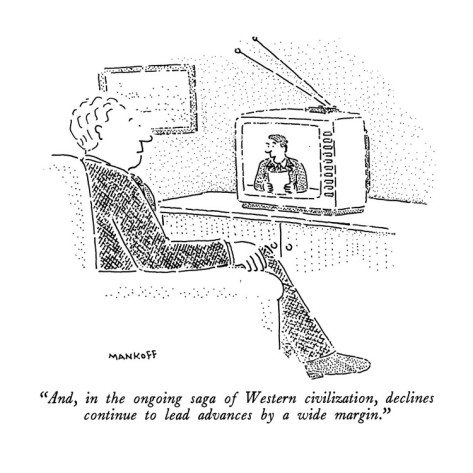
Robert Mankoff: Decline of Western Civilization

Robert Mankoff: Decline of Western Civilization

The final section of the book proposes a model for society based upon feeding the SDS and starving the FLD. The proposal builds in checks upon the FLD and encourages the SDS, balancing the drift between chaos, on one side, and coercion on the other. The Quest for Concord, the middle position of the pendulum, between the equally harmful extremes, is attainable. Regrettably, concord has never been sustained for more than a generation. The author will describe how all past societies failed through systematic ignorance of the dangers within the FLD. Fortunately, when the Five Laws of Decline are understood and checked, the author believes the West can achieve its quest for concord. This book then, isn’t an intellectual perusal through the history of a lost cause. Rather, it is written in the hope of reawakening the quest for concord and pointing out the adjustment that need to me made within society in order to attain it. This book provides a step-by-step roadmap for America, and the West, to step off of the political precipice and finally achieve the 2500 year quest for concord.

Historian, Arnold Toynbee, wrote how each society faces “challenge and response” crisis that demand great leadership to solve. While many may have written Western Society’s obituary, believing it has entered its twilight years, the author, in contrast, believes the West drift towards coercion is due to the “challenge” crisis not being addressed and solved. In truth, without understanding the systemic reason for the challenge, it would be practically impossible to respond to it. This book provides the systemic framework to make a “response” possible. Western Civilization’s rebirth is within reach. Without exaggeration, if this challenge is ignored much longer, Western society will fall. The once great Western Civilization will be added to the dustbin of history as another “rise and fall” tragedy. The question is: will Western Society learn the lessons of the SDS and the FLD soon enough to divert destruction?

Posted in Freedom/Liberty | 34 Comments »

Why America & Western Society Needs a LeaderShift

Posted by Orrin Woodward on March 20, 2013

The following is a portion of the introduction from a book I am working on about Western Society. LeaderShift is less than a month away from release and Oliver DeMille and I are pumped about it. However, there is much more to share on this important subject than can be contained in one book. The Quest for Concord is as old as Western Societies existence and has been attempted in every society since the Greeks. The LIFE Business intends to educate people on their history so we can ensure we protect the freedoms we enjoy for our posterity. Today’s reading is not light, but I promise if you take the time to read and comprehend, it will help you understand the pressing issues going on in today’s society.

Sincerely,

Orrin Woodward

Historical Case-Studies of SDS & FLD

With this understanding of the Six Duties of Society and Five Laws of Decline, the author can now describe more fully his chronological case-studies. The Greeks, as the founders of Western Civilization, were the first case-study society. The Greeks enjoyed a higher level of freedom than any previous ancient society. Consequently, the SDS were satisfied more fully than in any other previous society up until that time. Society and wealth grew rapidly as the Greek city-states traded with one another and confederated together to defend themselves against the Persian Empire. However, with no experience or understanding of the FLD, the stronger Greek city-states began plundering the weaker ones and the pendulum moved out of concord into chaos. Greek society divided into allied city-states (Sparta and Athens) who fought a series of civil wars, destroying their liberties and productivity. Both cities, and Greek society, were destroyed in a suicidal attempt to protect themselves from the plunder of the other. The Greek civil wars terminated when Greek liberty did with the arrival of the Roman Republic’s armies.

The Roman Republic began its leadership of Western Society and experienced great growth and prestige within society. However, it too was overcome by the temptations of the FLD when the Senate began to plunder small farmers and the provincials. The Gracchi brothers attempted reforms led to their assassinations and political wars for plunder led eventually to full-scale civil war within society. Injustice always carries within it the seed of its own destruction and the political wars eventually flowed into civil war and chaos. The political purges and civil wars of Marius and Sulla moved the pendulum into chaos. This only escalated further as the Senate and Populares fought for political leadership of the Roman Republic. The FLD killed the Roman Republic when political chaos paralyzed the rulers of Rome and opposing sides resorted to war. Clausewitz said, “War is politics by other means.” In the Republic’s case, “Politics was war by other means.”  The conservative elements (the Senate and Pompey) squared off against the reform-minded populist, led by Caesar. The end result was the destruction of the Roman Republic and the beginning of the Roman Empire. Even Caesar’s assassination did not restore the republic. The chaos was rooted too deeply within Roman society and Caesar’s death resulted in another round of civil wars, culminating with Augustus Caesar’s rule.

At long last, Western Society moved the pendulum from chaos towards concord. In essence, the Roman Empire early success was due to Caesar Augustus wisdom. He limited taxation, ended the plunder of the provinces, and shared power with the Senatorial class. Accordingly, the Roman peace (Pax Romana) produced concord, prosperity, and progress within society for the duration of Augustus rule. Unfortunately, wise rulers do not live forever. Predictably, the pendulum’s inertia, originally set in motion from chaos to concord, continued it momentum from concord into coercion. Later Caesars, ignoring Augustus’s example, increased their powers by further centralization, regulations, and taxes. The government’s gain in power and money was achieved parasitically, at the expense of society’s freedoms and prosperity. Indeed, by the end of the Roman Empire, the bloated bureaucracy coerced society’s wealth to feed the rapacious civil and military branches. Interestingly, when the Roman Empire fell, many within the oppressed Roman society, viewed the Gothic barbarians, not as invaders, but as liberators.

The Roman Empire, by Augustus’s restraint, solved many of the pressing issues that hindered the Republic. Consequently, society thrived under his SDS solutions and the empire expanded. The pendulum swung from chaos into concord and Roman society enjoyed the benefits through Augustus’s long tenure. Not surprisingly, however, the FLD temptation was too much for later Caesar’s with less talent and more greed. The FLD began to work its poison with the thriving society. The parasitic state ate the bowels out of the once-healthy society and the Roman Empire fell, less from external enemies, and more from internal enervation. Neither Roman society seemed to learn the key lessons offered by its Greek predecessor. In summation, the three case-studies from the Greco/Roman past, even though they shined brightly for a period of time, terminate in societal suicide. Not an impressive ending compared to its promising beginnings. All three societies met the SDS challenge and failed miserably with the FLD. Santayana’s statement, “The only thing we learn from history is that we don’t learn from history,” regretfully, has been proven to be valid in the study of history.

The next section reviews the Anglo/Saxon societies. Beginning with England and its society formed under the Kings, Lords, and Parliament, England developed innovative ways to check any specific groups power. England’s three great liberty documents – Magna Carta, Petition of Rights, and the Bill of Rights – attempted systematic fixes to the problems inherent within mankind’s plunderous nature. England, learned through experience than Kings could not be trusted with absolute power and needed checks upon their power. Nonetheless, the Stuart Kings attempted to exercise absolute control of England without parliamentary checks. Civil war was the predictable result. After an interregnum during Oliver Cromwell’s protectorate, the Restoration brings King Charles II to the throne. Like his dad before, Charles II believed in the “divine right of kings” and the House of Lords and Parliament battled to protect the people’s rights. Finally, when his brother James proved even worse, the Lords and House joined forces and invited William and Mary to England. King William agreed to sign the Bill of Rights and England believed its liberties were secure. However, plunderers have never allowed mere words on scraps of paper hinder them in their quest for power and plunder. When King George III took the throne as the third Hanoverian king, he attempted to rule as absolutely as any of the Stuart, proving the FLD cannot be checked by contracts or constitution, but only forces capable of resisting plunder.

King George III takes us to the founding of the United States and its two intriguing case-study societies. The first society was structured under the Articles of Confederation during the American colonies civil war against its parent England. It consisted of thirteen independent colonies who confederated together for protection. Interestingly, this model is similar to the Greek model where independent city-states confederated together against the Persian Empire. Although there were strengths and weaknesses of this society, it never had the opportunity to move through the “rise and fall” cycle. George Washington, James Madison, Alexander Hamilton, and others desired a stronger federal government than the Articles offered. The federalist feared the potential chaos ensuing from independent states warring politically, financially, and militarily if a stronger central government were not formed.

Accordingly, in 1787, the Articles of Confederation were scrapped and replaced by the Constitution. This document attempted to limit the actions of the federal government by clearly delineating the actions permissible. However, history reveals plunderers ignore words in the quest for power; therefore, the general welfare clause was twisted into a “catch all” phrase, permitting the federal government to do whatever it felt necessary. This tenuous arrangement between “sovereign” states and a “sovereign” federal government did not last long. Not even a century had elapsed when the increasing political wars finally spilled over into the predictable civil war. History may not repeat exactly, but the ill-effects of the FLD surely do. On one side, the Greek, Roman, American societies each experienced civil wars when the pendulum moved into chaos. On the other side, Rome, modern-day England, and modern-day America are experiencing the pain and enervation of the pendulum drifting into coercion. Chaos leads to civil war while coercion leads to lethargy.

Posted in Freedom/Liberty | 54 Comments »

Limited Taxes Equals Limited Government

Posted by Orrin Woodward on March 18, 2013

LeaderShift and Limited Government

LeaderShift, Oliver DeMille and my new book, is to be released on April 16th! In LeaderShift, we discuss how to limit government by limiting taxes and requiring balanced budgets. Indeed, political leaders must accept responsibility. If political leaders do not have to balance budgets, then we have taken away the responsibility for them to lead.

The concepts of success are simple to explain, but difficult to implement. The answers to North America’s fiscal problems are known; however, leaders must implement the fixes in order to restore our freedoms. The following hilarious, yet sad, video explains what’s wrong with America’s budget and LeaderShift will explain how to fix it!

Sincerely,

Orrin Woodward

Posted in Leadership/Personal Development | 56 Comments »

The Story of LIFE Leadership Business

Posted by Orrin Woodward on March 17, 2013

LIFE Leadership Story

LIFE Leadership is an ongoing story. Each person who joins the LIFE community chooses which part, whether large or small, he or she will play. What happens when a world-renowned best-selling author is introduced to LIFE and begins studying the history of this movement? The short answer is a compelling story of hopes, dreams, struggles, failures, perseverance, and finally victory. Thankfully, he has decided to write up the story of LIFE. In my opinion, it is great timing because never before has a LeaderShift been more needed than now. Indeed, this is exactly what the LIFE community intends to do – create a leadershift! Here is a portion of the introduction in his upcoming book about LIFE. What part will you play in the story?

Sincerely

Orrin Woodward

482990_446824842026136_1827074791_n

LIFE Business Major Convention


LIFE Leadership Introduction

The fate of free enterprise is very much in doubt. By the first decade of the 21st Century, critics of free enterprise and modern democratic freedom had convinced many people that free enterprise is an outdated system, one that cares more about corporate profits than economic opportunity for everyone.

This problem was the result of a split between two approaches to free enterprise, the traditional type of freedom based on the cooperation of idealists and realists to share profits so everyone has the chance to succeed financially, versus a more cutthroat corporatist emphasis on what we might call “Skeptical Pragmatism,” or doing whatever is deemed most profitable regardless of who it hurts, and keeping most of the profits for a few elites.

In the midst of this growing divide, it was perhaps inevitable that new companies would arise to challenge the shift toward corporatism, and to once again champion traditional free enterprise. It is against this backdrop that the story of the LIFE business began.

It is a story set in a business world created by the likes of Jack Welch, Sam Walton, Bill Gates and Steve Jobs. I will state my almost preposterous thesis here and now, as controversial as it may seem: Had history developed just slightly differently, the other names on this list would be those who created and expanded network marketing.

Indeed, network marketing should have been as big as WalMart. It would have been, except too many people at the top asked themselves, “Why would we only take a 10% profit when we could take 30%?”

The story of the LIFE business is the exact opposite. The top leaders asked, “Why would we take 30% of the profit when we could earn 10% and pass the rest to others in the business?”

Why would anyone do this? Did they miss the memo? Did they skip the unofficial lessons of many prestigious business schools?

Did they misunderstand capitalism? Or were they just less experienced, ambitious or visionary than their competitors on Wall Street?

This is the story of a company that dared to do it differently, to apply Sam Walton-like thinking to network marketing. Moreover, instead of soap, health drinks or other typical network marketing products, this is the story of a company that chose to build its central product line around the most American of exports—leadership.

This is not a story of perfect men or women, or a feel-good tale of continual success without major difficulties. Far from it. This is a story of men and women, ordinary individuals who faced extraordinary challenges with hard work, resilience, and, above all, persistence.

It is a story of people who believed in an idea, and who refused to let it go—even when it almost cost them everything. It is a story of a few men and women who would not bend to the “normal” business trends that created elitism and corporatism in the modern economy. Some may say it is a story of courage, while others might argue that more “sophisticated” businessmen wouldn’t have so stubbornly held to their ideals and risked it all.

But whatever else it is, this is a story about families, friendships, and principles. In a way, it would more naturally fit into the storylines of past centuries, where leaders were expected to stand up, stand out, take on the establishment and blaze new trails based on firmly-held beliefs. In our modern world of political correctness, group therapy, management by committee, and the drive to “fit in” and pursue popularity at all costs, the concept of standing up against the system because “it’s the right thing to do” may seem amusingly archaic to some people.

Yet that is exactly how LIFE came about. This is the story of a leader, indeed of a team of leaders, who set out to build a widespread community of leaders. And while such a story may feel anachronistic in the 21st Century, it may just be the type of story that will redeem this generation.

Could it be that the “success bias” of our modern world is desperately in need of what Stephen Covey called “the character ethic?” Do we live in a world where the most important leadership principle is a desperately-needed acknowledgement that character counts? If so, the story of the LIFE business is a story for our times.

It is a story unfinished, however. The more time I spent interviewing the main characters, researching and studying the events, documents and details of this story, the more I felt that writing this story was like writing about Sam Walton in the 1960s, before WalMart was a worldwide phenomenon. While the future of LIFE remains to be seen, the unique beginning of this business is a story worth telling in its own right. To paraphrase Santayana, the future remains in the future, and the best we can do is learn (hopefully) from the past.

Whatever your business or career, your level of education or status in society, the story of the LIFE business is a case study of what can happen when an ancient set of leadership principles (based on idealism, frugality, hard work and integrity) are applied in a modern business environment dominated by pragmatism. Every modern leader struggles with this very challenge, and this story is therefore deeply relevant for today’s leaders in every sector and field.

Posted in LIFE Leadership | 139 Comments »