I have been working on the background details to the government proposal in Oliver DeMille and my soon-to-be-released book LeaderShift. I know this sounds crazy, but I LOVE this stuff! A concerted study of history through the Five Laws of Decline reveals so much we can do, as a society, to improve. No matter how long this takes, I am going to capture the concepts for this generation’s leaders to apply if they desire a free society. The LIFE Business is filled with men and women who are willing to lead because they are willing to learn. The future is bright! Here is a portion of the introduction.
Sincerely,
Orrin Woodward
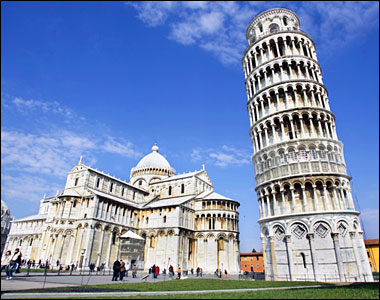
Leaning Tower Equals Weak Foundation
Mankind’s quest for societal concord (peace and harmony) between the opposite extremes of chaos and coercion is as old as human civilization. Indeed, every society quests after concord; however, it’s rarely achieved and never maintained. Despite the difficulties, mankind seeks the advantages gained through association when families form clans to create communities that combine into society. The Greeks founded Western Civilization, supplying many of foundational concepts for society and government through their city-states dotting the Aegean landscape. In fact, Greek philosopher Aristotle described human beings as political animals, who formed societies to enjoy the benefits of association. Nonetheless, the Greek failed miserably in the quest for concord as the city-states fratricidal wars created chaos throughout Greek society. Mercifully, after decades of civil war, the exhausted Greeks collapsed into the Roman Republic’s orbit. Ironically, however, even though Romans witnessed the catastrophic effects of the Greek chaos within society, the Republic fell victim to a similar chaos when the mounting Roman political and civil strife led to civil war. The Senate and Pompey squared off against Caesar which culminated in the destruction of the Roman Republic.
Despite the senatorial conspiracy that killed Caesar, the Roman Republic was not restored. Instead, another round of civil wars and chaos ensued until Augustus defeated Marcus Antony and birthed the Roman Empire. At last, Western Society moved the pendulum from chaos towards concord. Caesar Augustus ruled wisely. He limited taxation and the plunder of the provinces; thus, for a brief period, the results was the Roman peace (Pax Romana). Unfortunately, the pendulum’s momentum did not rest at concord. At Augustus death, the new Caesars increased government’s responsibilities until the pendulum moved into the control and coercion of society’s members. The Caesar’s and their ruling elites enjoyed more power at the expense of its citizens freedoms. By the end of the empire, the bloated bureaucracies consumed the wealth of its citizens to feed the coercive civil and military branches. In fact, when the Roman Empire fell, many within the oppressed Roman society, viewed the Gothic barbarians as liberators and not invaders.
Studying the Greco/Roman societies provide valuable lessons in the pendulum swings from chaos to coercion and back again. Despite momentary intervals of peace and prosperity, the pendulum never came to rest at concord. The pendulum’s momentum either carried it towards chaos or coercion. To be sure, there were solid parts in the Greco/Roman political foundations, but there were also sinkholes. Predictably, these sinkholes caused the political collapse of all three societies. The first two under chaos and the third under coercion. Therefore, identifying the specific failure modes of each Greco/Roman society and learning from them is essential for today’s political leaders.
Not surprisingly, the English (Anglo/Saxon) societies learned many lessons, both good and bad, from Greco/Roman history. In fact, the English-speaking peoples built their political foundations upon the strengths of the Greco/Roman (reason and order), Judeo/Christian (hope and ethics), and Anglo/Saxon (liberty and passion) societies. When King William, of Normandy, successfully invaded England in the13th century, the confluence of these rivers formed the the famed English political tradition. Therefore, the author examines three Anglo/Saxon case-studies societies for further review.
1. Great Britain under the Stuart Kings
2. America under the Articles of Confederation
3. America after the United States Constitution
These three societies attempted, by different methods, to rest society’s pendulum at concord. Each ultimately failed. Essentially, these societies failed in a similar fashion as the Greco/Roman models. The pendulum never rested, swinging into chaos and then back into coercion, with brief moments of concord. Indeed, it seems the Anglo/Saxons, in many ways, have repeated the mistakes of the Greco/Romans. Although the political structures may be different, underneath the edifice is the same failed foundation that continues to collapse when too much weight is placed upon it. In other words, if the definition of insanity is to continue to do the same thing while expecting a different results, Western Society’s political tradition has reached the point of insanity. The quest for concord remains unconsummated. Systematically, the political structures are failing because the pendulum moves out of concord into either chaos or coercion. No society, to date, has successfully rested the pendulum at concord. What are the systemic causes underlying these failed attempts? How can the momentum of the pendulum be checked to rest it at concord? The questions and more the author proposes to answer in the following chapters.
The purpose of this treatise is to determine solid ground from the sinkholes in the foundations of the Greco/Roman and Anglo/Saxon political traditions. By understanding the historical foundations reviewed in this book, Western Society will be strengthened in its quest for concord. Indeed, the dangers inherent when the pendulum swings to the either the side of chaos or coercion is irrefutable. In consequence, the author seeks the firm ground of concord between the opposite, but equally damaging, extremes of chaos and coercion. The case-studies will proceed in chronological order because each society learned from those that preceded it. The main objective is to identify why and how each society failed and what lessons can be learned from their example. Hence, each society’s successes and failures will be analyzed to determine what remained solid from what ultimately sunk in its political foundations. Ideally, to build enduring political structures today, society should build upon the foundational principles that proved successful and reform those that failed the test of time. History is relentless and unsentimental in its verdicts. Either the political structure stands or it collapses. The key to history is to identify why. Nevertheless, few political leaders seem willing to be tutored by these truths of history. Society, it seems, repeats failures because it’s unwilling to learn from them.
At any rate, Western Civilization has not fulfilled its quest for concord. As a result, determining past societies failures and preventing similar failures today ought to be the high priority in Western Society’s quest for concord. Understanding what forces move the pendulum from concord to either chaos on one side or coercion on the other is crucial. Consequently, before outlining the historical societies, the author must first explain two systems that influence the pendulum within society. One strives to center the pendulum at concord while the other moves it towards chaos or coercion. The first is the Six Duties of Society (SDS) and the second is the Five Laws of Decline (FLD). The Six Duties of Society are the essential building-blocks for creating a sustainable society, helping to build an environment where mankind can grow and prosper. In contrast, the Five Laws of Decline describe the effects of mankind’s sinful nature. If left unchecked, the FLD will parasitically destroy a formerly healthy society. Both systems will be explained in general now and specifically to each Greco/Roman and Anglo/Saxon case-study in the preceding chapters.
The important point for the reader to grasp is that society must satisfy the SDS in order to survive. However, even when the SDS are met, society isn’t secure. safe. For when societal prosperity increases, it stimulates the FLD into action. An unchecked FLD within society develops groups that seeks to plunder what the rest have produced. Eventually, an unchecked FLD destroys the SDS because the parasitic plunderers strip the plundered physically and mentally. This, in a nutshell, is the quick version of Western History. Unfortunately, even a cursory examination of each failed society in Western Civilization reveals the FLD as the culprit of collapse.