
Orrin Woodward on LIFE & Leadership

Inc Magazine Top 20 Leader shares his personal, professional, and financial secrets.

Archive for March, 2014

Dan and Lisa Hawkins: Communication Skills

Posted by Orrin Woodward on March 30, 2014

Dan and Lisa Hawkins share the Communication Code

Dan and Lisa Hawkins have become two of the most dynamic and effective communicators in LIFE Leadership. The popular demand for their leadership materials is expanding around the world. Why? Because Dan and Lisa treat leadership as their profession. Leadership is not a part-time, nor full-time, but a lifetime assignment for both of them. For instance, the video below is just a short segment of an amazing talk that would help marriages across the globe.

This talk, plus hundreds of others are available on Rascal Radio for the unbelievably low price of under 50 dollars per month. LIFE Leadership is changing the world one life at a time. Thousands of people per month on signing up as customers and members because they understand the importance of leadership in every area of life. Are you one of them?

Sincerely,

Orrin Woodward

Posted in Leadership/Personal Development, LIFE Leadership | 14 Comments »

Jesus Huerta de Soto: Booms/Busts Part II

Posted by Orrin Woodward on March 22, 2014

Here is part II of de Soto’s impressive summary of the Boom/Bust cycle at work in America. Those who fail to learn from history end up repeating it and American leaders seem intent on not learning from history. LIFE Leadership, on the other hand, is intent on teaching people the principles behind the processes at work within the world. I believe the more truth one applies to life, the more capable he/she becomes in navigating the rough spots.

Sincerely,

Orrin Woodward

Jesus Huerta de Soto

Jesus Huerta de Soto

At present, numerous self-interested voices are demanding further reductions in interest rates and new injections of money which permit those who desire it to complete their investment projects without suffering losses. Nevertheless, this escape forward would only temporarily postpone problems at the cost of making them far more serious later. The crisis has hit because the profits of capital-goods companies (especially in the building sector and in real-estate development) have disappeared due to the entrepreneurial errors provoked by cheap credit, and because the prices of consumer goods have begun to perform relatively less poorly than those of capital goods.

At this point, a painful, inevitable readjustment begins, and in addition to a decrease in production and an increase in unemployment, we are now still seeing a harmful rise in the prices of consumer goods (stagflation). The most rigorous economic analysis and the coolest, most balanced interpretation of recent economic and financial events support the conclusion that central banks (which are true financial central-planning agencies) cannot possibly succeed in finding the most advantageous monetary policy at every moment. This is exactly what became clear in the case of the failed attempts to plan the former Soviet economy from above.

To put it another way, the theorem of the economic impossibility of socialism, which the Austrian economists Ludwig von Mises and Friedrich A. Hayek discovered, is fully applicable to central banks in general, and to the Federal Reserve—(at one time) Alan Greenspan and (currently) Ben Bernanke—in particular. According to this theorem, it is impossible to organize society, in terms of economics, based on coercive commands issued by a planning agency, since such a body can never obtain the information it needs to infuse its commands with a coordinating nature. Indeed, nothing is more dangerous than to indulge in the “fatal conceit”—to use Hayek’s useful expression—of believing oneself omniscient or at least wise and powerful enough to be able to keep the most suitable monetary policy fine tuned at all times.

Hence, rather than soften the most violent ups and downs of the economic cycle, the Federal Reserve and, to some lesser extent, the European Central Bank, have most likely been their main architects and the culprits in their worsening. Therefore, the dilemma facing Ben Bernanke and his Federal Reserve Board, as well as the other central banks (beginning with the European Central Bank), is not at all comfortable. For years they have shirked their monetary responsibility, and now they find themselves in a blind alley. They can either allow the recessionary process to begin now, and with it the healthy and painful readjustment, or they can escape forward toward a “hair of the dog” cure. With the latter, the chances of even more severe stagflation in the not-too-distant future increase exponentially. (This was precisely the error committed following the stock market crash of 1987, an error which led to the inflation at the end of the 1980s and concluded with the sharp recession of 1990-1992.)

Furthermore, the reintroduction of a cheap-credit policy at this stage could only hinder the necessary liquidation of unprofitable investments and company reconversion. It could even wind up prolonging the recession indefinitely, as has occurred in Japan in recent years: though all possible interventions have been tried, the Japanese economy has ceased to respond to any monetarist stimulus involving credit expansion or Keynesian methods. It is in this context of “financial schizophrenia” that we must interpret the latest “shots in the dark” fired by the monetary authorities (who have two totally contradictory responsibilities: both to control inflation and to inject all the liquidity necessary into the financial system to prevent its collapse).

Thus, one day the Federal Reserve rescues Bear Stearns (and later AIG, Fannie Mae, and Freddie Mac or Citigroup), and the next it allows Lehman Brothers to fail, under the amply justified pretext of “teaching a lesson” and refusing to fuel moral hazard. Then, in light of the way events were unfolding, a 700-billion-dollar plan to purchase the euphemistically named “toxic” or “illiquid” (i.e., worthless) assets from the banking system was approved. If the plan is financed by taxes (and not more inflation), it will mean a heavy tax burden on households, precisely when they are least able to bear it.

Finally, in view of doubts about whether such a plan could have any effect, the choice was made to inject public money directly into banks, and even to “guarantee” the total amount of their deposits, decreasing interest rates to almost zero percent.

Posted in Freedom/Liberty, Leadership/Personal Development, LIFE Leadership | 11 Comments »

Jesus Huerta de Soto: Boom/Bust Cycles

Posted by Orrin Woodward on March 21, 2014

Jesus Huerta de Soto

Jesus Huerta de Soto

I have read one of the best books on the Boom/Bust cycle yet in Jesus Huerta de Soto’s book Money, Bank Credit, and Economic Cycles.  Although a very thick book and not one I would recommend to start an economic journey, with the proper Austrian Economic foundations, this book reveals the reason for the predictable boom/bust inflationary cycle. Further, it reveals why the State and its cronies self-interests makes it difficult for society to end the State’s madness.

Like a druggie that constantly needs another hit to ease his troubles, the American economy is addicted to cheap money that only exacerbates its problems. Instead of pyramiding fiat money on top of fiat money (which is what the State supported Big Banks do), money should be subjected to the free-market forces that would temper the gambling nature of today’s Big Banks who know that the profits are privatized and the losses are socialized thanks to the State. I believe the State/Big Bank partnership is the greatest money scam against society in the world.

Think about it. If a business knew that its losses would be transferred to the people, but its gains would be enjoyed by the owners of the business, what behavior would one expect from the business? Predictably, Big Banks can make rash investments locally and internationally knowing all the while that they are “Too Big to Fail” and most of society is “Too Ignorant to Care”. LIFE Leadership is a group of people who care about all areas of leadership truth and justice. America was founded upon the principle of justice for all and that means no special deals for anyone regardless of how big or small they might currently be.

The Western ideal dreams of creating a land where there is opportunity for everyone, not a land of special deal bailouts and handouts for copouts and dropouts! Simply stated, the working Middle Class is being squeezed. The Bible states, “He who will not work, will not eat.” It is time for the West to relearn the value of hard work for a worthy cause. Isn’t our children’s future worth the effort?

Here is Part I of the introduction to de Soto’s book.

Sincerely,

Orrin Woodward

The policy of artificial credit expansion central banks have permitted and orchestrated over the last fifteen years could not have ended in any other way. The expansionary cycle which has now come to a close began gathering momentum when the American economy emerged from its last recession (fleeting and repressed though it was) in 2001 and the Federal Reserve reembarked on the major artificial expansion of credit and investment initiated in 1992. This credit expansion was not backed by a parallel increase in voluntary household saving. For several years, the money supply in the form of bank notes and deposits has grown at an average rate of over 10 percent per year (which means that every seven years the total volume of money circulating in the world could have been doubled).

The media of exchange originating from this severe fiduciary inflation have been placed on the market by the banking system as newly-created loans granted at very low (and even negative in real terms) interest rates. The above fueled a speculative bubble in the shape of a substantial rise in the prices of capital goods, real-estate assets and the securities which represent them, and are exchanged on the stock market, where indexes soared. Curiously, like in the “roaring” years prior to the Great Depression of 1929, the shock of monetary growth has not significantly influenced the prices of the subset of consumer goods and services (approximately only one third of all goods).

The last decade, like the 1920s, has seen a remarkable increase in productivity as a result of the introduction on a massive scale of new technologies and significant entrepreneurial innovations which, were it not for the injection of money and credit, would have given rise to a healthy and sustained reduction in the unit price of consumer goods and services. Moreover, the full incorporation of the economies of China and India into the globalized market has boosted the real productivity of consumer goods and services even further. The absence of a healthy “deflation” in the prices of consumer goods in a stage of such considerable growth in productivity as that of recent years provides the main evidence that the monetary shock has seriously disturbed the economic process.

As I explain in the book, artificial credit expansion and the (fiduciary) inflation of media of exchange offer no short cut to stable and sustained economic development, no way of avoiding the necessary sacrifice and discipline behind all high rates of voluntary saving. (In fact, particularly in the United States, voluntary saving has not only failed to increase in recent years, but at times has even fallen to a negative rate.) Indeed, the artificial expansion of credit and money is never more than a short-term solution, and that at best. In fact, today there is no doubt about the recessionary quality the monetary shock always has in the long run: newly-created loans (of money citizens have not first saved) immediately provide entrepreneurs with purchasing power they use in overly ambitious investment projects (in recent years, especially in the building sector and real estate development).

In other words, entrepreneurs act as if citizens had increased their saving, when they have not actually done so. Widespread discoordination in the economic system results: the financial bubble (“irrational exuberance”) exerts a harmful effect on the real economy, and sooner or later the process reverses in the form of an economic recession, which marks the beginning of the painful and necessary readjustment. This readjustment invariably requires the reconversion of every real productive structure inflation has distorted. The specific triggers of the end of the euphoric monetary “binge” and the beginning of the recessionary “hangover” are many, and they can vary from one cycle to another.

In the current circumstances, the most obvious triggers have been the rise in the price of raw materials, particularly oil, the subprime mortgage crisis in the United States, and finally, the failure of important banking institutions when it became clear in the market that the value of their liabilities exceeded that of their assets (mortgage loans granted).

Posted in Leadership/Personal Development, LIFE Leadership | 11 Comments »

20 Leadership Habits to Break: Part II

Posted by Orrin Woodward on March 20, 2014

Here is part II of a presentation based upon Marshall Goldsmith’s book What Got You Here, Won’t Get You There. Leaders must break free from self-focus to truly lead others with a servant’s heart. Sadly, few leaders ever reach this ideal. Consequently, few communities reach their potential because everyone is protecting personal turf instead of serving others’ needs.  This isn’t just a corporate phenomena, as the same self-centered leadership occurs in charities, and churches. Nonetheless, this must change if North America truly wants to rebound from its economic malaise.

LIFE Leadership is this change. Teaching principles of leadership that have stood the test of time, LIFE is growing faster than ever. LIFE Leadership chooses to compete through serving customers instead of creating lawsuits, pyramid schemes, or leadership scams. If one truly wants to grow his/her leadership, then serving compensated communities is the best avenue. With world-class products to offer the world (Mental Fitness Challenge, Financial Fitness Pack, and Rascal Radio), LIFE’s future is bright.

Improve your leadership by breaking these bad habits and moving to the next level. Please share which areas you are working on.

Sincerely,

Orrin Woodward

Posted in Leadership/Personal Development, LIFE Leadership | 12 Comments »

20 Leadership Habits to Break: Part I

Posted by Orrin Woodward on March 10, 2014

This past week has been a whirlwind of love, emotion, and service with the tragic news of the passing of our great friend LIFE Leadership Founder Jackie Lewis. I will share my thoughts on her impressive testimony of life-transformation in an upcoming post. I appreciate all the people who reached out to encourage, serve, and pray for the Lewis and LeVeque families.

Today, I wanted to share a video from a recent LIFE Live event on the 20 Leadership Habits to Break. I read about these 20 bad habits from Marshall Goldsmith’s book What Got You Here, Won’t Get You There. By taking his list of habits and sharing some personal thoughts from each from my 20 plus years on the leadership front lines, this talk can help someone take their leadership to the next level. Without any further ado, here is the video.

Sincerely,

Orrin Woodward

Posted in LIFE Leadership | 19 Comments »

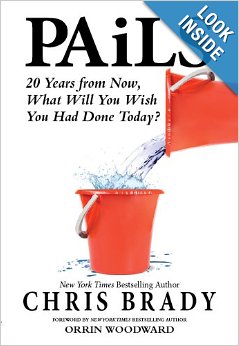
Chris Brady Releases New Book: PAiLS

Posted by Orrin Woodward on March 3, 2014

Chris Brady released his new book PAiLS at the LIFE Leadership Major Functions and it is already receiving rave reviews. Here is the Foreword I wrote for this powerful book helping anyone seeking to develop his/her game plan for the game of life.

Sincerely,

Orrin Woodward

Chris Brady: PAiLS

Chris Brady: PAiLS

When NY Times bestselling author and speaker Chris Brady notified me that he was sending a hardcopy of his latest book to me, I was intrigued.  For any time I read his works I find my mind expanded, my heart encouraged, and my resolve strengthened.  Although I have partnered with Chris for nearly twenty years, I still find myself marveling at Chris’s ability to communicate truth in a disarming fashion.  Further, he somehow does this while making everyone laugh hysterically.  Seriously, the only thing more fun than reading a Chris Brady book is having the privilege of sitting in the front row when he is speaking.

In any event, when I received the book, I devoured it in a matter of hours.  Thankfully, for me, no one was home, since there were several times when Chris brought me to tears – several times with his humor and other points with his poignancy.  If the reader has read Chris’s critically acclaimed book A Month of Italy, then he can relate to what I am saying.  Nonetheless, this book breaks new ground for the author as it addresses an important issue for today’s youth (and people of all ages, for that matter), namely, what is the best way to pursue one’s life goals and dreams?

In answering that question, Chris develops a framework for life and happiness that is both innovative and compelling.  In fact, Chris’s four-layer Ziggurat has become the basis for mentoring my own teenagers as they prepare for their journeys through life.  Starting with Preparatory Experiences and a Pragmatic Occupation, Chris then explains how these two layers can then be the foundation for chasing one’s Passionate Pursuit, culminating in fulfilling one’s Purposeful Calling. They say genius is the ability to make the complex seem simple.  Accordingly, the first chapter alone qualifies Chris for Mensa membership as he simplified one’s life into four layers that build upon one another.  Such insight is priceless.

Taking this information, I quickly reviewed in my mind the many people I have modeled, mentored, and studied to confirm the truthfulness of the life’s Ziggurat.  Every successful person utilizes the principles in this book whether they realize it or not.  Fortunately, with the writing of this book, Chris has provided the next-generation with a revolutionary approach to living that breaks down the half-truths and outright fallacies that hold people back from achieving their purpose in life.

Finally, when taking any advice in life, it is important to identify whether the person has “fruit on the tree” in the area he proposes to teach.  Having known Chris Brady since both of us were eighteen-year-old college kids, I have been blessed to watch Chris Brady build his life Ziggurat.  From his preparatory experiences in motor-cross racing to his pragmatic career as an engineer, Chris laid the foundation necessary to pursue his passion.  Indeed, after eight to ten hour workdays, Chris progressively developed mastery in the fields of writing, speaking, and leading.

After five years of toiling in anonymity, Chris broke into the mainstream with a string of bestselling books (having sold over a million copies in seven languages) and speaking engagements around the world in front of tens-of-thousands of people.  Moreover, he has supported numerous charitable works through his board position in All Grace Outreach Ministries.  In addition, Chris, and his lovely wife Terri Brady are nurturing parents to four entrepreneurially minded children.  To wrap up, I believe the best teachers model before they message, and Chris Brady’s life has authentically modeled the message he illuminates here.

Orrin Woodward

New York Times bestselling author

Founder of LIFE Leadership

Posted in LIFE Leadership | 17 Comments »