Here is a portion of my chapter on the Five Laws of Decline (FLD) from the new book I am working on. The more I study history and society, the more I realize how true the FLD are in real life. Modern politics merely confirms what the FLD teaches – that most men will sell out their character if the price is right. Oliver DeMille and I explain how the Five Laws of Decline work within society in our book LeaderShift. If you haven’t read that book, I encourage you to do so. The goal of LIFE Leadership is to educate the world on life-changing principles that make a difference in a person’s life.
Sincerely,
Gresham’s Law – Bad Behavior Drives Out Good Behavior
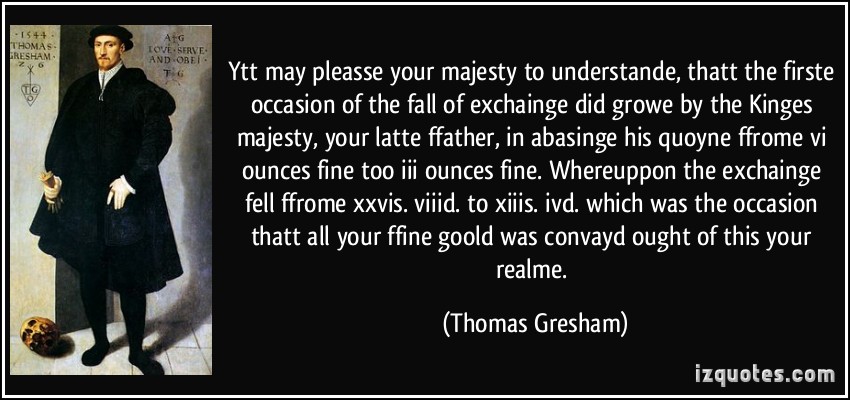
Thomas Gresham’s Law
Thomas Gresham, an English financier, developed his law through the study of monetary policy and wrote, “when government compulsorily overvalues one money and undervalues another, the undervalued money will leave the country or disappear into hoards, while the overvalued money will flood into circulation”. In short, bad money drives out good money. There are many historical case studies of this phenomena (for example, my book RESOLVED: 13 Resolutions for LIFE discusses colonial New England’s disastrous paper money experiment) where fiat paper money causes gold and silver specie to disappear from the marketplace. Why, in effect, would anyone pay for goods and services in real dollars when the State issues non-backed fiat paper as its legal tender? Real money is quickly stored by society’s members until the fiat legal tender paper fraud runs its course. Gresham’s Law, however, can also be applied to other fields besides just money. For instance, as the “political means” of wealth grows within society, Gresham’s law works to drive out good politicians who, after realizing they cannot restore justice, exit the political field rather than play by the new unjust rules. In effect, real leaders refuse to surrender their character to political bosses who demand “political means” of wealth creation for those they elect. Therefore, the best politicians are eliminated from the selection process and are replaced by less noble souls who sell out their ethics to be elected in the service of exploiters.
Accordingly, the growing FLD within society force the politicians to either play by the unethical rules or exit themselves from the game. Either way they fulfill Gresham’s Law as the good is driven from the field. Another way of viewing Gresham’s Law is to understand that what is rewarded increases while what is punished decreases. Few have described Gresham’s Law in action better than Bertrand De Jouvenal did when he wrote:
Through the prestige of its leaders and the popularity of its principles the group brings victory to its candidates, whom it has chosen less for their personal worth than for the pledge of their obedience to itself; moreover, they will be the more faithful to their party from the inability to make their way without it. The first result of this is a degradation of the assembly, which no longer draws its recruits from the best men. . . So far the debasement of the electors and the degradation of the assembly are only accidental. They are to become by progressive stages systematized. Syndicates of interest and ambitions will soon take shape which, regarding the assembly as a mere adjunct of Power and the people as a mere cistern for the assembly, will devote themselves to winning votes for the installation of tame deputies who will bring back to their masters the prize for which they have ventured everything, the command of society. . . Soon they secured for themselves the selection of the candidates, and, naturally, chose men in their own likeness: they did not choose Catos. From this has followed a prodigious drop in the level of parliaments and in the level of government. . . Parliament is then no longer a sovereign assembly in which an elite of independent citizens compare freely formed opinions and so arrive at reasonable decisions. It is now only a clearing-house in which the various parties measure their respective parcels of votes against each other’s.
An example from modern times that confirms Gresham’s Law is alive and well was the impeachment proceedings against President Bill Clinton. Regardless of the particular party one supports, doesn’t it seem curious that an impeachment vote on non-party moral issues could follow party-lines so closely? For how does anyone argue that party affiliation is the main indicator as to whether Clinton’s behavior was ethical or non-ethical? If the impeachment proceeding proved anything, it proved that party loyalty trumps personal ethics whenever they conflict. The impeachment trial validated De Jouvenal’s 1945 outlook while teaching that politics, if anything, is more subject to Gresham’s Law in the twenty-first century than it was in the preceding one. Gresham’s Law, to sum up, has driven independent thinkers from the political arena and substituted obedient servants who follow the party line instead of their internal conscience. The politicians are no longer leaders with independent thoughts, but rather mere subjects beholden to the party if he desires to stay in power.