Orrin Woodward on LIFE & Leadership

Inc Magazine Top 20 Leader shares his personal, professional, and financial secrets.

Archive for August, 2015

The Quest for the Philosopher’s Stone

Posted by Orrin Woodward on August 31, 2015

“The trouble with paper money is that it rewards the minority that can manipulate money and makes fools of the generation that has worked and saved.” – George Goodman

The philosopher’s stone was mankind’s quest to turn base metals into gold. Although there were several reasons for the quest, the main one was to increase the power of the sovereigns over their people. Kings and princes encouraged and rewarded alchemists from the Middle Ages to the end of the 17th century in the effort to discover the philosophers stone to no avail. Unfortunately, however, mankind discovered an easier way to turn valueless material into gold, namely fiat paper money and fractional-reserve banking. I cover the basics of these two processes in my book The Financial Matrix, but I wanted to share from Jack Weatherford’s informative book The History of Money to convey just how confused most people are about money. These are blue quotes are from Weatherford’s book with my comments below. Sincerely, Orrin Woodward – LIFE Leadership Chairman of the Board

Nero Debases Roman Coins:

Nero began to tamper with the coinage itself. In A.D. 64, in a naive attempt to deceive the populace, Nero decreased the silver content in the coins and made both the silver and gold coins slightly smaller. By collecting the existing coins and reminting them with his portrait bust but less silver, Nero produced a momentary surplus of sliver and gold. The same pound of silver that had formerly produced 84 denarii now produced 96, giving Nero almost a 15 percent ‘profit.’ He similarly increased from 40 to 45 the number of golden aurei manufactured from a pound of gold, thus rendering the coins about 11 percent less golden.”

Nero attacked private property by manipulating the measuring scale of money. Instead of a certain amount of silver making 84 denarii coins, it now made 96 denarii coins. The measure of how much silver in each coin was arbitrarily changed by the sovereign. This attack on private property is no different than the State owing a certain merchant 100 pounds of gold, and then paying the merchant only 50 pounds of gold. When the merchant complains, the State points to a new law that has changed the pound to half its former weight. Therefore, the State did pay 100 pounds of gold, but changed the definition of the pound to steal half the value of amount owed. In a sense, the State debased the weight of the pound just as Nero debased the denarii coins.

Law of Inertia: If Bad Behavior is not Punished, it Expands:
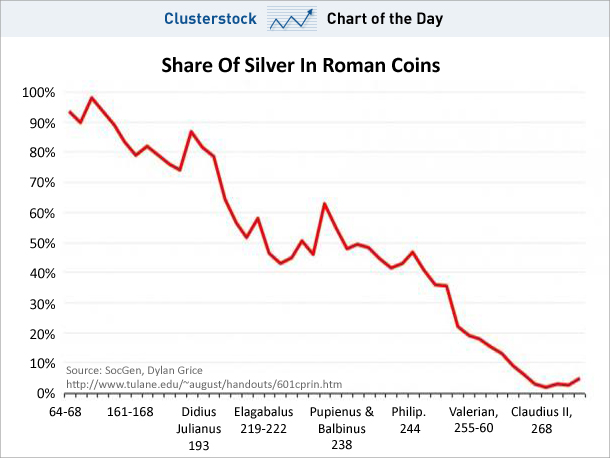
Roman Coin Debasement

Roman Coin Fraudulent Debasement = Inflation

Thus over the course of two hundred years, the silver content was cut from nearly 100 percent to virtually nothing. The amount of silver previously used to mint a single denarius eventually produced 150 denarii, and as the silver content decreased, the price of good increased in direct proportion. Wheat that had sold for one-half a denarius in the second century increased to 100 denarii a century later, a two-hundred fold increase.

If the State is allowed to arbitrarily change the monetary units at will, inflation occurs and the price system quickly accounts for the debased purchasing power of the monetary unit.  The State receives the benefit of the inflated money first, but they do so at the expense of later users of the money who now need more monetary units to buy the same production as previous. This is fraud perpetrated by the State upon society and one of the main reasons Rome fell.  The people lost trust in the money supply because the State could not stop debasing the dollar to benefit itself.  Accordingly, the late Roman empire devolved backwards to payment in kind and landlords protecting people rather than State. Once this occurred, society could no longer support the bloated  State and the Roman Empire collapsed under its own weight.

The Roman Empire Kills Its Money:

In the last centuries of the Roman Empire, the emperors operated without a workable currency; like the ancient empires that had preceded it, Rome turned to conscription and forced labor to meet its needs. The government often would not allow its citizens to pay taxes in the debased money that it still issued; instead, officials demanded payment in good, crops, or labor. . . As tax (and monetary) policies continued to suppress productivity and commerce, the emperors found it increasingly difficult to supply their armies and the bureaucracy with the equipment and goods necessary to rule the far-flung but diminishing empire. The markets had withered; even the emperor could no longer depend on the open market to supply him with the sandals, armor, weapons, saddles, tents, and other goods that an army needed. Out of desperation, Diocletian created government-sponsored workshops to manufacture armaments and supplies. As privately financed shipping and other transport enterprises declined, Diocletian also had to create government transport companies to move the goods that were manufactured in the workshops. Well before the end of the third-century, these changes made the emperor and the government the greatest manufacturers in the empire, in addition to being the largest owner of land, mines, and quarries. Step by step, the imperial government took over the direct administration of the economy and crowded out the small, independent merchants, landowners, manufacturers, and entrepreneurs. . . By its last decades, Rome had become another state-administered economy, an empire without money and markets. It had reverted to a palace system more like that of pharaonic Egypt or imperial China than that of the republican system on which it had been built.

Rome fell because as the State expanded, it destroyed the monetary system and thus the commercial system that used it as the medium of exchange in trade. Through increasing inflation and taxation the State killed society to feed the growing bureaucracy and military. The originally thriving Roman society provided a level of systematic justice unknown to previous empires eventually became just like the other empires as it killed the monetary system through repeated unjust debasements and the commercial society reverted to a command and control empire without money.  The Roman Empire died, in other words, when its money did.

Fractional-Reserve Banking is Fraud:

Under the new system a bag of a hundred florins that might once have sit idle for years in a noble’s strongbox could now be deposited for safekeeping in an Italian bank that had access to branches across the continent. The bank then lent the money and circulated the bill of exchange as money. The noble still had his one hundred florins, which were now one deposit in the bank; the bank had one hundred florins on its books. The merchant who borrowed the florins was richer, and the person who held the bill of exchange now had one hundred florins as well. Even though only one hundred gold coins were involved, the miracle of banking deposits and loans had transformed them into many hundreds of florins that could be used by different individuals in different cities at the same time. This new banking money opened vast new commercial avenues for merchants, manufacturers, and investors. Everyone had more money: it was sheer magic.

Actually, it is not sheer magic, but sheer fraud. In a nutshell, the banks creates a metaphysical representation (bank notes) of the actual money (precious metal commodity florins). This would be fine if there was only one banknote to represent the same commodity money, but fraudulently, the banks through FRB create multiple sets of banknotes to represent the SAME bag of florins. This is no different than a bank selling 10 people the same physical property by creating 10 separate metaphysical property titles to represent the land. Of course, in the property example, the fraud would be exposed because the owners would eventually show up at the property and realize, along with the the other “owners” of the property, that they were duped by duplicate property titles created for the same physical property. In the same way, the bank creates duplicate banknotes to represent the same physical commodity money. This is FRAUD. In the banknote example, however, all parties can use the banknotes representing the same bag without being aware that the others also have banknotes that represent the EXACT same physical bag of money.

Of course, this violates the laws of Logic. For two people cannot 100% own the same item at the same time and two people cannot be in the same spot at the same time. In a similar fashion, two people (let along 9 or 10 than FRB legally allows) cannot both have banknotes that metaphysically represent the same bag. Because this “magic” (read fraud) is allowed, the money supply is expanded metaphysically even though the physical money hasn’t changed size, just like the land was metaphysically  expanded by the fake titles even though the physical land has not changed. Unfortunately, the scam is rarely detected because the banknotes are just transferred from person to person without anyone realizing their are counterfeit not not backed by real commodity money. The result is huge bank profits, huge societal inflation, and indebtedness for governments, businesses, and people. Of course, another result is the predictable boom/bust cycle that bankrupts many others when the money supply deflation from its previous inflation.

Fractional-Reserve Banking (FRB), in other words, is modern man’s solution to the Philosopher’s Stone. Add to it the Central Banks special privilege to purchase items by creating banknotes not backed by anything and one can see that the modern day elites have accomplished what the middle-age kings and princes only dreamed of – creating fools gold, but having the legal right to pass off fool’s gold as real gold and enslave the people in the process. The is the Financial Matrix! Like I said previously, the modern golden rule reads: He who controls the fool’s gold controls the fools.
Posted in Finances, Freedom/Liberty, Orrin Woodward | 20 Comments »

Leisure & the Pursuit of Wisdom

Posted by Orrin Woodward on August 10, 2015

A big secret to life is when you discover that learning is just as enjoyable as entertainment is, but with long term benefits. – Orrin Woodward

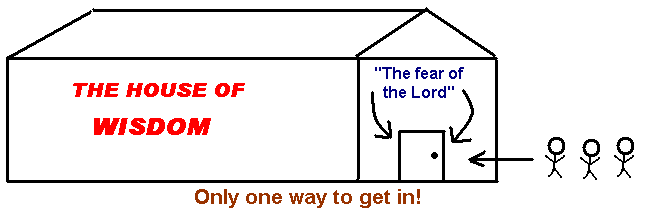
image18aIn the process of researching for my second book in the And Justice For All series, I stumbled across one of the most profound descriptions of the importance of education in a person’s life by Professor Ernest Barker. As I read the words below, I realized how important LIFE Leadership is in improving society. For LIFE helps people focus on achievement through a process of eliminating debt and building a community through serving others by pursuing wisdom and leadership. In effect, the size and speed of the results achieved is a measurement of the wisdom applied to their life and business. The Bible teaches clearly that all true wisdom begins with fear of the Lord and that Christians should seek righteousness and all others things will be added.

Unfortunately, however, few people apply these Biblical lessons consistently. Despite the numerous historical examples of people who applied Biblical wisdom to life and were blessed beyond measure, many still chase money rather than wisdom. In a capitalistic system, money flows to those who apply wisdom to business, but the reverse of this is not true – wisdom flows to those with money. For instance, Laurie and I have many monetary blessings, but none of these satisfy like sharing wisdom with others to stimulate breakthroughs in mentoring sessions or the “aha” moments of self-discovery when the veil of ignorance is removed and one sees clearly the principles to apply to move ahead. Indeed, once a person becomes a seeker of knowledge, he will never be bored again because there is always more wisdom to learn and apply. I love my life and wouldn’t trade places with anyone else because I have been blessed with the leisure to learn and grow. Even more importantly, I am blessed to share what I have learned with other hungry students seeking wisdom in life.

The Financial Matrix is a system of control designed to enslave people in their own ignorance. Hence, if one wished to escape the matrix, one must escape not only physically, but also mentally. To do this, a person must build a business asset to buy back his time because only then will he have the leisure to invest in a self-directed education to develop wisdom. LIFE Leadership is the vehicle to accomplish this where people can live their dreams by losing their debt? However, living your dreams requires a plan and a willingness to work hard. What is the reader’s plan to develop wisdom and seek righteousness? These two steps are foundational to having everything else added unto him to live his/her dreams. I pray you achieve all the success you earn.

Sincerely,

Orrin Woodward

Our modern economic society, we have seen, requires leisure and education as its complements and its correctives. They are two things which should go together. Leisure is a time to be devoted — not wholly, for the body has its claims to relaxation, and the mind too needs its gentle indulgences ; not wholly, but at any rate largely — to the purposes of education and the gaining of that knowledge, not to be acquired in the course of work, ‘which brings wisdom rather than affluence.’ Education, on the other hand, should be a training — not again wholly, but at any rate largely — in the right way of using leisure, which without education may be misspent and frittered away. This vital connexion between leisure and education is a fundamental thing. Unless we grasp it, we are in danger of abusing leisure and misusing education. And in order that we may grasp it, it is necessary that we should have a right conception of the meaning of leisure;

One of the old Greek philosophers made a distinction which may help us here. He thought that we ought not merely to distinguish between work and leisure, but also to distinguish between leisure and recreation. Work, he thought, was something done not for its own sake, but as a means to something else — affluence, let us say, or at any rate subsistence ; recreation was rest from work, which took the form of play, and issued in the recovery of the poise of body and mind, disturbed and unbalanced by work ; but leisure was a noble thing, and indeed the noblest thing in life ; it was employment in some activity (we may almost say some form of work) which was desirable for its own sake such as the hearing of noble music and poetry, intercourse with friends chosen for their worth, or the exercise of the speculative faculty.

In this fine sense of the word, we may say that we live for leisure ; that it is the end of our being, which transcends work and far transcends recreation ; that it is the growing time of the human spirit, which in its leisure from necessary toils, and the necessary recreations they entail as their counterpoise, can expand in communion with its own thoughts and with the thoughts of others and with the Grace of God. The sad thing about modern English society is that there is so little leisure in this higher sense. It is not only that we work so hard : it is also that we play so hard. Perhaps the monotony and uniformity of work sends us in reaction to the hazards of games, or the excitement of watching them, or the still greater excitement of betting upon them : perhaps the urban aggregations in which men now live make them unhappy unless they are crowding together to some common game or spectacle.

Whatever the reason, poor leisure is far too often out in the cold, while recreation is romping about all the rooms in the house. One need be no kill- joy or Puritan to think or talk in this strain. Life is something more than a series of alternate layers of lean work and fat hearty play. It is meant for the growth and development of the human spirit. And that growth needs its growing time, which is leisure. If leisure be largely for education, education is also largely for leisure. We too often think and speak of education as something intended to fit us for life’s work. Ideally, it should rather be intended to fit us for life’s leisure. I do not mean that education should be humane rather than vocational.

Education may be humane, and yet directed to work and the better doing of work. I mean something more — that education should mean the filling of our mind with interests and possibilities of high delight, which we can develop for ourselves in all our leisure hours ; that it should be an initiation in the tastes and pursuits which will crown our leisure with fulfilment ; in a word, that it should be a training and a preparation for the right use of the time of the spirit’s freedom. Perhaps education has not hitherto been sufficiently adjusted to this end. Perhaps, if it had been, it would have been directed more to the awakening of a taste for art and music, in order that they might become the permanent possession and the abiding joy of later years.

Be that as it may, it is surely true that education is a necessity if men are to gain the faculty of using leisure easily, happily, and fruitfully. The use of leisure is a difficult thing. The majority of us, when freedom is given into our hands, fly to the excitement of some form of recreation. We must be ‘doing’ something — preferably something physical : if we are not, we are lost and without resource. We know the routine of work : we know the rules and the routine of different forms of play ; but we do not know how to move freely, originally, and by our own choice in the world that lies above work and play — the world of leisure. This is why holidays sometimes pall, and leave us at a loss : it is why men who have retired from work sometimes fall into melancholy, and find their reason for living gone.

Leisure without faculty for its use may even be a mother of mischief; men may dissipate themselves in frivolities, and worse than frivolities, because they do not know how to concentrate themselves upon better things. A society which guarantees leisure is guaranteeing something which may be useless, and even dangerous, unless it adds, or at any rate encourages its members to add, the one thing which will enable the gift to be used — a continuous process of education.

The world offers to the mind of man many noble joys. There is a joy in knowing the flowers of the field, and calling them by their names. There is a joy in knowing tlie heavenly bodies which move above us, and in understanding the rhythm and the rules of their motions. There is a joy in knowing the past of our kind, and in unrolling the long record of human history which explains what we are to-day. There is a joy in entering into the vision of the poet and painter, who have seen the ideal beauty which is hidden from ordinary eyes. There is a joy in wrestling with the thought of great philosophers, who have pondered about the why and wherefore of this mortal world and our mortal existence in it. These are the joys of leisure ; and leisure is the growing time of the spirit because it is the time of these joys. But it needs an effort to catch these joys ; and you cannot catch them without hooks of apprehension.

You must know a little in order to want to know more. Blank ignorance is blank incuriousness, but a little knowledge may be the opportunity and the incentive for more knowledge. The facts presented to mere ignorance are facts which there are no hooks to catch ; but when a mind has had some little training, it develops tentacles of apprehension ; it is anxious to seize new stuff, to arrange it and co-ordinate it with the old stuff which is already there, and so to make a little systematic world of its own for its own high delectation. The mind which is furnished with these tentacles and hooks of apprehension is a mind which will never be embarrassed or dumbfounded by leisure.

It will begin to play at once, in the nobler sense of the word play: the hooks will grip more and more of things seen and unseen into its consciousness ; and in the growing time there will be growth. When we say, therefore, that education is a preparation for the enjoyment of leisure, we mean that it is an equipment of the mind with these hooks and tentacles, these curiosities and appetites. And from this point of view we may see that there is a large sphere for the education of the adult, and that education is in no sense only the concern of childhood. The child learns at school ; but the child learns at a time when real experience of life has not yet begun. He learns, and is often curious to learn ; but what he learns cannot be co-ordinated with, or grappled into, a first-hand experience, because such experience has not yet begun to be gathered.

When he goes out into the world, and begins to gather experience, that experience may seem to him the one essential thing, and the school time lessons may fade away into the outgrown occupations of a vanished childhood. It is at this age — the age of adolescence, young manhood and young womanhood — that everything turns on the rescue of young minds from being immersed in mere experience. It is now that they need to recover curiosities, and to be furnished with hooks and tentacles of apprehension, by which they can capture a knowledge which can now be co-ordinated with experience. History, for example, is one thing to a child — a record of exciting events which satisfies curiosity : it is another thing to an adult — a record of the moral experience of men and nations which can be compared with and interpreted by the moral experience which the adult has himself gone through.

But unless, in adolescent and adult years, the curiosity be reawakened and recovered, the adult mind may remain immersed in its own more immediate experience ; and the high contemplation which lifts it above such experience, and yet explains and interprets that experience, may never be attained. Adolescent and adult education are in this way of primary importance, if man is to rise to that height of his being in which he uses leisure for the purpose of contemplation of the world, in order to explain it, and his own experience of it, and to attain to the justification of faith in its purpose and operation.

Posted in Finances, Freedom/Liberty, Fun, LIFE Leadership | 27 Comments »