Orrin Woodward on LIFE & Leadership

Inc Magazine Top 20 Leader shares his personal, professional, and financial secrets.

Archive for May, 2014

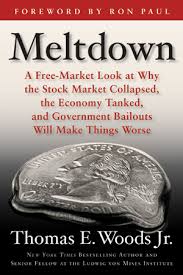
Thomas Woods – Meltdown

Posted by Orrin Woodward on May 31, 2014

Thomas Woods - Meltdown

Thomas Woods – Meltdown

The Austrian business-cycle theory is the missing factor in today’s economic discussions. It connects the dots on so many seemingly disparate data points and explains systematically what everyone else is treating as isolated events. Unfortunately, the business-cycle theory is rarely discussed and almost never truly understood by today’s talking heads.

The Austrian School of economics is the only school that has developed a working model of how savings and investment needs work together to create the natural rate of interest. No where is there a need for the central banks Statist central planning interventions to artificially lower the interest rates.

This, in fact, is why the theory is kept from mainstream discussions because it places the blame for the Global Financial Crisis where it belongs, namely, on the State’s partnership with the central banks to run the banking system cartel. The banking cartel is designed to protect the fraudulent fractional reserve banking system from collapsing upon itself. 

LIFE Leadership is set to release the first of my planned three book series on society and the State titled And Justice for All. The book will be available at the June Columbus major function. In the book, I describe how the State intervenes within society, allegedly to serve the populace, but actually to increase its power. I go on to describe how these State interventions affect society.  

Justice for all is the goal of every righteous society, but the government must be restrained to perform only its intended functions to accomplish the assignment. Who guards the guardians? This ought to be the question asked by all concerned citizens to ensure the destructive Five Laws of Decline do not destroy the productive Six Duties of Society.

Here is a brief summary on the business-cycle and Thomas Woods excellent book Meltdown from the Mises Institute. I highly encourage everyone to read this book as it is the best simple description of the business-cycle theory.

Sincerely,

Orrin Woodward – LIFE Leadership’s Chairman of the Board

Austrian business-cycle theory is straightforward, for those willing to devote the necessary time to study praxeology. But therein lies a problem. The average person lacks the patience to read Human Action and Man, Economy, and State. How then can he acquire the rudiments of Austrian cycle theory and grasp why the theory is true? To set the question aside, on the grounds that it is unnecessary for the man in the street to bother with such matters, is a counsel of despair. If the public does not understand the economics of depression, there is little hope that we can avoid disastrous government policies. Unless the free market receives sufficient popular support, our economic future is bleak.

Woods supplies just what we need. With great clarity, he shows that the Austrian theory of the cycle is firmly grounded in common sense. Additionally — and here his skill as a trained historian comes to the fore — he shows that Austrian theory explains not only the Great Depression but other less-well-known economic downturns as well. When the government followed a “hands-off” policy, recovery from a downturn was rapid; when, as most notably was the case in the New Deal, government tried to take control, the economy sputtered.

The basics of Austrian cycle theory fall readily into place once one considers a fundamental point: the economy can grow only by producing more goods. An expansion of the money supply does not suffice. Efforts to get something for nothing, by the government’s deficit spending or by an expansion of the money supply, cannot produce lasting prosperity.

The speed with which an economy grows depends on the extent to which people prefer present goods to future goods. Other things being equal, people always prefer satisfaction in the present; but the extent to which this preference prevails is crucial for economic development. In order to obtain more consumer goods than are immediately available, people must postpone satisfaction by saving, enabling a greater production of capital goods to occur.

Look at it from the saver’s perspective. Saving more indicates a relatively lower desire to consume in the present. This is another incentive for businesses to invest in the future, to carry out time-consuming investment projects with an eye to future production, rather than produce and sell things now. (p. 67)

The extent that they are willing to do so determines the rate of economic growth.

The preference people have for the present forms the main part of the rate of interest: Mises called this the originary rate of interest. This rate registers the way people allocate resources between consumption and production.

Trouble arises when the government, by increasing the supply of bank credit, depresses the money rate of interest below the natural rate. Businessmen, seeing that money is available, invest in capital-goods industries, and the result is a boom.

Once the monetary expansion stops, the boom cannot be sustained. The entrepreneurs who expanded their production of capital goods need more money to sustain their projects, but not enough is available at an interest rate that will secure for them a positive return. In the absence of monetary expansion, the rate of interest rises, since time preference has not changed (or at least there is no reason to assume it has.) At the higher rate of interest that now prevails, formerly profitable enterprises now have to be liquidated. This process of liquidation is precisely the depression.

Posted in Freedom/Liberty, LIFE Leadership | 15 Comments »

Fire the Manager and Hire the Leader

Posted by Orrin Woodward on May 22, 2014

Hockey legend Wayne Gretzky, when asked what made him great, responded, “I skate to where the puck is going to be, not where it has been.”  This simple statement concisely explains the difference between leaders and managers. Leaders acknowledge the present realities (where the puck is) but never forget the future possibilities (where the puck is going).

This is the key difference between leaders and managers. Whereas managers seek to organize the present resources of a company, a leader seeks to build the resources of a company by creating products, services, and systems that satisfy currently unmet needs in the marketplace.

Vision is tomorrow’s reality expressed as an idea today and leaders are the drivers that make today’s ideas tomorrow’s reality. Are you a leader actively sailing your ship to its future or merely a manager allowing the wind to blow you where it will? LIFE Leadership is about teaching people to seize the helm and sail! My advice is to fire the manager and hire the leader within.

The world has plenty of people capable of managing the results of your productivity, but is suffering from a dearth of true leadership. Despite having no guarantee of success, despite lacking all the relevant data and despite competing against bigger and faster ships, leaders still muster the courage to set sail upon the rough seas of free enterprise.

So what are you waiting for? Get out of the harbor of life and out onto the high seas. This is where the adventures, the learning, and the prizes are in life. Will everything go perfectly? Of course not! But refusing to leave he harbor ensures that you will never arrive at your port of destination. Leaders must leave home port to arrive at their future destination.

Perhaps you think the effort is not worth the reward. Only those who have not experienced the joy of sailing on the high seas could contemplate such a thought. Antoine de Saint-Exupéry described it best, “If you want to build a ship, don’t drum up the men to gather wood, divide the work, and give orders. Instead, teach them to yearn for the vast and endless sea.”  Personally, I yearn for the high seas that God has called me to and seek others of similar intestinal fortitude to take the journey with me.

Thus reminds me of Ernest Shackleton’s advertisement seeking men to be the first to journey to the South pole. The ad read, “Men wanted for hazardous journey. Low wages, bitter cold, long hours of complete darkness. Safe return doubtful. Honour and recognition in event of success.” Interestingly, there were no guarantees, nor huge bonuses, but just the challenge of doing something great together!

In fact, it’s the challenge of doing something that has never been done before that unites a team and steels their resolve to finish what they have started.  At the Columbus LIFE Leadership Convention, on June 21 of 2014 (Saturday starting at 8am until every book is signed), LIFE Leadership will seek to do what has never been done before in the history of mankind.

With Guinness World Records™ staff officially tracking the proceedings, LIFE will seek to break the all-time record for Largest Book Signing. The goal is to break over 5,000 books signed in one sitting. Perhaps, if enough people participate, and my hand holds out 🙂 we can break 6,000 books signed!

In any event, leaders make events like this possible and I would like to thank all the leaders in advance who intend to play a part in making history in Ohio. Isn’t it time to fire the manager and hire the leader in your life?

Sincerely,

Orrin Woodward

Guinness Book of World Records Attempt

Guinness Book of World Records Attempt

Posted in Leadership/Personal Development, LIFE Leadership | 22 Comments »

Seek Wisdom

Posted by Orrin Woodward on May 15, 2014

Life is less like a box of chocolates and more like a box of jalapeños. If you don’t apply wisdom, what you do today may burn your butt tomorrow.

I read a tweet recently from Brian Powers on life, chocolates, and jalapeños. I changed the quote slightly to tie it to the importance of wisdom and the quote above resulted. Life truly is about gaining wisdom in the 8F’s so that one can learn to handle any situation with peace and grace. Since everyone experiences the ups and downs in life, wisdom is the key delineator between successfully navigating the storms of life or being added to the growing list of shipwrecked lives.

Relativism = Value Free

Relativism = Value Free

The Free Dictionary defines wisdom as the ability to discern or judge what is true, right, or lasting; insight. If wisdom requires on to judge between truthfulness and rightness of one’s actions then one must believe that there is truth and right in the world. After all, how can one discern truth and right when one is a relativist and rejects the notions of good/evil, truth/error, and right/wrong?

LIFE Leadership begins with this foundational principle to seek wisdom. The Bible states, “Be ye transformed by the renewing of your mind” and the transformation for many begins with the recognition of a moral order in the world. For without this moral order, seeking wisdom is a fools errand as one would have rejected the goal (discerning truth) before one begins the journey.

One of the many things I love about the LIFE Leadership community is it is difficult to remain a relativist when one attempts to lead. Leadership, at its essence, is buying into one’s purpose/vision and then selling it to others. This purpose/vision must be inspirational and rational in order to be bought into with conviction by the community. However, a relativist struggles with conviction. This isn’t surprising when one considers that a relativist’s statement of faith centers around, “nothing is true absolutely.” Of course, my quick rejoinder is, “are you absolutely sure that nothing is true absolutely?”

This is the quandary for all relativist who attempt to lead a community. If he answers my question by saying, “I am absolutely sure,” then he has disproved his own statement of faith. If he says, “I am not absolutely sure,” then I say, “great, let’s help you start reading, listening, and associating, so you can be sure about what you believe.”

At the end of the day, it’s the leader’s certainty, and the conviction that comes from this certainty, that creates the passion around the purpose for other’s to follow. Thus, knowing why you believe what you believe is foundational to all leadership.

How has LIFE Leadership helped you develop wisdom in life and discern truth and right in today’s relativistic age?

Sincerely,

Orrin Woodward

Posted in Leadership/Personal Development, LIFE Leadership | 35 Comments »

Central Banks Lead a Monetary Cartel

Posted by Orrin Woodward on May 13, 2014

My studies for my new book And Justice for All (to be released by LIFE Leadership) have led me to an interesting conclusion – the central banking led bank cartel has captured Western Civilization’s productive capacity. It all centers around the mysterious Fraction Reserve Banking (FRB) process. The (FRB) process could not abuse society to the extent it does without the State approved cartel that backs the Too Big Too Fail (TBTF) entities. Indeed, the cartel permits banks to carry minimum reserve requirements and loan out money it technically does not have.

Fractional Reserve Banking

Fractional Reserve Banking

For instance, imagine a FRB system with a reserve requirement of 5%. This allows the FRB system to turn $1,000,000 into $20,000,000 (1 million/.05 = 20 million). The $1 million has been turned into 20 million, creating $19 million extra dollars out of FRB thin air). Even with just a 5% interest rate, this is approximately $1 million in interest income on an original investment of $1 million! This is an astronomical ROI of 100% before expenses because of the wonders of the FRB process. This cartel-protected profit is drawn from the productive elements of society who are paying interest on money that only exist on a ledger sheet or computer screen. If any other business were to attempt to sell 20 times as much product as he actually had on hand, he would be convicted of fraud. Not so with our State protected FRB cartel system.

Even worse, the FRB increases in the money supply leads to inflation and the subsequent boom/bust cycle. Basically, the fractional loans expand the money supply by further FRB loans until the people are buried in debt and can no longer service it. At this point, the debtors are bankrupted and the house, car, or business assets associated with the loans are returned to the bank. However, during a bust cycle, many debtors in society default at the same time sending the defaulted upon assets back to the banks at a sliver of their former prices. For just as the boom cycle inflated the money supply and prices through the FRB process initiating new loans, the numerous defaults deflate the money supply and prices when the loans are canceled.

In America, the 2008 financial debacle was caused by the boom/bust cycle activated by excessive FRB loans to non-qualified borrowers. When the original manageable interest-only payments reset to the higher interest and principal payments, the house owners defaulted en masse (many bankrupting themselves in the process). The meteoric rise in prices during the housing boom can be traced back to FRB system bubbling up the money supply through approving practically all mortgages. Of course, the central bank is designed as a lender of last resort if banks suffer too many defaults at any given time. But 2008 bust was bigger than the centrally planned cartel-managers could manage. In fact, the losses were so great that the big banks could not borrow enough money from the Fed Reserve to avoid bankrupting themselves (like they had so many consumers); therefore, the central banks and its crony cartel banks ran to the USA Treasury. Shamefully, rather than pay the piper for the FRB misdeeds, they instead sought State bailouts claiming they were TBTF. In essence, society suffered doubly from the evils inherent within the FRB cartel – it loses copious amounts of wealth during the bust period and then is forced to pick up the tab to “save” the banking systems profits. Is this really And Justice For All?

Ron Paul explains his thoughts on the banking cartel (which corroborates my research) in his book End the Fed:

American presidents actually worked to implement and defend the gold standard, which put a brake on the ability of the largest banks to expand credit without limit. The gold standard worked like a regulator in this way. Ultimately, banks had to function like every other business. They could expand and make risky loans up to a point, but when faced with bankruptcy, they had nowhere they could turn. They would have to contract loans and deal with extreme financial pressures. Risk bearing is a wonderful mechanism for regulating human decision making. This created a culture of lending discipline.

In the jargon of the day, the system lacked “elasticity.” That’s another way of saying that banks couldn’t expand money and credit as much as they wanted. They couldn’t inflate without limit and count on a centralized institution to bail them out…

The banking industry has always had trouble with the idea of a free market that provides opportunities for both profits and losses. The first part, the industry likes. The second part is another issue. That is the reason for the constant drive in American history towards the centralization of money and banking, a trend that not only benefits the largest banks with the most to lose from a sound money system, but also the government, which is able to use an elastic system as an alternative form of revenue support. The coalition of government and big bankers provides the essential backbone of support for the centralization of money and credit…

Consider the Soviet case: to my knowledge, no business ever went under with the Soviet system but society in general grew ever poorer. Think of that Soviet system applied to the banking industry and you have the Fed.

Sincerely,

Orrin Woodward

Posted in Freedom/Liberty | 13 Comments »

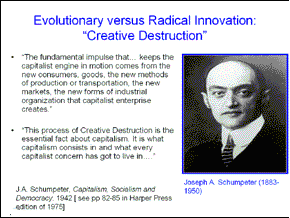
Compensated Communities Equals Creative Destruction

Posted by Orrin Woodward on May 8, 2014

Leadership, in any field, demands individuals who can think for themselves. Unfortunately, in today’s conformance-oriented culture, thinking is in short supply. For instance, the fear of ridicule causes more people to fail in life than lack of talent ever has. I am not proposing people rebel against all societal norms since that is just as thoughtless as conforming to all. Rather, I am suggesting that a person ought to think through what is truly important in his life and then follow the proper principle-centered trail to achieve it.

Why follow the masses into mediocrity if you have a burning desire to do something worthwhile? Yes, many won’t understand you; yes, many will laugh at your naiveté; yes, some will even fight against you. Nonetheless, a person who is true to his or her purpose is the only one who can live a life of no regrets. This, in fact, is what led me into the leadership field. For as an engineer, I realized that my efforts to reach the mountaintop, despite enjoying immense success, was not taking me where I wanted to go.

Thankfully, God, in His matchless wisdom, opened another door for me. It wasn’t the products or company that attracted me to network marketing, but rather an embryonic leadership engine that captivated me. Although not fully understood, the origins of LIFE Leadership were formed while studying the best training organizations within network marketing. These training organizations somehow managed to build loyal tribes of people who bought and sold the company’s products.

It didn’t take long for me to realize that the secret to massive results in network marketing was less the specific product sold and more one’s ability to lead people. The products can change (even within the same company) but relationships can be for life. This breakthrough led me to form a leadership training company and launch a revolution in leadership and community building.

Indeed, Chris Brady, Tim Marks, and I started meeting every Monday morning to design and PDCA our fledgling training company. Our goal was to teach people the essentials of leadership, systems, and processes to build communities. The results were nothing short of spectacular. From 200 people in attendance monthly in 1998, we grew to over 5,000 in monthly attendance by 2003. We surpassed the growth of all other organizations and proved the adage that everything rises and falls on leadership.

Creative Destruction

Creative Destruction

Leaders, in effect, cause Schumpeter’s Creative Destruction to occur wherever they go. Average results are not acceptable to leaders; therefore, they are driven to change the rules, the culture, and themselves in order to win. This drive to excel is what causes the Creative Destruction in each field which enhances society. However, like all change, what benefits society at large does not benefit everyone equally. For any time a new entrant climbs to the top, the older, more established organizations, are forced to adjust.

LIFE Leadership is causing adjustments throughout network marketing. Of course, LIFE is loved by those who enjoy the benefits of the world-class leadership and personal development training. Not surprisingly, however, the new methods and approaches to network marketing – so transformational that it has birthed a new field called Compensated Community – are disliked by the old-guard who resist any change to the existing pecking order. Although LIFE seeks to improve society and carries malice towards none, it refuses to tolerate mediocrity in any area it is involved. If this mindset upsets the marketplace, then so be it.

What areas of mediocrity are you tolerating in life? LIFE Leadership provides the personal development products needed to generate the Creative Destruction necessary for you to live the life you’ve always wanted? What are you waiting for? If your ladder is leaning against the wrong wall then it only makes sense to move it. Perhaps your destiny awaits your move into LIFE Leadership’s Compensated Community.

Sincerely,

Orrin Woodward

Posted in Leadership/Personal Development, LIFE Leadership | 26 Comments »